

Expanding into a new market is exciting, but it’s also one of the most complex moves a company can make. From navigating local regulations and setting up a legal entity to hiring talent and building operations, the process can take months or even years. For many businesses, this becomes a major bottleneck to growth. This is where the Build Operate Transfer model comes in.
Instead of navigating expansion alone, companies partner with a local provider who builds and runs operations on their behalf, until they’re ready to take full ownership. It’s a practical, low-risk way to enter new markets while staying focused on core business priorities.
In this guide, we’ll walk through how the BOT model works, why companies use it, and how it compares to other outsourcing strategies, so companies can decide if it’s the right approach for your global expansion plans.
A simple Build Operate Transfer (BOT) model explanation is a structured outsourcing approach where a service provider sets up and manages operations for the time being, then eventually transfers ownership to the client company. It combines elements of outsourcing and long-term investment, giving companies a clear path from entry to full control.
Instead of immediately establishing a legal entity, businesses can begin operations under the provider’s structure. This allows them to move faster while ensuring compliance with local regulations.
A BOT setup typically involves two main parties, the client company and the BOT provider. The provider handles infrastructure, recruitment, and day-to-day operations, while the client retains strategic oversight and direction.
Over time, collaboration deepens as processes, teams, and systems are aligned with the client’s standards, preparing for a smooth transition.
Unlike traditional outsourcing, where control remains with the vendor, the BOT model is designed for eventual ownership. The goal isn’t just service delivery, but building a fully functioning operation that the client will eventually take over.
This makes BOT ideal for companies that want long-term presence, not just short-term cost savings.
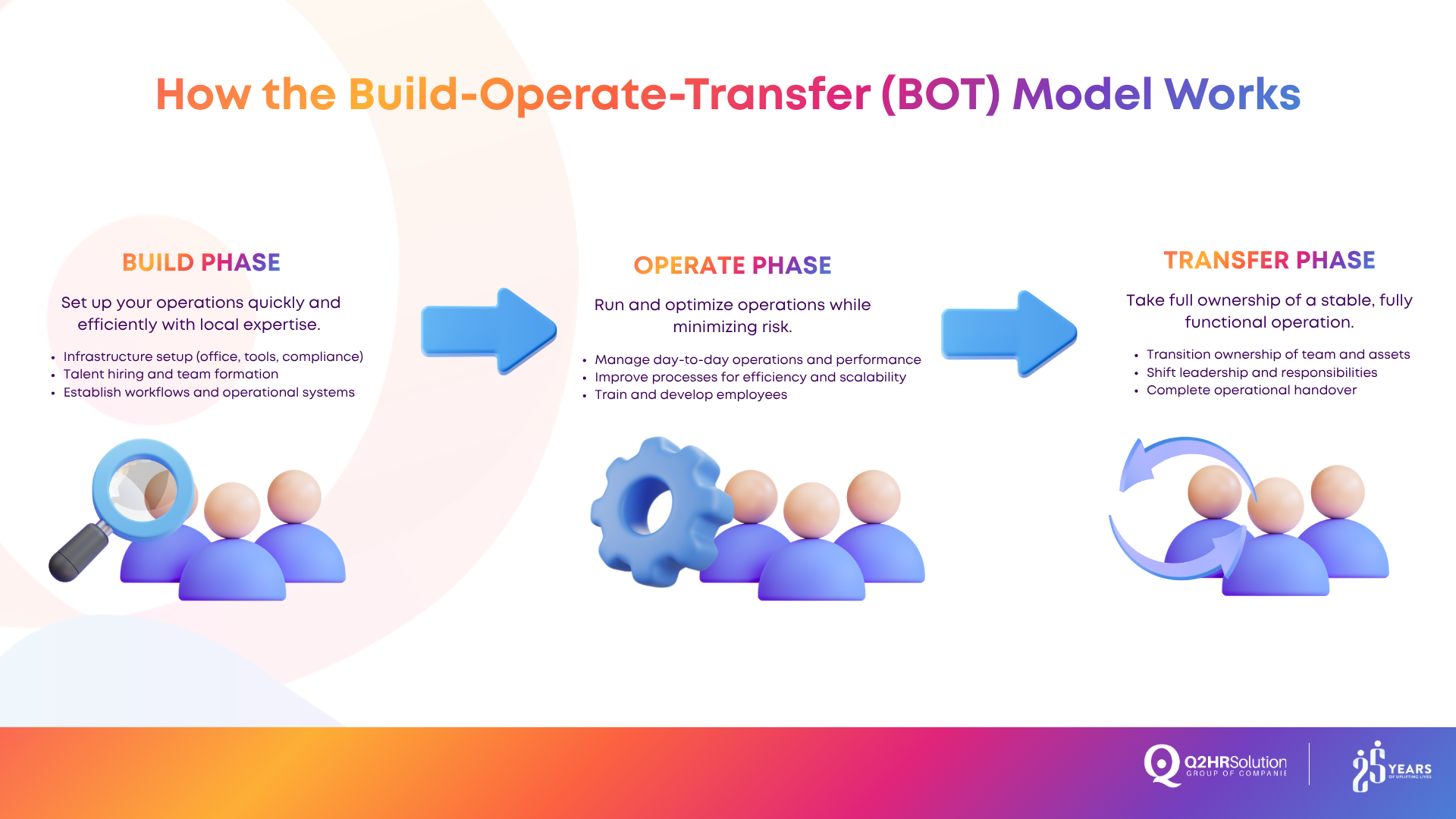
The build phase is where companies lay the foundation of their operations in a new market. Instead of navigating complex setup processes alone, businesses rely on experts providing BOT outsourcing model to establish everything, from infrastructure to talent, quickly and efficiently. This phase is especially valuable for companies that want to enter a market fast without being slowed down by administrative and regulatory hurdles.
Setting up infrastructure in a new country can be time-consuming and resource-intensive. Companies would need to secure office space, implement IT systems, and ensure compliance with local standards; all before operations can even begin.
With the build operate transfer process, the provider takes care of this entire process. This allows businesses to bypass the usual delays and start with a fully functional setup that is already aligned with local requirements and operational needs.
Hiring in an unfamiliar market often comes with challenges such as limited talent networks, lack of employer branding, and unfamiliar hiring practices. This can slow down expansion and lead to mismatches in talent quality.
BOT providers solve this by leveraging their established recruitment channels and local expertise. They help companies build strong, qualified teams quickly while ensuring alignment with the company’s culture and expectations.
Beyond infrastructure and hiring, companies need to create systems, workflows, and reporting structures that support daily operations. Without this, even a well-built team can struggle to perform effectively.
Through the BOT model, providers establish these operational frameworks early on. This ensures that teams are productive from the start and that processes are scalable as the business grows.
Once the build phase is established, the focus shifts to managing and optimizing performance. The operate phase allows companies to scale their presence in a new market while minimizing risk, as the provider continues to handle day-to-day execution. This phase is critical in ensuring that the operation runs smoothly before ownership is transferred.
Day-to-day management includes overseeing team performance, handling administrative functions, and ensuring that business goals are consistently being met. For companies entering a new market, this level of support is crucial in maintaining stability.
By having the provider manage operations, companies can focus on strategic growth rather than operational challenges. This creates a balance between control and efficiency, especially during the early stages of expansion.
As operations grow, processes need to evolve to support efficiency and scalability. Without structured workflows, teams may face inconsistencies that affect productivity and performance.
BOT providers continuously refine and optimize processes based on real-time insights. This helps create a more streamlined operation that is aligned with both local conditions and global standards.
Employee capability is a key driver of success in any operation. Training ensures that teams are equipped with the right skills, knowledge, and understanding of company expectations.
In the BOT model, providers implement structured training programs to improve performance and prepare employees for long-term integration. This also ensures a smoother transition when ownership is eventually transferred.
The transfer phase is the final stage of the BOT process, where ownership of the operation is gradually handed over to the client company. By this point, the business is already stable, fully operational, and aligned with the company’s standards. This makes the transition more seamless compared to building operations independently.
Ownership transfer involves handing over all operational assets, systems, and workforce to the client. This allows the company to take full control of an already established and functioning operation.
Instead of starting from scratch, businesses gain a ready-to-run setup that has been tested and optimized. This significantly reduces the risks typically associated with expansion.
Leadership transition is a critical component of the transfer phase. Responsibilities shift gradually from the provider to the client’s internal leaders to ensure continuity.
This phased approach allows leadership teams to adapt while maintaining operational stability. It also ensures that knowledge and expertise are effectively transferred.
The final step is the complete handover of operations, including processes, documentation, and governance structures. This ensures that the client has full visibility and control over the business.
By the end of this phase, the company is equipped to manage operations independently, with minimal disruption and maximum efficiency.
BOT enables companies to start operations quickly without waiting for entity setup. This speed is critical in competitive markets where timing can impact growth.
By relying on local expertise, companies avoid costly mistakes related to compliance, hiring, and operations. Studies from institutions like the OECD highlight how local partnerships reduce entry risks in foreign markets.
BOT providers bring established recruitment networks and market knowledge, making it easier to build high-quality teams.
Instead of investing heavily upfront, companies can spread costs over time while operations are already generating value.
BOT allows companies to scale gradually, adjusting team size and structure based on business needs.
The build operate transfer model is widely used across industries that need to scale globally while maintaining long-term control. As part of BOT strategy, companies use this approach to enter new markets faster without the full risk of immediate setup. Compared to traditional outsourcing models, it offers a more structured path toward ownership.
Technology and software development industry often use the build operate transfer outsourcing model to quickly build offshore development teams while retaining control over processes and intellectual property. Through this strategy, they can scale engineering capabilities faster without compromising long-term ownership.
In the BPO sector, BOT is commonly used to set up customer support and back-office operations efficiently. This allows companies to transition from BOT into fully owned operations over time.
Enterprises leverage the build operate transfer model to establish shared services centers for HR, finance, and IT. This approach helps centralize operations while reducing the complexity of initial setup and ensuring long-term scalability.
Companies use this strategy to expand R&D functions in talent-rich markets without long setup timelines. With BOT, they can focus on innovation while the provider manages operational execution.
Banks and fintech firms adopt the build operate transfer model to expand in regulated environments while maintaining compliance. This allows them to build secure operations that can later be fully integrated into their global structure.
Traditional outsourcing focuses on service delivery like sourcing, management of job offer contracts and onboarding, while BOT focuses on building long-term internal capability with eventual ownership after completing the entity set up process.
Staff augmentation adds talent to existing teams, whereas BOT builds entire operations from the ground up.
Captive centers require immediate investment and setup, while BOT allows a phased, lower-risk approach.
EOR helps with employment compliance and is often a perfect fit for companies that want to enter a new market without setting up a whole entity yet. On the other hand, BOT goes further by building full operational infrastructure and transferring ownership.
Each model provides faster operational access to new markets, the main difference lies on the client company’s long-term goal.
With a lot of staffing strategy offering different benefits to companies looking to enter a new market, it is important to understand when to use build operate transfer model and how it fits the overall objective and business direction of a company.
BOT is an ideal strategy when entering unfamiliar regions, as you will often need support and local expertise in navigating the process of setting up entity without delaying the operations.
Companies can quickly establish tech teams without managing local hiring complexities. When the operations is already up and running, BOT providers can quickly transfer the ownership to client companies without disrupting the ongoing process.
BOT supports long-term operational hubs for core business functions, allowing businesses to streamline their processes and enhance productivity. By providing a centralized platform for essential activities such as customer relationship management, inventory control, and financial tracking, BOT not only simplifies day-to-day operations but also enables owners to focus on strategic growth initiatives.
Before embarking on a build operate transfer strategy, it is essential for companies to engage in thorough strategic planning and market analysis. This foundational step requires a detailed understanding of the company’s objectives, such as growth targets and desired outcomes, alongside a comprehensive analysis of the target markets.
Businesses must not only identify potential customer segments but also assess the competitive landscape, regulatory considerations, and market trends that could impact operations.
The success of a BOT heavily relies on the selection of the right partner, often referred to as the BOT provider. Companies must consider various factors when making this critical decision, including the provider’s experience in the industry, demonstrated track record in executing BOT projects, and depth of local knowledge.
Once a partner is selected, the next phase is the operational setup, which encompasses a variety of essential activities that lay out the groundwork for successful operations.
This includes establishing the necessary infrastructure, such as physical facilities and technology systems, alongside hiring a skilled workforce that aligns with the company’s operational goals. A solid operational setup not only prepares the business for day-to-day functions but also sets a precedent for quality and performance standards.
As operations commence, the focus shifts to operational management, where ongoing performance monitoring and process optimization are paramount.
This phase may also involve adapting strategies based on real-time data and market feedback, allowing businesses to remain agile and responsive to changing conditions. By creating a culture of continuous improvement, companies can ensure that operations evolve in alignment with market demands.
Transition planning is a crucial step in BOT implementation as it ensures a seamless handover of operations from the provider to the client. A well-defined roadmap detailing the timeline, responsibilities, and key milestones is essential for executing this transition smoothly.
By anticipating and preparing for the transition, small business owners can significantly reduce disruptions and maintain operational integrity.
The final ownership transfer marks a significant milestone in the BOT strategy, where the client officially assumes full control of operations. At this step, it is critical to ensure that all systems are fully operational, teams are well-trained, and processes are functioning as intended.
Once everything is in place and functioning optimally, the client company can confidently steer their business towards new horizons, equipped with the resources and insights gained throughout the whole BOT journey.
While it is a popular approach for infrastructure development and public-private partnerships, BOT outsourcing risks and challenges are an integral part of the process that must be navigated for successful implementation.
If not properly managed, critical knowledge may not be fully transferred during the transition phase from the operating entity to the government or final ownership body. This lack of effective knowledge transfer can lead to operational disruptions, as incoming teams may struggle to understand the intricacies of the systems and processes developed during the initial operational phase.
Another major challenge in the BOT model is achieving operational alignment. When different stakeholders, including private operators and public authorities, have varying processes, expectations, or operational cultures, it can significantly impact the overall efficiency of the project.
Legal and compliance considerations further complicate the BOT model, as each market presents its own unique regulatory landscape that must be meticulously navigated throughout the BOT lifecycle. Failing to adhere to local laws, industry standards, and compliance requirements can expose stakeholders to substantial legal liabilities and financial penalties.
Offshore Development Centers serve as vital hubs for talent acquisition and development, enabling companies to build high-performing offshore teams with minimal setup friction.
By utilizing BOT, companies can focus on their core business objectives while outsourcing the complexities of team establishment and management to specialized partners.
Global Shared Services play a crucial role in expansion strategy. By centralizing operations, businesses can significantly improve efficiency and reduce costs across various regions.
Distributed Workforce Models have also emerged as a key component of the BOT framework. This model support flexible, global team structures that are well-aligned with modern remote work trends.
The Philippines has emerged as a leading destination for Build-Operate-Transfer (BOT) projects, attracting both local and international investors who are keen on capitalizing on the country’s unique advantages.
This popularity stems from several factors that make the BOT outsourcing in the Philippines an attractive solution, particularly in sectors like business process outsourcing (BPO), infrastructure development, and technology services.
One of the most significant advantages that the Philippines offers is its vast pool of skilled professionals. The country is home to a large number of English-speaking graduates each year, many of whom possess degrees in fields such as information technology, engineering, finance, and management.
This proficiency in English, coupled with a strong educational system that emphasizes critical thinking and creativity, makes Filipino workers highly competitive on a global scale.
The Philippines boasts an established business process outsourcing infrastructure that has been developed over the last two decades. With numerous business hubs concentrated in urban areas like Metro Manila, Cebu, and Davao, setting up operations in the country has become increasingly seamless.
Navigating the regulatory landscape is crucial for any foreign entity looking to invest in a new market. In the Philippines, local providers play an essential role in helping international companies understand and comply with labor laws, tax regulations, and industry standards.
By partnering with local firms that specialize in regulatory compliance, BOT investors can mitigate risks and avoid potential legal pitfalls, ensuring a smoother transition and operation.
Choosing the right partner is one of the most critical decisions when implementing a build operate transfer model. A strong BOT provider doesn’t just execute tasks, they also act as a strategic partner who can build, manage, and transition operations effectively.
The success of your expansion often depends on how well your chosen partner aligns with your business goals, operational standards, and long-term vision.
When evaluating a build operate transfer provider, industry experience should be a top priority. Providers with a strong background in your sector understand the nuances, challenges, and best practices required to build effective operations.
This level of expertise ensures that your build operate transfer strategy is implemented with fewer risks and faster execution. It also helps in building teams and processes that are aligned with your industry standards from the start.
A reliable BOT partner should also have strong operational capabilities, including established systems, workflows, and management structures. These are essential to ensure that operations run smoothly during the build and operate phases.
Execution is just as important as strategy. Providers with proven operational strength can deliver consistent performance while scaling operations efficiently.
Expanding into a new market requires a deep understanding of local regulations, labor laws, and talent dynamics. A BOT outsourcing company with strong local market knowledge can help navigate these complexities with ease.
This is especially important where compliance and hiring play a major role in early success. Local expertise reduces risks and accelerates the overall setup process.
Clear governance and transparency are critical when working with a third-party partner. Companies need visibility into operations, performance metrics, and decision-making processes throughout the engagement.
A well-structured build operate transfer model includes regular reporting, defined accountability, and open communication. This ensures alignment between both parties and builds trust over time.
The final phase of any BOT process is the transition, making support during this stage essential. A strong service provider will have a clear transition plan that covers leadership handover, knowledge transfer, and operational continuity.
Effective transition support ensures that the client can take full ownership of operations without disruption. This is what ultimately defines the long-term success of the BOT engagement.
In the context of the Build-Operate-Transfer model, setup costs represent a significant initial investment that lays the groundwork for the project’s success. These costs encompass a variety of elements, including the development of the necessary infrastructure, such as buildings, roads, and utilities that are essential for the operation of the project.
Once the project moves beyond the setup phase, operational costs become the ongoing expenses that are crucial for the daily management of teams and processes. These costs typically include salaries and benefits for staff, maintenance of equipment, utility expenses, and other administrative costs that arise during regular operations.
Transition costs are an often-overlooked aspect of the BOT model, yet they play a pivotal role in the eventual handover of the project from the private operator to the public sector or the designated owner.
These costs encompass a range of activities necessary for a seamless transfer of ownership, including legal fees, re-evaluation of asset values, and the establishment of protocols for the new management team.
The Build-Operate-Transfer model is poised to evolve significantly in the coming years, as more organizations recognize its potential for facilitating international expansions while minimizing risks.
This strategy allows companies to establish operations in new markets with a structured approach, where they first build the infrastructure, operate it for a specified period, and then transfer ownership to local stakeholders or partners.
In recent years, there has been a notable increase in the establishment of Global Capability Centers (GCCs) by multinational corporations. These centers serve as hubs for delivering specialized services, such as research and development, IT support, and customer service, allowing companies to tap into diverse talent pools across the globe.
As businesses continue to globalize, GCCs are becoming vital for driving innovation and operational excellence.
The expansion of the remote workforce has fundamentally changed the landscape of employment, leading to a shift in how organizations approach hiring and team collaboration. With advancements in technology and communication tools, companies are no longer limited by geographic boundaries when it comes to sourcing talent.
The integration of technology into business operations is revolutionizing the way organizations function, leading to unprecedented levels of efficiency and scalability. Automation and digital tools are streamlining processes, reducing manual effort, and minimizing human error, which allows companies to allocate resources more effectively and focus on strategic initiatives.
The build operate transfer model is a business expansion strategy where a provider sets up and manages operations on behalf of a company, then eventually transfers full ownership to them. It allows businesses to enter new markets faster while minimizing risks related to setup, hiring, and compliance. Over time, the company gains full control of a fully established operation.
A BOT partnership typically follows three stages: build, operate, and transfer. The provider first establishes the infrastructure and hires the team, then manages daily operations while optimizing performance. Once the client is ready, ownership of the operation is gradually transferred.
Industries that require scalable operations and access to global talent benefit the most from BOT. These include technology, business process outsourcing (BPO), shared services, research and development, and financial services.
The transition phase timeline varies depending on the complexity and scale of the operation. In most cases, it can take anywhere from several months to a few years.
The build operate transfer model offers several advantages, including faster market entry, reduced expansion risk, and access to local expertise. It also allows companies to scale operations while maintaining a clear path toward full ownership.
BOT is not necessarily better than traditional outsourcing as it depends on the company’s goals. While outsourcing focuses on service delivery, BOT is designed for companies that want to eventually own their operations. It’s a better fit for long-term expansion strategies rather than short-term cost savings.
Yes, startups can use the build operate transfer model, especially when expanding into new markets with limited internal resources. It allows them to build teams and operations quickly without the upfront complexity of setting up a legal entity. This makes it a practical option for scaling early-stage businesses globally.
The Build-Operate-Transfer model offers a practical path for companies looking to expand globally without taking on unnecessary risk. This strategic framework is particularly appealing for organizations that recognize the complexities of entering new markets, as it enables them to mitigate potential pitfalls while capitalizing on local knowledge and infrastructure. If you’re exploring global expansion and want a structured, low-risk approach, the BOT model is worth considering.
At Q2 HR Solutions, we specialize in assisting companies through every phase of this model, helping you build, operate, and transition your teams seamlessly. Our expertise means that you can focus on your core business functions and growth strategies while we meticulously handle the groundwork, including recruitment, training, and compliance with local laws. Contact us to start your expansion journey today. Don’t let uncertainty hold you back; embrace the future of your business with confidence.