

Organizational development is a long-term approach for improving a company’s operations by aligning its people, procedures, and culture with its goals. It combines data, leadership, and change strategies to assist businesses in transitioning from where they are now to where they need to be tomorrow in a planned and sustainable manner.
Modern businesses face rapid change, greater employee expectations, and a constant pressure to innovate, thus organizational growth is required to remain adaptable and competitive rather of relying on one-time fixes. When done right, it improves performance by offering clearer direction and better execution, boosts culture by promoting trust and collaboration, and encourages long-term growth by developing the talents the organization needs.
In this comprehensive guide, we will take a deep dive on what organizational development means, how it affects the whole business strategy, and why having the right consultancy partner may directly boost long-term business objectives.
Organizational development is a systematic, evidence-based attempt to improve an organization’s structures, procedures, and human skills over time. It employs data, diagnostics, and focused interventions, such as training, process reform, or culture initiatives, to help the company transition from its current condition to a better future.
Unlike short-term projects, it focuses on long-term capability development, allowing the business to adapt continuously rather than only reacting to difficulties.
Many leaders today are asking what Organizational development in HR is, as they look for more strategic ways to improve performance, strengthen culture, and drive sustainable growth. In simple fashion, it frequently refers to the collaboration between HR and business leaders to create processes that define how work is done. This includes aligning talent strategies, such as recruitment, performance management, and rewards, with the company’s strategy and goals, as well as ensuring leaders and teams have the necessary skills to execute.
HR operations that integrate organizational development activities become strategic partners, leveraging people’s insights, workforce planning, and change support to create organizational effectiveness rather than simply administering policies.
The main objective of a great organizational development strategy is to improve overall effectiveness, foster a healthy and engaging culture, and ensure that the organization is adaptable to change. This often entails clarifying strategy, enhancing collaboration and communication, and building leadership and workforce competence across all levels. A strong strategy also seeks to remove friction, such as unclear responsibilities, inefficient processes, or segregated teams, which prohibit the company from meeting its objectives.
Organizational effectiveness identifies bottlenecks in how work flows between teams and functions, and then redesigns procedures, structures, and responsibilities to increase the efficiency of the organization. This improves business performance by lowering cycle times, increasing quality, and making it easier for people to accomplish the appropriate work at the right time. As a result, firms have more capacity and resources to devote to innovation and growth efforts.
Culture shapes how individuals behave when no one is looking, which has a significant impact on performance, risk, and customer experience. OD examines values, behaviors, and informal norms before designing interventions like leadership role modeling, recognition programs, and communication methods to intentionally change culture. Over time, this results in a more inclusive, accountable, and trusting atmosphere in which people are more eager to participate, speak up, and give ideas.
Engaged employees are more productive, loyal, and likely to provide excellent customer service. Since OD uses surveys, focus groups, and data analysis to identify the drivers of engagement in each business, it addresses issues such as a lack of feedback, unclear career routes, and poor leadership. OD improves the total employee experience, from onboarding to development and recognition, hence increasing motivation, retention, and discretionary effort, which directly translates to improved business success.
Sustainable growth needs more than a good product or market opportunity; it requires an organization that can scale, adapt, and reinvent itself. Organizational change management lays the groundwork for long-term growth by making systematic improvements to structure, capability, and culture: strong leadership pipelines, resilient teams, and agile procedures.
This enables firms to explore new markets, integrate acquisitions, and adapt to evolving risks and trends without losing focus or burning out their employees, thereby enhancing both overall efficiency and long-term business performance improvement.
Leadership development is an important part of Organizational development strategy because leaders set the tone, influence culture, and make vital decisions. OD activities frequently involve competence frameworks, leadership programs, coaching, and succession planning to ensure that leaders at all levels are prepared to lead to change. Organizations gain improved leadership competence, which results in clearer priorities, better decision-making, and stronger team support.
Employees’ workplace experiences and how culture promotes or hinders performance are included as well. Common strategies include increasing organizational communication, updating performance management, and reinforcing recognition and feedback processes. These initiatives seek to create a culture in which employees feel respected, heard, and linked to the organization’s mission and goals.
Structure determines how power, accountability, and information move throughout an organization. OD work in this area may include clarifying responsibilities, realigning reporting lines, or transitioning from inflexible hierarchies to more agile, cross-functional arrangements. An optimal structure lowers confusion, accelerates decision-making, and ensures that resources are focused on the most critical goals.
Workforce capability development is to ensure that employees have the skills and knowledge required by businesses today and in the future. This comprises competency mapping, learning and development programs, reskilling and upskilling activities, and career paths. Investing in capability helps firms’ close skill gaps, enhance internal mobility, and reduce reliance on external hiring for important roles.
Process improvement involves evaluating how work is completed and changing workflows to make them simpler, faster, and more dependable. OD practitioners can use approaches like Lean, Six Sigma, or continuous improvement to eliminate non-value-added activities and establish ownership. By involving the people who do the work in diagnosing problems and co-creating solutions, process improvement builds ownership and increases the likelihood that new ways of working will stick.
Over time, better-designed processes reduce errors and rework, increase customer happiness, and free up staff’s time to focus on higher-value activities. This not only supports greater efficiency, but also contributes to a more engaging, less frustrating work environment.
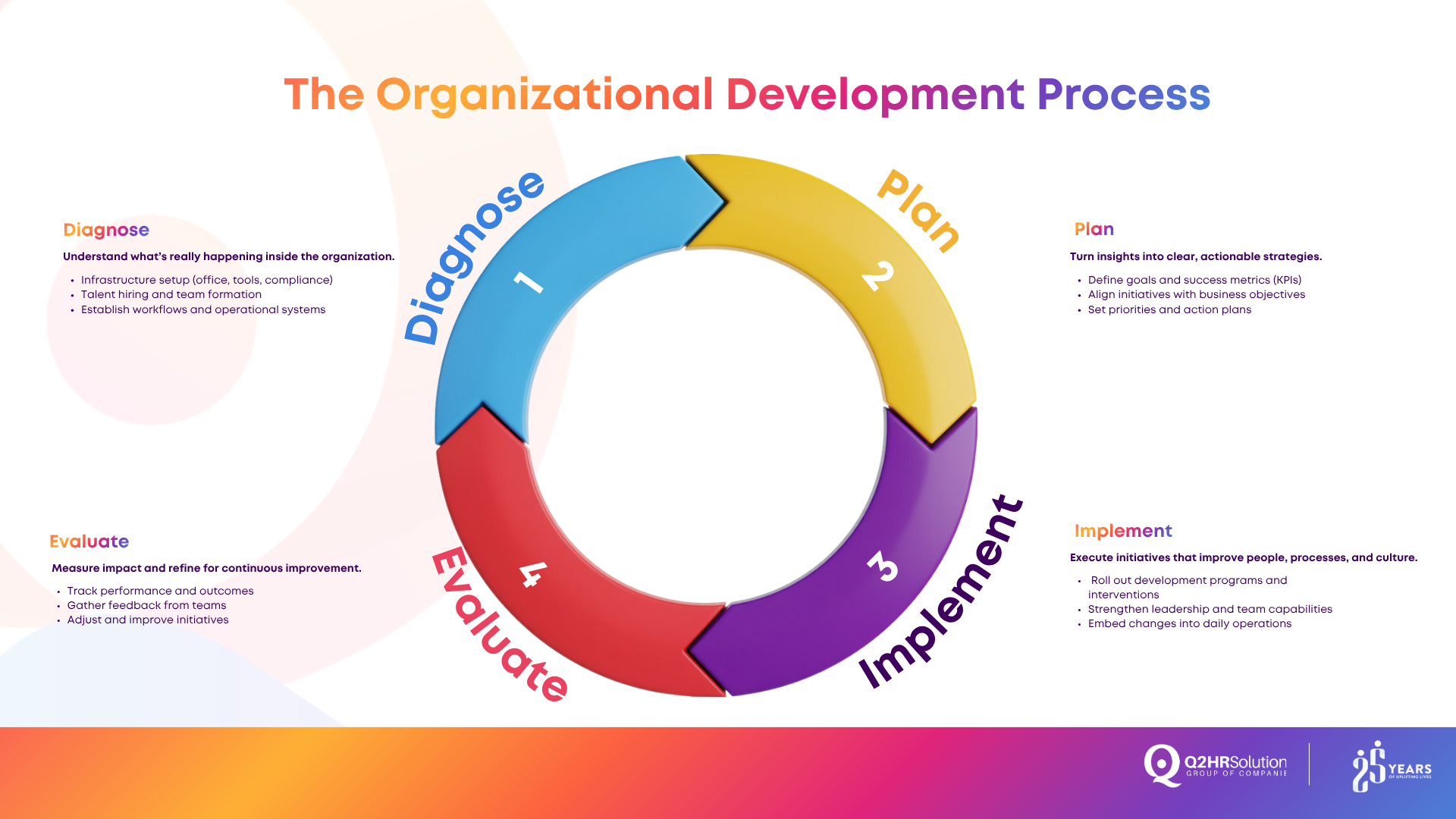
Every effective organizational development framework begins with identifying the root causes, patterns, and behaviors that influence organizational performance. This step of the OD process gathers insights through qualitative and quantitative methods such as employee surveys, interviews, focus groups, and data analysis. Since the goal is to have a thorough awareness of the organization’s culture, processes, and pain issues.
Also, a good diagnosis is necessary to distinguish between surface-level symptoms, such as low morale or poor communication, and their underlying causes, such as leadership inadequacies or misaligned structures. Leaders may save time and effort by diagnosing and addressing the core causes of dysfunction, rather than simply addressing symptoms.
After identifying key issues, the next stage is to translate findings into a feasible strategy. Strategic planning aligns development programs with the organization’s mission, vision, and performance objectives. Teams set clear priorities, quantifiable goals, and performance indicators (KPIs) during meetings and collaborative workshops. This ensures that everyone understands how their contributions contribute to the organization’s overall success.
Goal alignment promotes departmental coherence, increases accountability, and inspires teams by connecting daily actions to strategic results. Finally, this stage closes the gap between analysis and action, offering a clear direction for changing activities.
In this stage, the organization implements particular OD interventions aimed at strengthening its systems and people. These activities could include leadership development programs, team-building seminars, restructuring efforts, process improvements, or organizational culture campaigns. Effective implementation necessitates strong leadership support, open communication, and active employee participation.
Before scaling activities, organizations frequently launch pilot projects, collect feedback, and make required changes. Integrating OD initiatives into ordinary workflows ensures that they are not perceived as isolated projects, but as critical components of the organization’s growth and development.
Evaluation is a crucial phase for determining the impact and success of OD programs. It entails comparing results to set objectives, examining quantitative measures like productivity and retention rates, and gathering qualitative feedback via follow-up surveys or interviews. This procedure determines whether the treatments resulted in the expected cultural or performance transformations. Continuous improvement guarantees that the insights learnt from each endeavor inform subsequent OD efforts, resulting in a loop of learning and refinement. Over time, this iterative strategy strengthens the organization’s adaptability, resilience, and sustained excellence.
Low engagement may appear across as high turnover, absenteeism, and limited discretionary effort. A proper organizational development consulting can identify the causes of disengagement, such as a lack of recognition, bad management, or limited growth prospects, and designs focused on remedies.
Addressing these factors creates a more energizing environment in which employees feel engaged to their jobs and the organization’s mission.
Misalignment and miscommunication within teams can result in rework, delays, and conflict. Clarifying decision rights, revamping workflows, and establishing regular cross-functional information exchange forums are all possible for OD interventions in this area. Over time, this increases openness, minimizes misconceptions, and allows for faster, more coordinated execution.
Inefficient operations frequently cause frustration among both employees and customers. OD guidance can help teams map present processes, identify bottlenecks, and co-design more efficient workflows. Companies benefit from improved procedures because they save money, make fewer mistakes, and provide better service.
Leadership gaps, whether on the front lines or at the top, can delay strategy execution and harm culture. Organizational development work in this area entails identifying essential positions, assessing present competencies, and developing and implementing succession plans. Strengthening the leadership bench guarantees consistency, reduces risk, and creates clear career paths for high-potential personnel.
Resistance to change is a natural human reaction, but uncontrolled resistance can derail even the greatest plans. Organizational effectiveness helps by involving stakeholders early on, communicating properly, and preparing leaders to handle problems and assist their staff. With the correct strategy, resistance may be transformed into helpful feedback that improves change design and implementation.
Organizational development (OD) vs change management are two closely related disciplines, yet they operate at different levels and time horizons within a company. Organizational development (OD) is strategic and systemic; it looks at the organization as a whole, including its vision, structure, culture, leadership practices, and work processes. Its primary goal is to enhance overall organizational effectiveness and long-term adaptability.
In this sense, OD aims to strengthen the foundation of the business by cultivating a culture of continuous learning, innovation, and collaboration. For instance, introducing leadership development programs or redesigning an organization’s workflow to support agility are key initiatives that build capacity for ongoing improvement.
In comparison, change management focuses on the tactical implementation of specific changes or projects. It provides structured methods to guide employees and teams in adapting to new systems, policies, or organizational shifts. Its main objective is to minimize resistance, maintain productivity, and ensure a smooth transition from the current state to the desired future state. While OD creates the environment for sustainable growth and readiness for change, change management executes particular transitions effectively.
When aligned, OD sets the long-term direction and culture needed for resilience, whereas change management ensures that individual change efforts succeed in practice.
HR transformation vs organizational development is distinct yet still related. They complement each other by improving the organization’s day-to-day operations, as well as the overall well-being of the organization. In this context, we already have a grasp of what OD is, along with how it focuses on improving the company’s overall standing through its people and their capabilities. It’s a planned and systematic effort that allows an organization to change strategies, structures, processes, and culture to improve their company’s effectiveness, adaptability, and overall health. However, this wouldn’t be possible without something to drive them and keep things going. It wouldn’t be possible without the system that employees have to follow in order to maintain protocol and quality work.
Contrary to OD’s focus on cultural and behavioral changes, HR transformation focuses on redesigning HR’s operating model, processes, and technology by automating administrative tasks like payroll and recruitment. It focuses on improving efficiency and employee experience by aligning the HR function with the overarching business strategy. It’s not just about doing the same things faster with a computer; it’s about doing the right things to make the company more competitive.
Aligning with the metaphor earlier, if OD is building the “muscles” that an organization requires to learn, then HR transformation is the work-out plan that needs to be followed to continuously strengthen and sustain those capabilities. They complement each other in a way that HR transformation is necessary to attain organizational development, as HR transformation designs itself to change the process, policies, and system to align with high‑level change initiatives. If both are utilized correctly, they create a balanced approach and efficient systems that are backed by strong, capable teams, leading to a more resilient and high-performing organization.
HR Data and Analytics are key tools for decision-making. They are values that allow organizations to move beyond intuition and rely on data-driven insights. Through these metrics, they could pinpoint organizational development interventions, design more effective campaign programs, and adjust their strategies accordingly. As part of digital HR transformation, data becomes a foundation for building stronger organizational capabilities, and not just for measuring performance. They play a vital role in predicting what comes next, identifying potential risks, and enabling proactive decision-making.
With HR data, they become more than just a purely administrative function but rather a strategic partner for organizational development.
In these evolving times, employee engagement is no longer just a “nice to have”, it’s already a necessity that directly impacts productivity, retention, and overall company culture. An employee engagement platform is a tool designed to measure employee motivation that typically includes features like real-time feedback, peer recognition, and analytics dashboards. This initiative helps in achieving a higher retention rate among employees, making them stay longer with the company.
Beyond retention, it also helps in improving productivity as employees now tend to feel more proactive and focused on their work. It also strengthens the company culture because they feel more connected and committed to their work. As part of HR Tech Solutions, companies could align their strategies while supporting long-term growth of their employees through employee engagement platforms.
Having automated HR processes means making everything standardized. From the workflows. up to the overall employee lifecycle. Automation makes everything smooth, consistent, and reduces errors, creating a stable backbone for initiatives like leadership development, restructuring, or culture change.
These HR processes also enable employees to relax and build trust in HR systems. It also allows HR teams to focus on more strategic initiatives, supporting both operational efficiency and long-term OD.
Building high-performing teams in an organization is important as they are the backbone of every successful organization. Without them, the organizational effectiveness will decline, and the quality of work will fall off. Organizational development helps build these teams by improving collaboration, communication, and accountability. These involve setting clear goals and roles to know, improving communication, and equipping teams with tools that are useful in solving problems easily. Moreover, a team composed of intelligent and passionate individuals is essential for making informed decisions that help the organization achieve its goals. It also fosters innovation, encourages diverse perspectives, and promotes adaptability in a rapidly changing business environment.
Honing an employee to develop his leadership skills can be quite challenging but essential, especially for team-effort projects. This means that the person should be willing to go beyond his technical skills to challenge his strategic and analytic thinking. It also goes beyond being a leader in name, as it also involves trying to work well with other people despite any circumstances, in-depth guidance, and keeping everything structured and aligned toward the organization’s goals.
With that being said, leadership programs are a typical organizational development strategy that helps employees have potential and guide the organization through market shifts and internal change.
Company culture reflects how employees think, behave, and perform at work. A healthy and strong company culture is important as they support engagement, productivity, and retention. Hence, strengthening company culture should be a must as it also ensures alignment with the organization’s goals. OD helps strengthen company culture by encouraging open communication, recognizing and rewarding positive behaviors, and promoting shared values and vision. Because when culture is aligned with goals, everything just becomes easy as it creates an environment where employees can thrive, ultimately supporting sustainable growth.
The Philippine workforce is known for its adaptability. During the pandemic, many people were struggling to keep their jobs due to the lockdowns, but some Filipinos were able to adapt a work from home set-up and thrive on it. They are capable and resilient when it comes to facing uncertainties.
At present, the workforce is continuously evolving, driven by the rising demand for digitalization and technology-driven solutions. At the same time, many employees’ value job security, stable benefits, and supportive managers. With that, organizational development initiatives must cater to these employee needs where they must find a balance between innovation and clear communication.
In terms of Workplace Culture Considerations, Filipinos surprisingly value hierarchy when it comes to work. They respect their team leaders and are always willing to learn. They also value group harmony and relationships at work, making it quite difficult for them to gain feedback. This emphasis on maintaining positive interactions sometimes leads to hesitation in addressing issues openly, requiring leaders to foster a supportive environment that encourages honest and constructive communication. In situations like this, key initiatives like anonymous feedback channels and small group discussions may work to address issues without ruining team bonding.
The OD initiatives in the Philippines have to function within a detailed HR compliance structure that is influenced by the Labor Code, the rules and regulations of the DOLE, and the rules and regulations of the sector in relation to wages, benefits, health and safety, and dismissal among others. Hence, integrating compliance into OD strategies protects the organization while promoting a fair and productive work environment, strengthening overall organizational effectiveness.
When choosing the right organizational development consultant, it’s important to look at its experience and industry expertise first. This is critical as the consultant will take part in the strategies, culture, and goals while working for the company. Hence, asking for their track-record with organizations like yours can provide insight into their ability to deliver results, adapt to your specific challenges, and implement solutions that align with your business objectives.
Furthermore, it’s also important to evaluate their communication style and if they are willing to understand the company’s goals on a deeper context, to the point that they can anticipate potential challenges, provide tailored recommendations, and effectively guide teams through change.
Aside from the consultant’s experience, it’s also important to evaluate the frameworks that he will be proposing. OD consultants use data-driven frameworks for diagnosis, design, and evaluation rather than relying purely on intuition. Moreover, they should be able to explain their data like the back of their hand, otherwise it’s possible that they really don’t know what they are doing.
Key performance indicators are also efficient to measure one’s success as these will be the basis for future decision-makings that would help in achieving the company’s goals and organizational change management objectives.
As OD efforts almost always imply substantial change, organizations will need someone who is skilled in change management, not just in analysis. This includes developing a communication plan, ensuring stakeholder engagement, conducting workshops, managing resistance to change, and coaching leaders through tough change processes. Someone who can articulate the different process or approach they use, provide examples of how they have supported leaders or teams in managing change in previous roles, and demonstrate flexibility in their approach to suit organizations is what employers should be looking for in terms of an OD consultant.
Organizational development is a long-term approach for improving a company’s operations by aligning its people, procedures, and culture with its goals.
Some examples of organizational initiatives are leadership development programs, team-building events, employee platforms, new performance management systems, and mentoring schemes. There are a lot more initiatives that employers could implement but these specific initiatives are aimed to enhance employee capabilities, strengthen organizational culture, and improve overall efficiency and effectiveness, ultimately supporting long-term business growth.
It improves employee engagement by creating a work environment that values growth, collaboration, and recognition. In return, this boosts the employee’s morale, productivity, and retention while also maintaining a positive company culture.
The role of HR is to keep things moving. Their role is to drive and support initiatives that enhance the organization’s effectiveness. HR ensures that all strategies, processes, and policies are aligned with the business objectives, and at the same time, employees benefit from the opportunities provided, including training, performance management, change management, and acting as a bridge between employees and the company to ensure a productive workforce.
Investing in organization development consulting is important to companies that are undergoing major changes such as restructuring, growth, declining employee engagement, and improving overall organization performance and efficiency. It can also be important in situations such as rolling out new strategies, introducing technology into the organization, and enhancing the organization’s culture.
Organizational development is important in making your company more adaptable, robust, and aligned. It’s where every element of the business is working together towards a goal. When done thoughtfully and over time, investing in development can be a key business enabler for long-term success. Strategic development has a direct influence on the success of the organization through improved decision-making, team adaptability, and resourcefulness.
At the same time, it enhances team building, leadership development, and learning and career progression transparency. Businesses that embrace development as a continuous and strategic practice have the potential to innovate and compete as markets, technology, and human needs continue to evolve. Accessing outside consulting services can bring additional knowledge, structure, and objectivity to complex and extremely sensitive change agendas to help leaders build and sustain changes their businesses need.
As organizations continue to navigate change and growth, having the right expertise in place can make a significant difference. Working with an experienced organizational development consultant like Q2 HR Solutions can provide the structure, insight, and support needed to turn strategy into sustainable results.
If you’re looking to strengthen performance, align your people systems, and drive long-term impact, now is the time to take a more intentional approach to development. Contact us and explore how we can help you build a more resilient, high-performing organization.