

Payday has a strange way of revealing how healthy a company actually is. When it runs quietly in the background, nobody notices. But the moment salaries land late, a government contribution is missed, or an offshore hire gets taxed incorrectly, payroll suddenly becomes everyone’s problem. In situations like these, a reliable payroll outsourcing service stops looking like an administrative expense and starts looking like a business safeguard.
This is happening more often in Australian companies with offshore teams. Not because companies got careless, but because their teams stopped sitting in one country. More Australian businesses are building teams in global markets like the Philippines, which means payroll now has to work across two tax systems and two compliance regimes at once. For those thinking longer term, payroll outsourcing is also a core building block of the build-operate-transfer (BOT) model, where a partner sets up and runs your offshore operation until you’re ready to own it.
In this article, we’ll discuss what outsourcing the payroll function actually covers, what to look for in a provider when your team spans Australia and the Philippines, and how it fits into a larger BOT arrangement if offshore expansion is on your roadmap.
Hiring at home got hard, so teams went offshore, and payroll had to follow. Research data shows around 79% of Australian employers struggle to find appropriately skilled workers, and the ACS Digital Pulse report estimates the country will need roughly 312,000 additional technology workers by 2030. Those roles won’t all be filled domestically, which is why over 300 Australian companies already work with more than 44,000 Filipino professionals, making Australia the second-largest market for Philippine outsourcing after North America.
Here’s the catch, though. The moment you employ someone in the Philippines, you’ve taken on a second payroll universe. Government mandatories such as SSS, PhilHealth, Pag-IBIG, 13th month pay, BIR withholding, are some labor specifics that none of any Australian payroll software knows anything about.
Back home, companies are still juggling Single Touch Payroll reporting and superannuation rules that change more often than most finance teams would like. Running both manually is possible. It’s just rarely a good use of anyone’s time, which is why so many companies hand it to a payroll outsourcing service instead. Mordor Intelligence values the global market at about USD 12.44 billion in 2025, projected to reach USD 16.87 billion by 2030, and Australia is one of its more active corners.
In plain terms, a payroll outsourcing service takes over the calculation, processing, and compliance side of paying your people’s salaries, taxes, statutory contributions, payslips, and government reporting, so your internal team doesn’t have to. Some providers stop there. Others bundle payroll into a wider employment service by managing benefits and HR admin end to end.
That distinction matters. A payroll-only provider keeps your books clean. A provider that combines payroll with employment infrastructure removes the need to set up a Philippine legal entity at all. In this setup, your staff are employed compliantly under the provider’s management while working exclusively for you. For Australian companies testing the waters offshore, that second model is usually where the conversation starts, because it shortens the path from “we’d like to hire in Manila” to “someone starts Monday.”
The honest answer is that you should choose a provider based on compliance depth, security, scalability, and pricing transparency. Plenty of providers can cut a paycheck on time. Fewer can do it correctly across two countries, month after month.
A provider that only knows Australian payroll is solving half your problem. If your team sits in the Philippines, your payroll outsourcing service needs people who live and breathe Philippine labor law and handles the mandatory contributions, the holiday pay rules, and the final pay timelines when someone resigns. Get this wrong and the penalties land on you, not just the provider.
Because of this, it’s worth asking very specific questions during evaluation. Who handles BIR filings? How do they compute 13th month pay for mid-year hires? What happens when statutory rates change? Vague answers are a red flag. The reliable providers answer in detail, because they’ve been burned by these edge cases before.
Payroll data is some of the most sensitive information a company holds like salaries, tax file numbers, bank details, and government IDs. When that data crosses borders, the risk grows. You’ll want to know where it’s stored, who can access it, and whether the provider complies with both the Australian Privacy Act and the Philippine Data Privacy Act.
Certifications help, but so does watching how a provider talks about security. The good ones explain encryption, access controls, and breach protocols clearly. The less mature ones wave at “industry-standard security” and move on. Simple rule of thumb: if they can’t explain their security posture in a sales call, assume it isn’t clear internally either.
A lot of Australian companies start with three or four offshore roles and end up with thirty. Your provider should handle that arc without the service degrading, which means asking about capacity, account management, and whether they have actual on-the-ground presence in the Philippines rather than a subcontracted partner you’ll never meet.
Local presence matters more than people expect. When an employee questions their payslip or a government office requests documentation, someone needs to handle it in the right time zone, with the right local relationships. Providers with real Philippine operations resolve these things in hours. Remote-only setups can take weeks, and your employees feel that gap directly.
Reliable payroll pricing is predictable and itemized. Per-employee-per-month is the most common model, and it works because you can forecast it. Be cautious with quotes carrying long lists of “additional services”. Remember off-cycle runs, year-end reporting, government liaison because those are items that will turn out to be things you’ll need every year.
The cheapest quote is rarely the real cost, either. A missed statutory deadline in the Philippines or a super misstep in Australia costs more than the fee difference between two providers. Boring pricing usually signals a provider that has its operations figured out. Dramatic discounts usually signal the opposite.
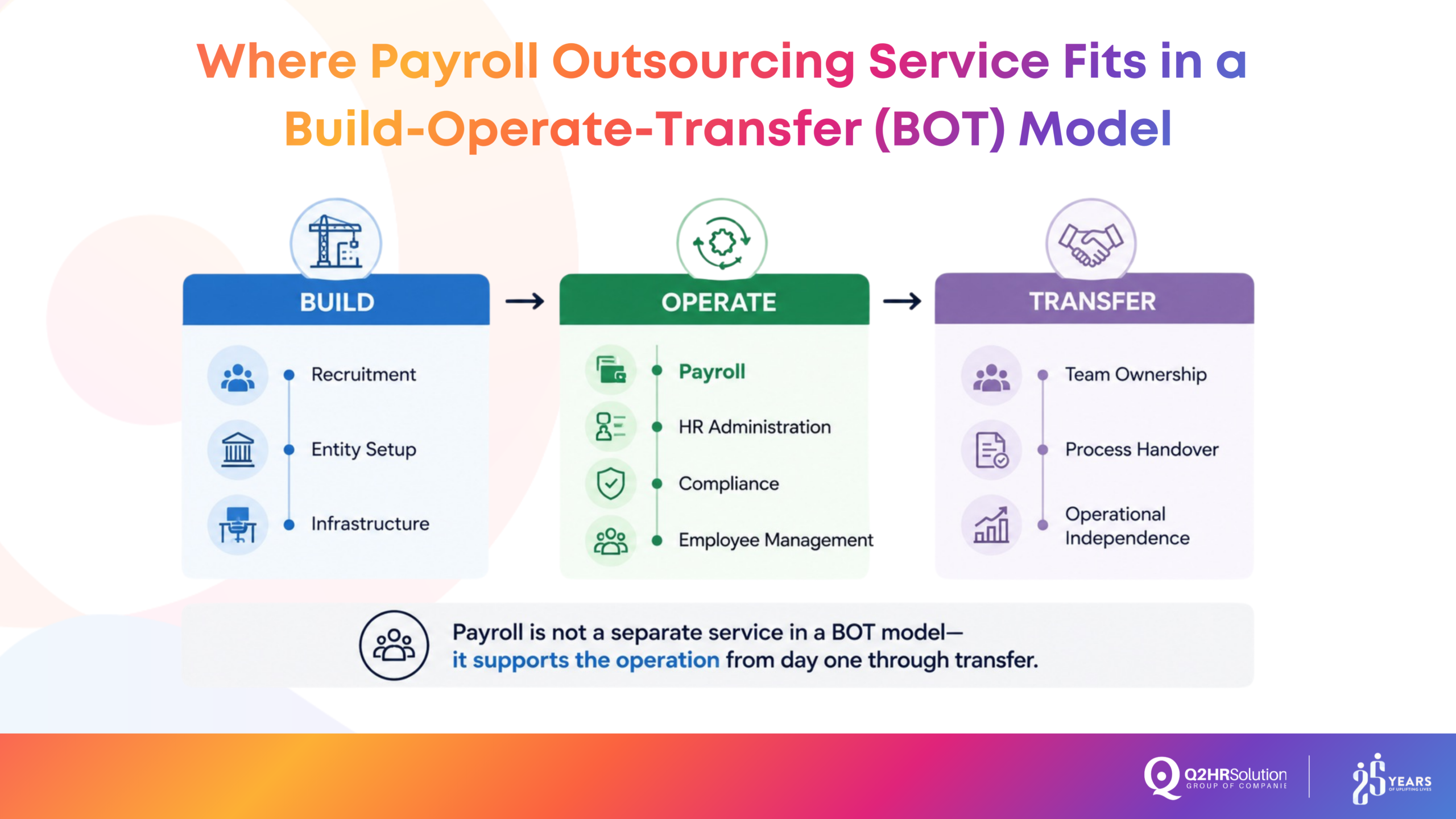
If your plans go beyond a few offshore staff, say a full Philippine team you eventually want to own, payroll becomes one piece of a larger structure. Under a BOT arrangement, a partner builds your offshore operation (recruitment, facilities, equipment), operates it on your behalf (payroll, HR, compliance, day-to-day management), then transfers the whole operations once you’re ready to incorporate locally.
The appeal is sequencing. You get the team and the cost advantages now, without the legal entity and registrations on day one. The payroll function that your partner runs during the operate phase becomes the one you inherit at transfer, with it being already compliant, already documented, already running. Which is exactly why the payroll capability of your BOT partner deserves the same scrutiny as a standalone payroll outsourcing service because eventually, it becomes yours.
Most providers charge per employee per month, with rates varying by complexity. Domestic-only payroll costs less than one spanning between Australia and the Philippines. BOT workforce arrangements usually price as a percentage of salary or a flat monthly fee covering payroll, benefits, and HR administration together.
Some can, and that’s the capability worth filtering for. Look for providers with genuine operations in the Philippines, not just a software integration. Providers handling SSS, PhilHealth, Pag-IBIG, and BIR requirements properly takes local expertise that generic global platforms often lack.
No. Your staff can be legally employed by a partner’s Philippine entity while working exclusively for you, which keeps everything compliant without the cost of incorporation. If you later establish your own entity, a BOT structure lets you transfer the team across.
Payroll outsourcing covers one function: paying your people correctly and compliantly. BOT covers the whole operation, from recruitment, facilities, HR, payroll, and management, with a planned handover to you at the end. Payroll sits inside BOT as one of the core services your partner runs until transfer day.
Choosing a payroll outsourcing service comes down to a fairly unglamorous truth, the best providers are the ones you stop thinking about. Salaries land on time, contributions get filed, and compliance questions get answered before you knew to ask them.
For Australian companies building teams in the Philippines, that reliability has to stretch across two countries, and the providers who can genuinely do that are fewer than the marketing suggests.
It’s also worth thinking one step ahead. If your offshore plans are bigger than a handful of hires, payroll is the thread that runs through the entire build-operate-transfer journey. From your first employee under a partner’s entity up to the day you take ownership of a fully operational Philippine team. At Q2 HR Solutions, payroll sits inside our broader BOT and offshore staffing services, which means the payroll function we run for you today is built to become yours tomorrow. If you’re weighing up offshore expansion, or just tired of wrestling with two payroll systems, you can reach out to us, and we’re happy to talk through what the setup could look like for your team.