

You’ve probably had a moment where someone on your team just seemed to check out. Not loudly, not dramatically, just quietly. One day they’re engaged, and then a few months later they’re physically present but mentally somewhere else, probably already talking to another employer. It happens more often than most leaders realize. That’s the thing about employee experience. It’s not one big event that breaks people. It’s the accumulation of small things. Knowing how to improve employee experience in your company is really just knowing how to pay attention to those things before they become reasons someone leaves.
The tricky part is that employee experience problems rarely show up as one big issue. They tend to build quietly through everyday interactions. It could be unclear communication from leaders, limited opportunities for growth, recognition that feels inconsistent, or workplace policies that no longer match what employees need. On their own, these things may seem minor. But over time, they shape how people feel about coming to work, staying with a company, and contributing beyond the minimum required.
In this article, we will discuss what employee experience actually looks like in day-to-day workplace settings, why it has become a priority for many organizations, and what companies can do to create a more positive and engaging environment for their employees.
A lot of companies confuse employee experience with employee perks like free coffee, pizza Fridays, that sort of thing. But those things are nice-to-haves, not the foundation. Employee experience is actually the sum of everything a person feels, observes, and goes through from the moment they apply for a job to the day they leave. It includes the physical workspace, the tools they use, how their manager treats them, whether the company’s values match reality, and whether they feel like they matter.
Jacob Morgan, who wrote The Employee Experience Advantage, describes it as the intersection of three environments such as culture, technology, and physical space. That framework holds up really well, especially for Philippine businesses navigating hybrid setups post-pandemic. When any one of those three breaks down, say, the tech is outdated or the culture is clique-heavy, the whole experience suffers.
What’s interesting is that employees rarely judge a company based on one big event. Most opinions are formed through hundreds of small experiences. Looking at how to improve employee experience in your company should let companies know that it’s not as simple as a single program or initiative. It usually comes from improving multiple parts of the employee journey.
The numbers here aren’t easy to ignore. Gallup’s State of the Global Workplace report found that only 23% of employees worldwide are engaged at work. In Southeast Asia, that figure tends to run even lower. Disengaged employees don’t just underperform. They cost companies real money through absenteeism, errors, and high turnover.
For Philippine businesses, this is particularly relevant because talent competition is intense. BPO companies, startups, multinationals, and traditional corporations are all fishing from the same talent pool. When people have options, they go where they feel valued. This is why figuring out how to improve employee experience in your company isn’t just an HR priority, it’s a business continuity issue.
There’s also the culture piece. Filipino workers tend to place high value on relationships at work, on feeling part of a team, and on being treated with respect. A toxic leader or a cliquey team environment can undo whatever competitive salary you’re offering.
Employees begin forming opinions about a company long before their first day. A smooth recruitment process sends a message that the organization is organized and respectful of people’s time. On the other hand, poor communication or lengthy hiring delays can create frustration before employment even begins.
The onboarding stage matters just as much. New employees who feel welcomed, supported, and informed often reach productivity faster. They also tend to develop stronger connections with their teams.
The daily experience matters more than occasional company events.
Employees often remember whether managers listen during one-on-one meetings, whether workloads are manageable, and whether expectations are clear. Small interactions repeated over months usually have a greater impact than annual team-building activities.
Because of this, companies exploring how to improve employee experience in your company often find themselves examining ordinary workplace practices rather than looking for dramatic solutions.
Many workplace frustrations can be traced back to communication gaps.
Employees generally perform better when they understand priorities, expectations, and business goals. When communication becomes unclear, confusion grows. Confusion often creates stress, which eventually affects morale and performance.
A study by Gallup found that employees who clearly understand what is expected of them are more likely to be engaged at work. The connection is not surprising. People naturally perform better when they know what success looks like.
Trust develops when employees feel informed rather than surprised.
Organizations don’t need to share every business detail, but transparency about company direction, challenges, and changes can make a significant difference. Employees often appreciate honesty, even when the news is not ideal.
This creates a stronger sense of connection between leadership and employees, which contributes to a healthier workplace culture.
One common reason employees leave organizations is the feeling that they’ve stopped growing. Career development doesn’t always mean promotion. Sometimes employees simply want new skills, larger responsibilities, or opportunities to contribute to different projects.
According to LinkedIn Workplace Learning reports, learning opportunities remain one of the top factors employees consider when evaluating employers. Growth creates momentum, and momentum helps maintain engagement.
Employees are more likely to stay when they can see a future within the company.
When career paths are unclear, people often assume advancement opportunities are limited. This uncertainty can eventually encourage employees to look elsewhere. For organizations wondering how to improve employee experience in your company?, creating visibility around career development can be a practical starting point.
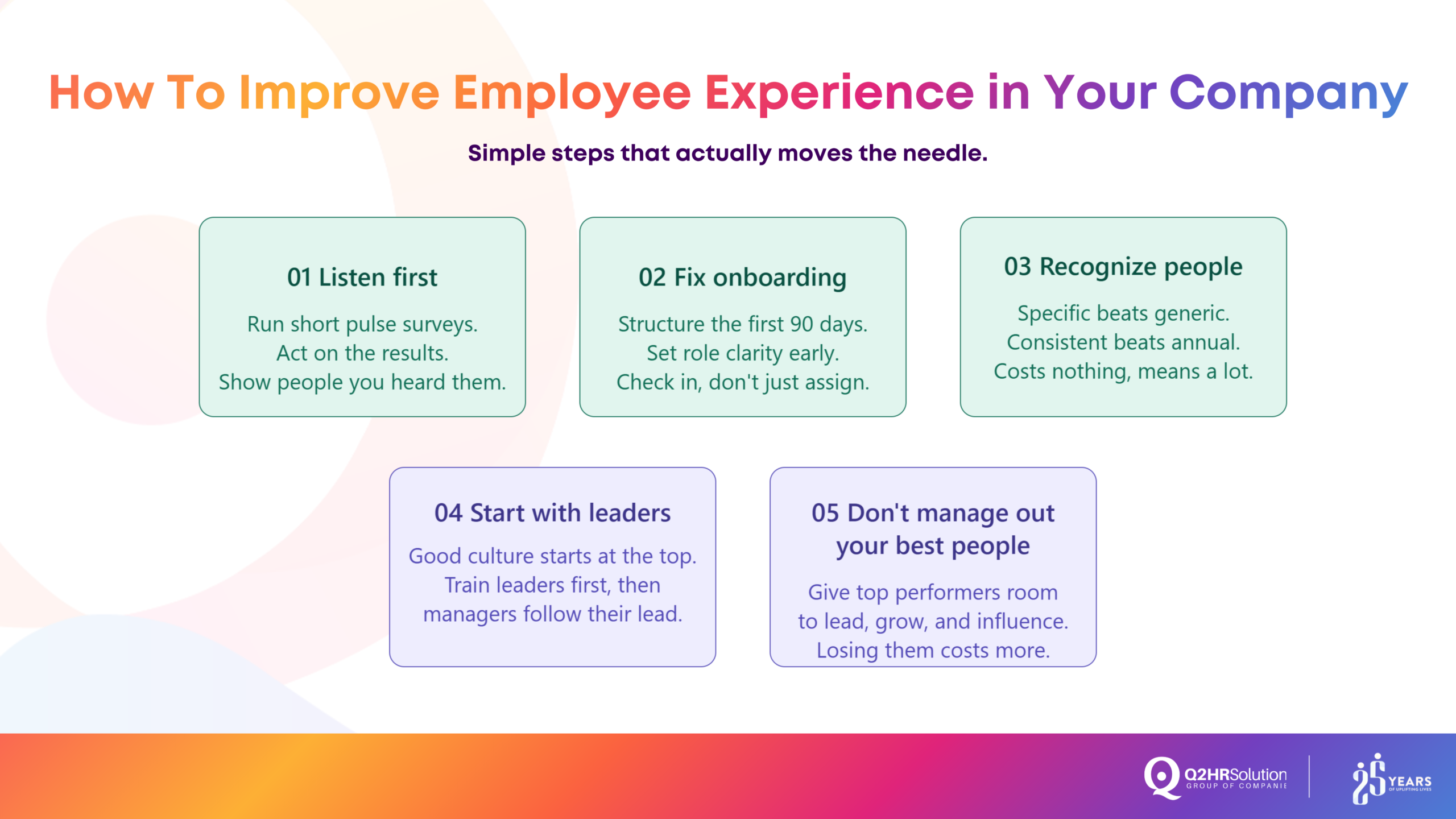
Recognition still matters more than many companies think, mostly because people notice it more when it’s missing than when it’s present. Employees put in time, energy, and effort into their work, and when those contributions go unnoticed for long periods, motivation slowly starts to dip. It doesn’t happen overnight, but over time, people begin questioning whether what they’re doing actually matters. Recognition also doesn’t always have to be financial. A simple, sincere acknowledgment from a manager can sometimes carry more weight than formal rewards.
Beyond motivation, recognition also shapes behavior in a very direct way. People naturally repeat actions that get noticed and appreciated, so when organizations consistently recognize collaboration, innovation, or even small wins, they quietly reinforce the kind of behavior they want to see more of across teams. Over time, this becomes part of the workplace culture without needing formal enforcement or reminders.
Research and studies consistently supports this, highlighting appreciation as one of the strongest drivers of employee experience and engagement, which makes recognition less of a “nice to have” and more of a foundational part of how employees stay connected to their work.
The short answer is yes.
Flexibility has become one of the most discussed workplace topics because employees increasingly value control over how they work. For some organizations, this means hybrid work arrangements. For others, it may involve flexible schedules or output-based performance measures.
The key point is not necessarily remote work itself. Employees often appreciate flexibility because it helps them balance professional and personal responsibilities.
Many Philippine companies exploring how to improve employee experience in your company are now reviewing workplace policies through this lens. The goal is not simply to offer flexibility but to create an environment where employees can perform effectively without unnecessary friction.
One mistake organizations make is assuming they already know how employees feel. Employee experience is often different from leadership perception. This is why surveys, pulse checks, feedback sessions, and exit interviews remain valuable tools.
The most effective organizations do more than collect feedback. They act on it.
When employees see visible improvements based on their input, trust increases. Participation rates improve. Future feedback becomes more honest and useful. Without measurement, companies may spend resources solving problems that employees don’t actually consider important.
Organizations trying to answer how to improve employee experience in your company often discover that listening is the first step before making major changes.
Employee experience refers to how employees feel about their interactions with a company throughout their employment journey. It includes workplace culture, management, communication, development opportunities, and daily work experiences.
Employee experience affects retention, productivity, engagement, and employer reputation. Companies that create positive employee experiences often find it easier to attract and retain skilled talent.
Managers can improve employee experience by communicating clearly, providing regular feedback, recognizing achievements, supporting development, and maintaining strong relationships with team members.
Yes. Employees who feel valued, supported, and connected to their workplace are generally more likely to remain with an organization for longer periods.
Many organizations conduct annual engagement surveys while supplementing them with quarterly pulse surveys or regular feedback discussions throughout the year.
Knowing how to improve employee experience in your company is less about grand gestures and more about getting the basics right, consistently. Listen to your people. Build managers who actually care. Create clear paths for growth. Make the work environment that your people won’t dread. And when you ask employees how they feel, actually do something with the answer.
The organizations that stand out are usually the ones paying attention to the details. They listen to employees, communicate clearly, recognize contributions, and create opportunities for growth. These actions may seem small individually, but together they shape how employees feel about where they work.
As competition for talent continues to grow across the Philippines, employee experience will likely remain a major factor in business success. If your organization is evaluating ways to strengthen retention, engagement, and workplace culture, it’s worth taking a closer look at the experiences employees have every day. And if you need support in figuring out where to start or want to talk through what makes sense for your specific setup, feel free to reach out our team of HR doctors. A fresh outside perspective can go a long way.