

A company can have talented employees, solid products, and ambitious goals, yet still struggle to maintain momentum as it grows. When progress starts slowing despite everyone’s efforts, it’s hard not to wonder, how to improve organizational effectiveness? The challenge is that the answer is rarely tied to a single problem. More often, it’s a combination of communication gaps, unclear priorities, inefficient processes, and teams that are no longer as aligned as they once were.
These issues tend to become more noticeable during periods of growth. What worked when a company had 20 employees can start breaking down at 100. Information passes through more layers, decisions take longer to make, and coordination becomes more difficult. People remain busy, but the connection between effort and results isn’t always as clear as before.
In this article, we’ll take a closer look at organizational effectiveness, why it matters, and the factors that often influence it. From leadership and communication to employee engagement and operational processes, we’ll explore the patterns that frequently separate organizations that scale smoothly from those that struggle to keep pace with their own growth.
Organizational effectiveness refers to how well a company turns its resources, people, and strategies into meaningful results. That sounds straightforward enough. But in reality, effectiveness is often less about working harder and more about working in a way that keeps people moving in the same direction.
A business can have skilled employees and strong products, but if teams are misaligned or decision-making is slow, performance can still suffer. If you’ve ever looked at a growing organization and wondered, how to achieve organizational effectiveness? You’re asking the same question many businesses are trying to answer today. Companies are realizing that growth and effectiveness are not always the same thing. One can happen without the other.
The organizations that perform well over time usually create systems that help people focus on the right priorities while minimizing unnecessary friction.
Growth is generally viewed as a positive sign. Yet growth also introduces complexity.
As companies expand, they add more employees, departments, reporting lines, and processes. Coordination becomes harder. Information takes longer to travel. Decisions often require input from more people than before. It’s during this stage that leaders sometimes find themselves quietly asking, how to improve organizational effectiveness? They realize that the systems that supported a smaller organization may no longer be enough for a larger one.
Think of it like a road network. A route that works perfectly for a small town can become congested once the population doubles. The roads themselves haven’t changed. The demands placed on them have. Organizations usually face a similar situation as they scale.
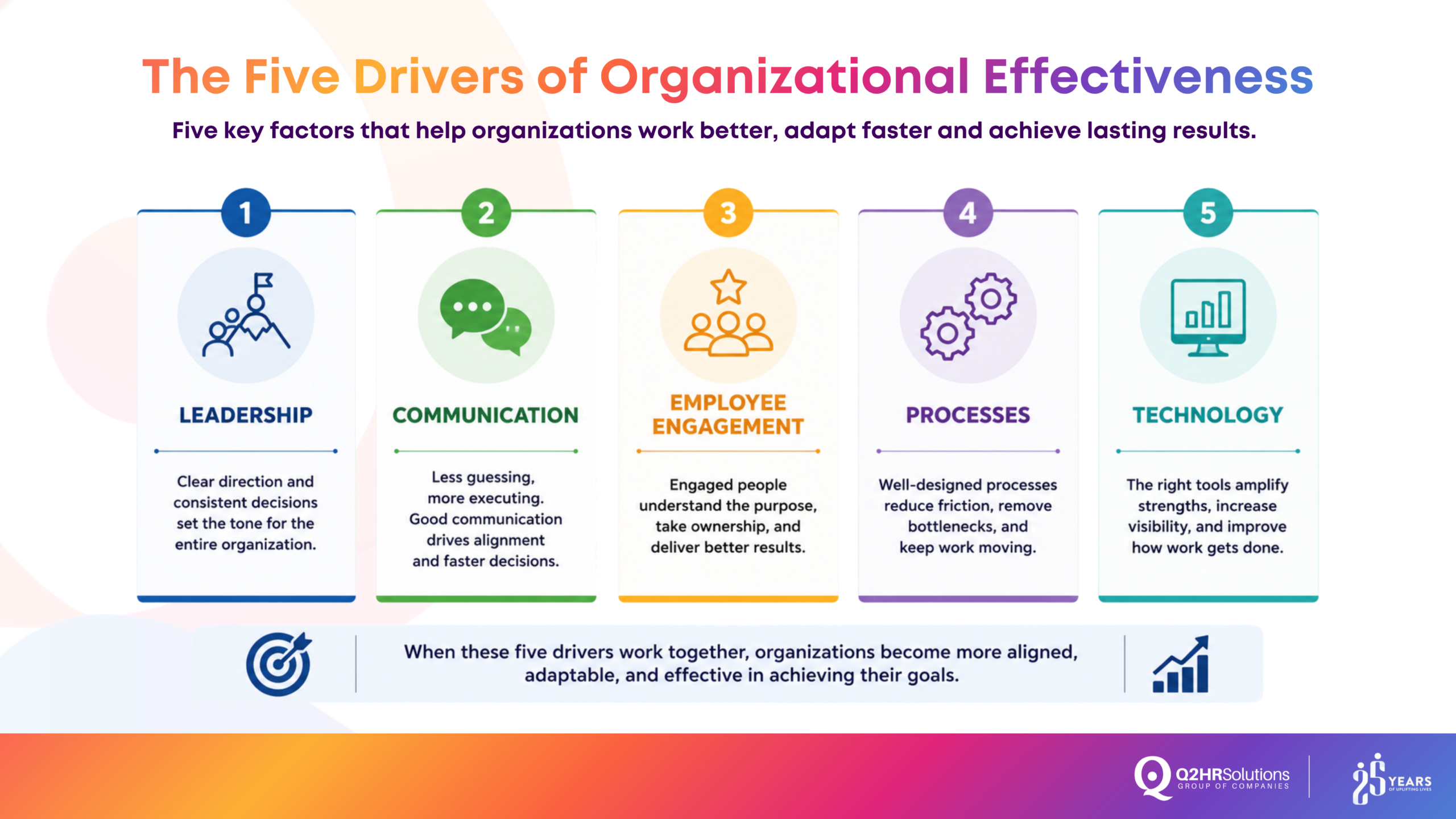
Leadership affects organizational effectiveness in ways that aren’t always obvious. Employees pay attention to what leaders prioritize. If collaboration is encouraged, teams often work more closely together. If communication is inconsistent, that behavior can spread throughout the organization as well.
Have you ever looked at a high-performing organization and thought about how to achieve organizational effectiveness? Well, leadership is usually part of the answer. The way leaders communicate, set expectations, and make decisions can shape how the entire organization operates.
People generally perform better when expectations are clear. They also work more confidently when decisions are communicated openly and priorities remain consistent. Without those conditions, even talented teams can struggle to perform at their best.
The issue is not always capability. Sometimes it’s clarity.
When organizational problems surface, communication is rarely the first thing people blame. Departments can end up pursuing different priorities without realizing it. Teams may interpret the same objective in completely different ways. Small misunderstandings gradually turn into larger operational problems.
After dealing with enough missed deadlines and duplicated work, it’s easy to see why conversations eventually drift toward understanding how to improve organizational effectiveness. Because companies often notice that strong communication helps reduce uncertainty.
People spend less time guessing and more time executing. Information reaches the right people faster, which often leads to quicker decisions and fewer mistakes. That may sound simple, but its impact can be significant.
Most employees want to feel that their work matters.
When people understand how their contributions support larger company goals, they tend to be more invested in the outcome. They are often more willing to collaborate, solve problems, and take ownership of their responsibilities.
It’s easy to see why employee engagement enters the conversation when organizations start asking, how to improve organizational effectiveness? The truth is, people generally perform better when they understand their role, feel supported, and have a clear sense of purpose.
The goal isn’t necessarily to create a perfect workplace. It’s about creating conditions where people can do their jobs effectively without constantly encountering avoidable obstacles. Organizations that succeed in this area often benefit from stronger retention, better teamwork, and more consistent performance over time.
Every company needs structure. The challenge is finding the right amount of it. Too little structure creates confusion. But too much structure creates delays. Many businesses discover that adding more approvals, meetings, or policies doesn’t always solve operational issues. In some cases, those additions create even more friction.
If you’re wondering how to improve organizational effectiveness, one of the first places to look is your processes. The issue is not always the people doing the work. Sometimes the way work moves through the organization is what creates bottlenecks, delays, and frustration.
Think about an airport. Security checks are necessary, but if every passenger had to pass through ten different checkpoints, travel would become painfully slow. The goal is to create enough structure to maintain order without preventing movement.
Organizations face the same balancing act. The best processes support work instead of slowing it down.
Technology has become a major investment area for many Philippine companies. New platforms promise better collaboration, greater visibility, and more efficient workflows. Sometimes they deliver exactly that. Still, technology rarely fixes organizational issues on its own.
A communication problem remains a communication problem even when a new software platform is introduced. Likewise, unclear responsibilities often stay unclear regardless of how advanced the tools become.
If you’re asking how to achieve organizational effectiveness, it’s important to look beyond the technology itself. The systems, processes, and habits surrounding those tools often have a bigger impact on performance than the tools alone.
Technology tends to amplify existing strengths and weaknesses. If an organization is already aligned, digital tools can accelerate performance. If it isn’t, technology may simply make the problems easier to see.
If you’re asking how to improve organizational effectiveness, the first step is knowing how to measure it. Financial results such as revenue growth, profitability, and market share are important indicators. They show whether the business is moving in the right direction.
However, those numbers rarely tell the entire story. They often reflect decisions made months earlier, meaning operational issues can remain hidden until they begin affecting performance.
That’s why many organizations also monitor employee retention, customer satisfaction, project completion rates, and decision-making speed. These metrics provide a clearer view of how the organization functions on a day-to-day basis. Together, they help leaders assess whether their efforts are leading to better outcomes across the business.
Common signs include slow decision-making, communication gaps, declining employee engagement, missed deadlines, and difficulty adapting to growth or change.
Organizational effectiveness helps businesses align people, processes, and goals, leading to better productivity, stronger collaboration, and improved long-term performance.
Leadership, communication, employee engagement, well-designed processes, and the effective use of technology all influence how well an organization performs.
Technology can support collaboration and streamline workflows, but it works best when paired with clear processes, effective communication, and strong leadership.
Organizational effectiveness rarely comes down to a single initiative, department, or leadership decision. It develops through the way people communicate, how decisions are made, how teams work together, and how well the organization adapts as it grows. When those pieces start working in sync, companies often find it easier to maintain momentum, execute priorities, and navigate change without creating unnecessary friction.
Business conditions will continue evolving, whether through new technologies, shifting workforce expectations, or increasing competition. Organizations that regularly evaluate how they operate are often better positioned to respond to those changes while maintaining alignment and performance across the business.
For companies looking to strengthen organizational effectiveness, having the right support can make the process more manageable. Q2 HR Solutions helps organizations build stronger teams and workplace strategies that support long-term business performance. Get in touch with our team to learn how we can help your organization create a more effective and sustainable path for growth.