

HR operations are the everyday functions that keep a workforce running, things like payroll, contracts, compliance, employee records, and benefits administration. In a single, settled market they tend to run quietly in the background. It is usually only when a business grows into a new country that they start to feel complicated.
That is exactly the moment many KSA companies reach when they begin hiring in global markets like the Philippines. Questions that were never an issue back home, such as who runs payroll, which contributions are mandatory, and how contracts should be written, suddenly need clear answers. What once looked like simple admin turns into a web of unfamiliar local rules.
Getting this right is about more than paperwork. Smooth HR operations keep employees paid correctly and on time, keep the business compliant with Philippine labor law, and free up leaders to focus on growth rather than firefighting. This article explains what these functions involve, walks through clear examples, looks at the challenges of running them across borders, and shows how the right local partner can help Saudi companies set up properly in the Philippines.
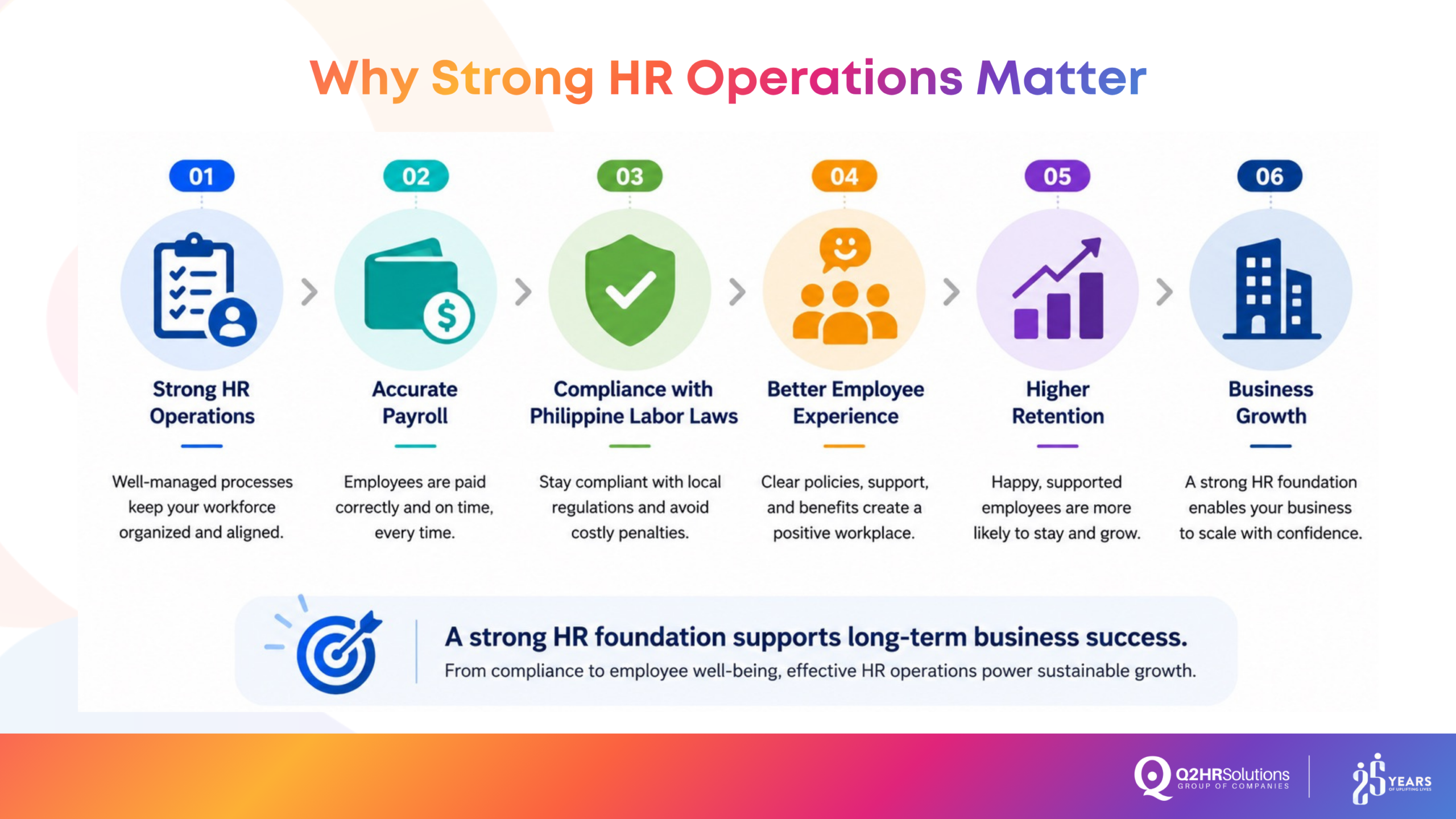
For Saudi businesses entering the Philippines, the temptation is to treat the back office as an afterthought and focus only on hiring. That rarely ends well. Strong HR operations are what turn a handful of new hires into a stable, compliant, and productive team.
The Philippines has its own contracts, statutory contributions, and reporting requirements, and getting any of them wrong can be expensive. Beyond compliance, the quality of day to day people management shapes how quickly employees settle in and how long they stay. A disorganized back office leads to late payslips, frustrated staff, and avoidable turnover, none of which a company wants while it is still trying to establish itself in a new market. Head office and investors also expect clean, timely reporting from the new market, and that only happens when the underlying admin is handled with care from the very start.
The term covers a wide range of functions, so it helps to look at concrete examples rather than a vague definition.
This sits at the very front of the process. It covers sourcing candidates, coordinating interviews, preparing employment contracts, and getting new hires set up with the tools, accounts, and information they need from day one.
This is the function employees notice most. Salaries, government-mandated contributions to agencies such as SSS, PhilHealth, and Pag-IBIG, payslips, and tax filings all fall under here, and accuracy is non-negotiable because mistakes erode trust fast.
These run quietly in the background. Maintaining accurate employee records, tracking leave entitlements, and keeping documentation aligned with Philippine labour law all protect the business if questions ever come up later.
This is what keeps the team healthy. Handling grievances, supporting managers, running appraisals, and shaping a fair workplace culture all sit within HR operations, and they have a direct effect on retention.
This is the forward-looking piece. Good workforce planning means forecasting hiring needs, mapping the skills the business will require, and preparing for growth or seasonal demand, so the team stays the right size and shape for whatever comes next.
These tie everything together. A good HR information system centralizes records, automates routine admin, and gives leaders clear visibility over their people, which is where much of modern HR operations now lives.
Seen together, these functions are less a checklist and more a connected system. When one part slips, such as a late filing or a missed clause in a contract, the effect tends to ripple across the others, which is exactly why they are best run as a whole rather than in isolation.
Running these functions in your home market is one thing. Running them in a country where you have no legal entity is another challenge entirely.
The first hurdle is compliance. Philippine labour law covers contracts, benefits, working conditions, and termination rules that differ from those in the Kingdom, and the penalties for getting them wrong are real.
The second is setup time. Registering an entity, opening the right accounts, and building HR operations from scratch can take many months, which is a long wait when you already have candidates ready to start.
The third is continuity. Even after setup, someone has to actually run payroll every cycle, keep records current, and stay on top of changing regulations. Without local expertise, careful workforce planning can quietly fall apart as the team grows and the rules shift.
Faced with all of this at once, many KSA companies reach the same conclusion. They want a team in the Philippines, but they would rather not spend months building and running an entire back office from scratch in a market they are still getting to know. That is the gap a Build-Operate-Transfer model is designed to close.
The idea behind a Build-Operate-Transfer, or BOT, arrangement is simple. Instead of doing everything alone, a local partner builds the operation, runs it on your behalf, and then hands it over once it is stable and ready.
In the build phase, the partner sets up the structure, hires the initial team, and puts the right systems and processes in place. In the operate phase, they handle the running of day to day HR operations, from payroll and compliance to employee support, so the business can stay focused on its core goals. In the transfer phase, once everything is proven and running smoothly, full control passes back to the company.
Providers like Q2 HR Solutions offer BOT services built for exactly this situation, helping KSA companies establish a compliant, well run team in the Philippines without the risk and delay of going it alone. From the first hire through to a fully operational unit, we manage the heavy lifting and keep the cross-border process efficient and properly handled. Rather than leaving you to navigate unfamiliar rules by yourself, we build the foundation, run it alongside you, and transfer it when the time is right. Because the team is built and tested locally before it changes hands, the business inherits something that already works rather than a project that still needs fixing.
At a high level, HR operations include recruitment, onboarding, payroll, benefits administration, compliance, employee records, performance management, and workforce planning. Together they keep the workforce running smoothly and lawfully.
Yes. Through a Build-Operate-Transfer or Employer of Record arrangement, a local partner can legally employ and manage staff on your behalf, so you can operate in the Philippines without setting up a company first.
Outsourcing usually hands a function to a third party indefinitely. A Build-Operate-Transfer model is designed to give the operation back to you once it is established, so you end up owning a ready-made, fully functioning team.
It varies with role and scale, but a BOT partner can have people hired and working far faster than building an entity from scratch, often turning months of setup into a matter of weeks.
Hiring in the Philippines gives KSA companies access to a large, skilled, and English-speaking workforce, but the people side of the business only works when the back office behind it is solid. Recruitment, payroll, compliance, employee relations, and planning all have to run together, and all of them have to respect local rules.
Trying to build that from scratch in an unfamiliar market is slow and risky. A Build-Operate-Transfer partner takes on the hard parts, stands up a compliant team, runs it until it is steady, and then hands it over, so expansion feels less like a leap and more like a guided step.
Whether you are making your first Philippine hire or standing up a full team, Q2 HR Solutions can build, operate, and transfer it with you. Get in touch with our team today to see how our BOT expertise can help you expand into the Philippines smoothly, compliantly, and with confidence.