

Every growing company runs on two kinds of thinking, the big-picture direction and the day-to-day execution. Mixing up the two is a common reason why growth plans to stall. The difference between a strategic plan and an operational plansits right at the center of that confusion. One sets the destination. The other maps out how you actually get there.
For companies in the Philippines, this matters more than it might seem. A business can have an inspiring vision and still struggle if nobody has turned it into weekly tasks, clear owners, and real deadlines. Just as easily, a team can look busy and productive while quietly drifting away from where the company actually wants to go.
Getting both plans right, and knowing how they connect, is what keeps ambition and action pointed in the same direction. This article breaks down what each plan is, how they differ, why the distinction matters, and where organizational development comes in to keep both working together.
A strategic plan is the long-view document. It answers the big questions. Where is the business going over the next three to five years, what does success look like, and which priorities deserve real focus and investment. It is usually owned by leadership and sets the direction that everything else follows.
A good strategic plan is less about detail and more about clarity of purpose. It defines goals such as entering a new market, growing revenue by a set margin, or becoming the employer of choice in an industry. Part of the difference between a strategic plan and an operational plan is exactly this altitude. The strategic plan stays high, focused on the why and the what rather than the how.
An operational plan is where strategy meets the calendar. It turns those big goals into the specific activities, budgets, timelines, and responsibilities that make them real. If the strategic plan sets to grow revenue by twenty percent, the operational plan spells out who does what each quarter to make that happen.
Operational plans are detailed, short-term, and practical. They cover the day to day, things like staffing levels, workflows, targets, and the resources each team needs to hit them. This is the other half of the difference between a strategic plan and an operational plan. One points to the horizon, the other keeps the engine running week to week.
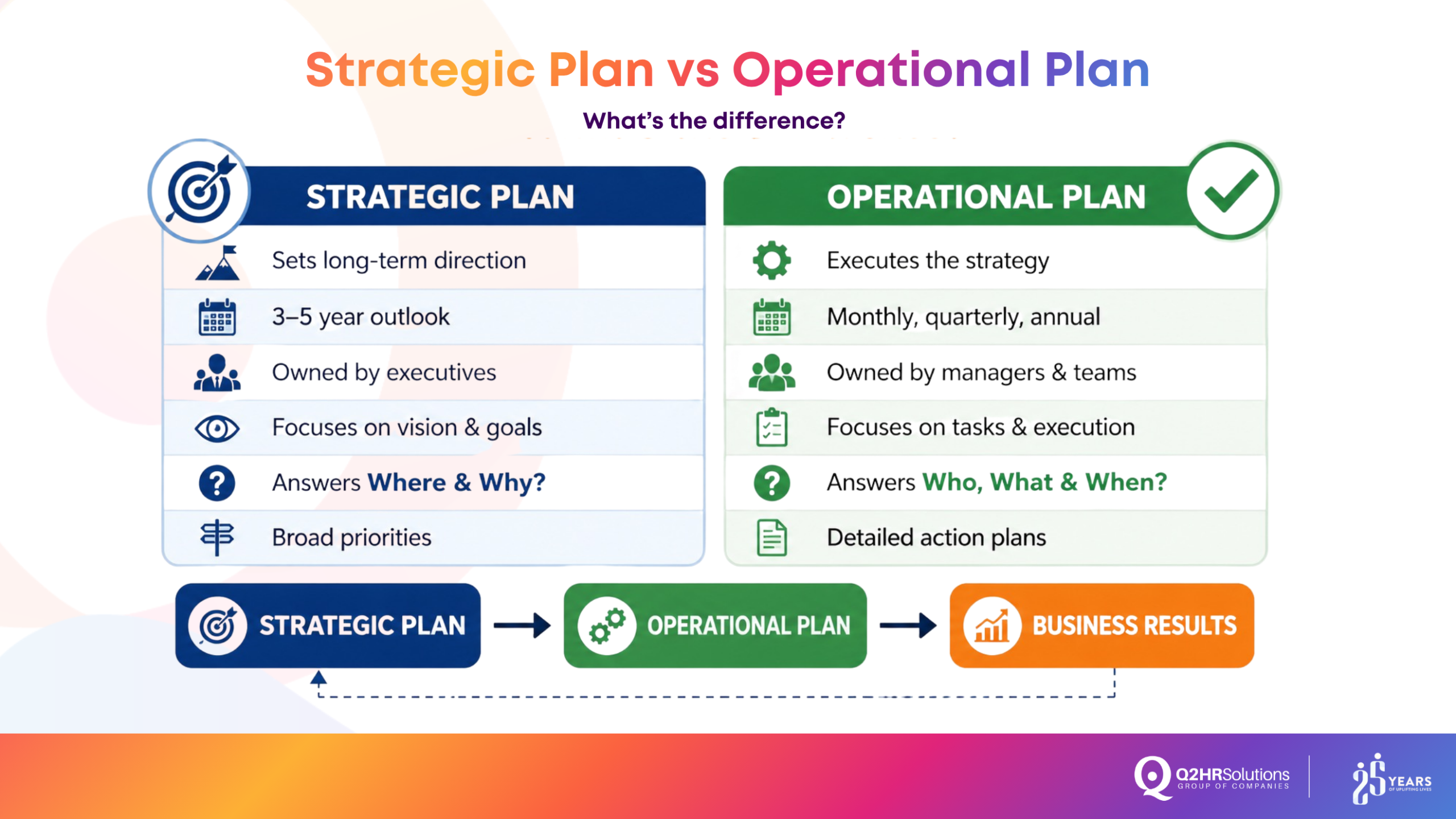
Laid side by side, the contrast is clear. A strategic plan is long-term, broad, and set by leadership. An operational plan is short-term, detailed, and carried out by teams on the ground. One deals in years, the other in weeks and quarters. One asks where and why, the other asks who, what, and when.
Still, the difference between a strategic plan and an operational plan is not a wall between them. They are two halves of the same system. The strategic plan gives the operational plan its purpose, and the operational plan gives the strategy its legs. When they are disconnected, you get one of two familiar problems. Either a beautiful strategy that never gets executed, or a team working hard on tasks that no longer serve the bigger goal.
The clearest way to understand the difference between a strategic plan and an operational plan is to see them as vision and execution, each of little use without the other.
For businesses navigating tight competition and fast-changing conditions, the gap between planning and doing can get expensive. Many local companies set ambitious goals but lose momentum because those goals were never broken down into clear, owned actions. Understanding the difference between a strategic plan and an operational plan helps leaders spot exactly where that breakdown happens.
It also shapes how a company responds to change. When the market shifts, the strategic plan might need a genuine rethink, or the operational plan might just need retuning. Knowing which is which saves time and prevents overreaction. This is often where an outside perspective helps, someone who can look at both levels and tell you honestly where the disconnect really lies.
This is where organizational development, or OD, earns its place. OD looks at the whole organization, its structure, people, culture, and processes, and works out why goals are or are not being met. A good OD partner treats a company a little like a doctor treats a patient. Rather than reacting to surface symptoms, they diagnose the root cause first, then recommend the right treatment.
That diagnosis often reveals whether a problem is strategic or operational. Sometimes the strategy is sound but execution is broken. Other times teams are executing well against the wrong strategy. Well-designed OD strategies close that gap, aligning structure and behavior with the goals the business is actually chasing.
Organizational development consultants act as “HR doctors” for companies across the Philippines. They help diagnose what is really holding a business back, then guide leaders through the difference between a strategic plan and an operational plan so the two finally pull in the same direction. Practical OD strategies turn that clarity into change people can feel on the ground.
Planning problems rarely sit on their own. A stalled strategy might really be a hiring problem, a leadership gap, or a team that was never properly assessed for the roles it holds. That is why it helps when your OD partner also understands the wider people picture.
OD partners like Q2 HR Solutions bring organizational development together with recruitment, executive headhunting, background investigation, and psychometric assessment under one roof. So when a diagnosis points to a missing skill or the wrong person in a key seat, the same partner can help you act on it. Sound OD strategies are far easier to carry out when the people side is handled by a team that already knows your business.
The value here is not in buying more services. It is in having one partner who sees how strategy, execution, and people connect, so guidance in one area is shaped by what is happening in the others.
Neither outranks the other. The difference between a strategic plan and an operational plan is one of role, not value. A strategy without execution is just a wish, and execution without strategy is just motion. Companies need both workingtogether.
A strategic plan is usually revisited once a year, or when major market changes hit. An operational plan is far more active, often reviewed monthly or quarterly to keep teams on track.
It sits underneath both. Good OD strategies make sure the structure, culture, and people are set up to deliver the strategy and run the operations, rather than quietly working against them.
Yes. Even a small team benefits from knowing where it is headed and how it will get there. The plans can be simple, but having both keeps a growing business from drifting.
Strategy and execution are two sides of the same coin. One sets the direction and the other makes it happen, and a company performs best when both are clear, connected, and reviewed on the right rhythm. Confusing them, or letting them drift apart, is what quietly stalls otherwise capable businesses.
For Philippine companies navigating growth and change, the goal is not to choose between vision and action but to align them. That alignment gets easier with a partner who can diagnose where the disconnect sits and help close it, at the level of structure, people, and process.
Whether you are refining your long-term direction or tightening how the daily work gets done, Q2 HR Solutions can help you connect the two. Schedule a consultation with our HR doctors today to see how our organizational development expertise, backed by a full suite of HR services, can help your business plan clearly and deliver consistently.