

Saudi Arabia is one of the most dynamic business environments in the Middle East — and one of the most complex to navigate from a payroll and employment compliance perspective. For companies looking to hire talent in the Kingdom, whether for a project, a permanent function, or a distributed team across the Gulf, the question of how to handle payroll in KSA is rarely straightforward.
Saudi labour law, Saudisation requirements, the Wage Protection System, and mandatory GOSI obligations all create a compliance environment that demands local expertise. Getting it right is not simply about paying people on time — it is about ensuring every aspect of the employer payment process meets KSA regulatory standards from day one.
This is where an Employer of Record (EOR) model changes the equation entirely. Rather than establishing a local entity — a process that can take months and carries significant ongoing compliance obligations — businesses can partner with an EOR provider to handle payroll, employment contracts, statutory contributions, and workforce administration on their behalf.
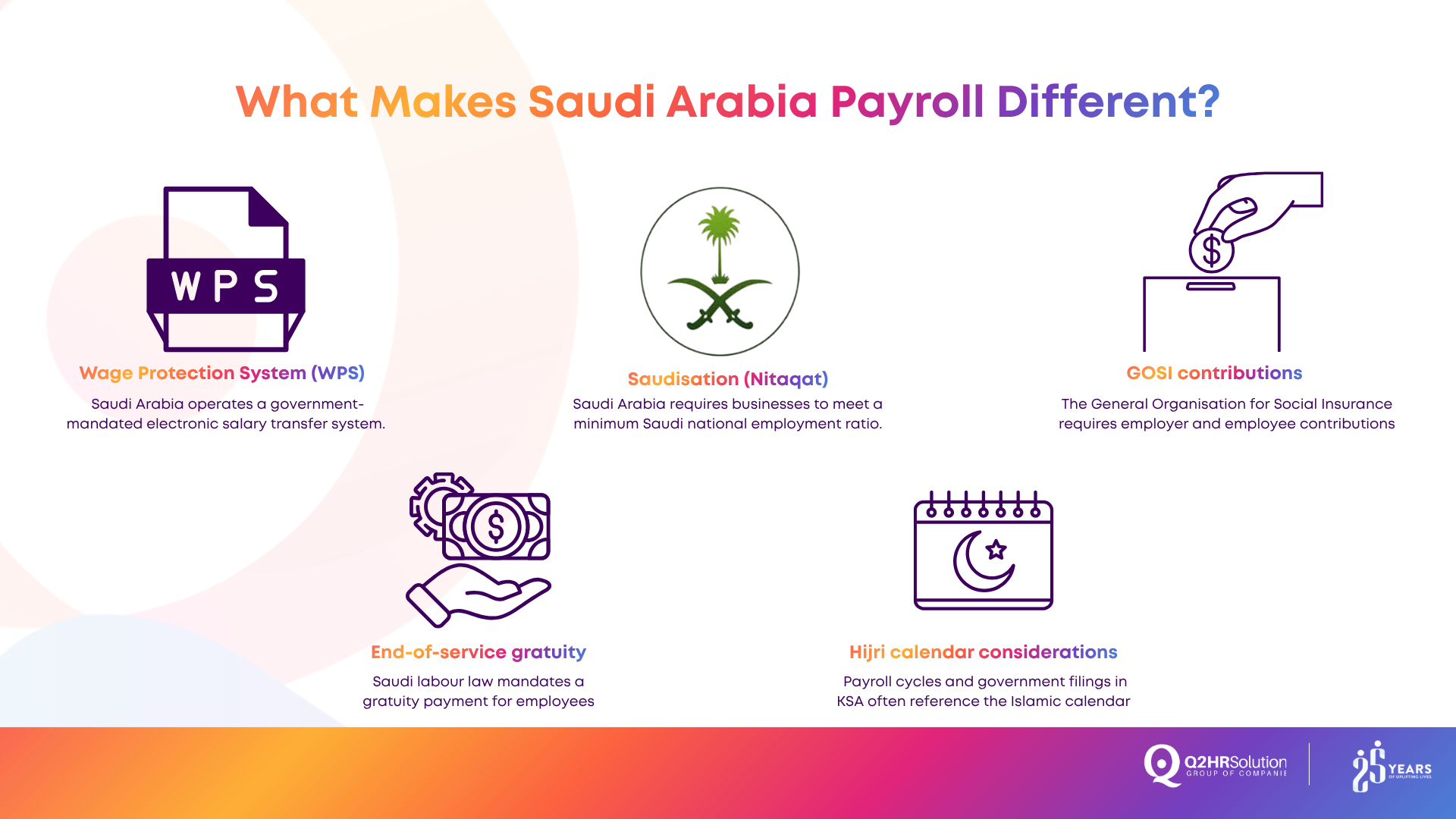
Before addressing how to handle payroll in KSA, it helps to understand what sets it apart from payroll management in most other markets. Several features of the Saudi employment landscape make it uniquely complex for foreign businesses:
Each of these elements requires specialist knowledge to manage correctly. For a business without an established in-country HR and payroll function, the risk of non-compliance — even unintentionally — is real and consequential.
EOR payroll is the mechanism by which a business deploys and pays workers in a market without holding a local legal entity. The EOR provider becomes the legal employer of record in Saudi Arabia — employing the individual under a compliant KSA contract, processing salary through the Wage Protection System, managing GOSI contributions, and handling all statutory employer payment obligations.
The client business retains full day-to-day direction of the worker’s activities, deliverables, and performance. The EOR handles everything behind the employment relationship — the administration, the compliance, and the employer obligations that KSA law requires.
For companies that need to pay remote employees in Saudi Arabia — particularly those building distributed teams across the GCC or deploying project-based talent into the Kingdom — this model removes the single biggest barrier to entry: the requirement to establish a legal presence before hiring a single person.
A full-service EOR payroll solution for Saudi Arabia typically includes:
The result is a fully managed payroll operation in Saudi Arabia — without the overhead of building and maintaining an in-house function from scratch.
Yes — through an EOR arrangement. The EOR holds the legal employer status in KSA, which means you can pay remote employees in Saudi Arabia compliantly without registering a local entity. This is the most common approach for businesses entering the KSA market on a project basis or testing demand before committing to a permanent structure.
The WPS is a Saudi government electronic salary monitoring system that requires employers to pay staff through approved financial channels by a defined monthly deadline. A compliant EOR provider handles payroll through WPS-registered channels as standard — meaning your workers are paid correctly and on time, and your KSA employment relationship remains in good standing with the Ministry of Human Resources.
Saudisation (Nitaqat) ratios apply to the legal employer — in an EOR model, that is the EOR entity. A reputable EOR partner in KSA manages its own Nitaqat compliance and advises on how your specific workforce composition interacts with those requirements. Choosing an experienced, locally established EOR provider matters here: the penalties for falling outside acceptable Nitaqat bands are significant and affect business operations directly.
A Professional Employer Organisation (PEO) co-employs workers alongside the client business. An EOR is the sole legal employer in the host country. In a market like Saudi Arabia — where local entity requirements and Saudisation ratios apply — the EOR model tends to be the cleaner, lower-risk structure for foreign businesses that do not yet have a registered presence in the Kingdom.
The question of how to handle payroll in Saudi Arabia does not have to be the obstacle that delays your market entry or adds unacceptable compliance risk to your expansion plans. With the right EOR partner, you can deploy talent in KSA quickly, manage employer payment obligations correctly, and maintain full regulatory compliance — without building a local infrastructure before you are ready.
Q2HR Solutions supports businesses across the GCC and beyond with EOR payroll services built on deep local expertise, established in-country relationships, and a track record of managing the full complexity of Saudi employment law. Whether you are looking to pay remote employees in KSA for the first time, or scale an existing operation without entity risk, we are ready to help.
Ready to handle payroll in Saudi Arabia without the complexity? | Speak to our EOR team at https://www.q2hrsolutions.com/contact-us/.