

The Philippines has become an increasingly important destination for companies building remote, distributed, and international teams. But once you’ve found the right Filipino talent, there’s another question to answer: How should you legally employ them?
For some companies, employer of record services offer a practical way to hire employees in the Philippines without establishing a local entity first. For others, setting up a Philippine corporation, branch, or other legal structure may make more sense for a long-term operation.
The right choice depends on more than the monthly cost of an EOR. You also need to consider hiring speed, payroll, statutory benefits, compliance, administrative responsibilities, control, headcount, and your long-term plans.
This guide breaks down both options so you can determine which approach fits your business.
These services allow a company to employ workers in a country through a local employment structure without establishing its own entity there.
In a typical EOR arrangement, three parties are involved:
Your company → Employer of Record → Employee
Your business typically remains responsible for the employee’s day-to-day work, including their responsibilities, performance, projects, and business objectives.
The EOR, meanwhile, handles the formal employment administration according to the arrangement, which can include:
An EOR isn’t simply a payroll company. A company with its own Philippine entity can outsource payroll while remaining the legal employer; with an EOR, the EOR provides the local employment structure as part of the service.
A global employer of record extends this concept across multiple countries.
Instead of establishing a separate employing entity every time the company hires in a new jurisdiction, a business can use global EOR services to access local employment infrastructure in different markets.
Global EOR services can be useful for startups and growing businesses expanding into multiple countries without establishing an entity in every market. However, an EOR does not eliminate local employment requirements; it primarily outsources much of the employment infrastructure and administration.
Setting up your own Philippine entity means creating the legal and administrative infrastructure needed to operate and employ people directly in the country.
The appropriate structure depends on the company’s activities, ownership, and long-term plans.
A Philippine corporation provides a foreign company with a direct local operating structure, subject to applicable foreign ownership and investment rules.
A branch office is an extension of a foreign corporation rather than a separate legal personality with liabilities generally remaining with the head office. For a domestic-market enterprise, the Philippine Board of Investments (BOI) identifies a US$200,000 minimum capital requirement, which may be reduced to US$100,000 under specified circumstances.
A representative office has more limited activities and cannot operate as a conventional revenue-generating business. BOI also identifies a US$30,000 minimum inward remittance.
It’s also important not to rely on the outdated idea that incorporating a Philippine company necessarily requires months of paperwork.
The Securities and Exchange Commission (SEC) now operates eSPARC, including OneSEC and ZERO processing.
The SEC describes OneSEC as “One day Submission and E-registration of Companies.” The system is designed to automate the registration process for qualifying domestic stock corporations.
The SEC also states that ZERO processing uses digital signatures and eliminates conventional paper-based signing and submission for covered applications.
Incorporation is only the beginning. A direct Philippine employer still needs systems for:
Establishing an entity also places the company directly within the country’s broader operating environment. In the World Bank’s 2023 Philippines Enterprise Survey, businesses identified issues including business licensing and permits, tax rates, labor regulations, workforce skills, and infrastructure among the obstacles affecting operations.
In other words, the question isn’t simply how long it takes to register a company. It’s how much infrastructure you want to build and maintain yourself.
The fundamental difference is straightforward: an EOR provides an employment infrastructure that you use, while your own entity gives you direct ownership of that infrastructure.
|
Factor |
EOR Services |
Own Philippine Entity |
| Establish your own Philippine entity | No | Yes |
| Initial setup burden | Generally lower | Higher |
| Hiring infrastructure | Provided through EOR | Built or outsourced by company |
| Payroll administration | EOR-managed according to agreement | Company-managed or outsourced |
| Statutory administration | EOR-managed according to agreement | Company responsibility |
| Day-to-day employee management | Client | Client |
| Corporate control | More limited | Greater |
| Administrative responsibility | Lower | Higher |
| Market testing | Flexible | Greater initial commitment |
| Long-term local operation | Depends on strategy | Direct local presence |
The real cost comparison is not an EOR fee versus a company-registration fee; it is the cost of outsourced employment infrastructure versus the cost of building and maintaining your own.
An entity doesn’t eliminate administrative costs. It shifts them to the company.
Salary is still the largest direct expense for most employers. The Philippine Statistics Authority’s 2024 Occupational Wages Survey reported an average monthly wage of ₱21,544 among covered full-time workers, while the Information and Communications industry averaged ₱43,676. Actual costs vary considerably by occupation, industry, and location.
Whether employees are hired through an EOR or directly through your own entity, applicable employment costs still need to be accounted for.
The Social Security System (SSS) states that, effective January 1, 2025, the regular Social Security contribution rate is 15% of the Monthly Salary Credit (MSC), up to ₱35,000.
The rate includes a 10% employer share and 5% employee share, plus the applicable Employees’ Compensation contribution.
Pag-IBIG Fund rules also require employer and employee contributions.
Under the applicable Pag-IBIG guidelines, the employer contribution is 2%, with the contribution calculation subject to the applicable ₱5,000 monthly compensation ceiling.
Employers must also account for and remit applicable PhilHealth premiums, which are shared between employers and employees.
Because government contribution rules can change, businesses should always check the latest PhilHealth premium guidance when calculating current employment costs.
Covered rank-and-file employees who have rendered at least one month of service are entitled to 13th-month pay, calculated as total basic salary earned during the year ÷ 12. Department of Labor and Employment (DOLE) requires payment no later than December 24.
The Bureau of Internal Revenue (BIR) requires employers and other withholding agents to comply with applicable compensation withholding and tax reporting obligations.
The BIR’s current list of tax forms provides the applicable forms and descriptions.
An EOR doesn’t remove employee costs; it changes where employment infrastructure sits.
EOR: employee compensation + employer statutory costs + EOR fees + applicable benefits. Own entity: employee compensation + statutory costs + payroll, HR, accounting, legal, and entity-maintenance costs.
For a small or uncertain team, avoiding that infrastructure may be valuable; for a large, permanent operation, an entity may become more economical.
An EOR can shorten the path to hiring because your company does not first need to establish its own Philippine employment infrastructure.
That doesn’t mean every EOR can hire an employee instantly, and it doesn’t mean establishing an entity necessarily takes months.
The better comparison is the amount of work required before the company can operate as an employer.
The process generally involves:
The process can involve:
The SEC has made the corporate-registration portion much faster through eSPARC. Its OneSEC system is designed around one-day submission and e-registration for qualifying domestic stock corporations.
But incorporation isn’t the same thing as being fully operational as an employer.
If the immediate goal is to hire a small team while deciding whether the Philippines will become a significant operating market, an EOR can provide a way to start without first building the entire infrastructure.
An EOR can centralize much of the day-to-day employment administration, while a company with its own entity assumes direct responsibility for maintaining its Philippine employment infrastructure.
This is one of the most important differences between the two models.
One common mistake international companies make is assuming there is a single Philippine minimum wage.
There isn’t.
The National Wages and Productivity Commission (NWPC) maintains regional wage orders, and minimum wages differ depending on the region and applicable classification.
For example, NCR Wage Order No. NCR-25 and subsequent wage orders establish rates applicable to workers in Metro Manila, while other regions have their own wage orders.
The latest applicable rate should always be verified through the NWPC’s current wage-rate database.
This matters for businesses hiring remotely across multiple Philippine locations.
The Philippine Labor Code establishes requirements covering working hours, overtime, leave, holiday and premium pay, night-shift differential, and other employment standards.
The exact rules depend on the employee and circumstances, so companies should not treat payroll as simply a matter of calculating a monthly salary.
Termination is another area where companies need to understand local requirements.
Philippine labor law recognizes just and authorized causes for termination, along with procedural requirements. The OECD’s 2026 assessment of the Philippine labor market notes that authorized-cause dismissals can involve substantial documentation and, in some cases, exposure to reinstatement, backpay, and legal costs.
An EOR can help administer the process, but Philippine employment law still applies.
Employment involves sensitive personal information, including government IDs, tax records, health information, compensation, and bank details.
Companies should understand who controls and processes employee data, where it is stored, and what security measures apply, particularly when information is shared with an EOR or other providers.
The National Privacy Commission (NPC) identifies information such as government-issued social security numbers, health records, and tax returns as sensitive personal information under the Data Privacy Act.
This is particularly relevant when employee information is shared between a foreign company, an EOR, payroll providers, HR systems, and other third parties.
The practical difference is who manages the employment infrastructure: an EOR centralizes much of it through the service relationship, while an entity leaves the company responsible for building or outsourcing those capabilities.
Employer of record payroll services can simplify Philippine payroll by putting payroll administration and statutory employment processes under one local employment structure.
Payroll in the Philippines involves considerably more than sending an employee their monthly salary.
A simplified payroll flow looks like this:
Gross compensation
↓
SSS contribution
↓
PhilHealth contribution
↓
Pag-IBIG contribution
↓
Applicable withholding tax
↓
Net pay
At the same time, the employer must account for its own statutory contributions and obligations.
Under an EOR arrangement, the EOR can manage the payroll and statutory administration covered by the service agreement.
The client still needs to provide accurate information about compensation, allowances, employee status, leave, salary changes, and other relevant employment details.
The company can choose to:
This leads to an important distinction:
An EOR combines the employment relationship with outsourced payroll and administrative infrastructure; a company with its own entity can outsource payroll separately.
The EOR model simply combines the local employment relationship with the outsourced administrative infrastructure.
A Philippine entity gives a company greater direct control over its local employment infrastructure, while an EOR reduces the amount of employment administration the company has to manage itself.
With an entity, the company directly controls HR policies, compensation, benefits, payroll arrangements, employment documentation, and local processes. With an EOR, the company generally retains control over the employee’s work, performance, projects, and business priorities while the EOR manages formal employment administration.
With an EOR, the company generally retains control over the employee’s actual work:
The EOR handles the formal employment administration according to the agreement.
A useful way to think about it is:
You manage the work.
The EOR manages the employment infrastructure.
Before signing an EOR agreement, companies should understand exactly where responsibilities begin and end.
Ask:
The more clearly these responsibilities are defined, the easier the relationship will be to manage.
EORs can make it easier to add employees without first building an entire local employment operation, while an entity can provide a stronger foundation for a large, permanent Philippine workforce.
The Philippine labor market provides significant room for expansion.
The PSA estimated that 51.16 million Filipinos were in the labor force in 2025, with 49.01 million employed during the year.
In December 2025 alone, the country had 49.43 million employed people, and services accounted for 62.4% of employment.
The workforce itself is also evolving as technology changes the skills and tasks companies need. An Asian Development Bank study using Jobs and Skills Survey data from the Philippines examines workplace digitalization, skills use, and access to technology.
For companies in technology, customer service, finance, operations, and other service-oriented industries, that represents a substantial potential labor pool. It also means that scaling a team may involve changing skill requirements, not simply adding headcount.
EORs are particularly useful when headcount is uncertain, hiring may fluctuate, or you’re testing the market. An entity becomes more attractive when the Philippines is a strategic operating location, you expect sustained hiring, and you need dedicated local infrastructure and leadership.
The key distinction is between administrative scalability and corporate scalability.
An EOR can make employment administration easier as you grow. An entity gives you your own infrastructure to grow from.
The most useful question isn’t “Which model is better?”
It’s “What are we actually building in the Philippines?”
Consider two companies.
A US-based software company wants to hire a small initial team but isn’t sure whether its Philippine workforce will eventually grow to 10 employees or 100.
The company has never operated in the Philippines and isn’t sure whether it will eventually hire 10 people or 100.
For this business, minimizing initial infrastructure commitments may be important.
An EOR could let the company evaluate talent availability, hiring demand, operating costs, management needs, and long-term headcount before committing to its own infrastructure.
Now consider a business that expects to establish a 100-person Philippine team over several years.
The company plans to hire local managers, build a dedicated HR function, establish long-term operations, and make the Philippines an important part of its international structure.
In that situation, establishing a Philippine entity deserves much closer consideration.
The important distinction is:
“I need to employ people in the Philippines.”
versus
“I am building a Philippine business.”
Those are two different strategic decisions.
Here’s a quick recap of how the two approaches compare across the seven rounds:
|
Round |
EOR Services |
Own Philippine Entity |
| 1. Cost | Wins for lean expansion: Lower upfront infrastructure investment can make sense for small or uncertain teams. | Wins for scale: Building your own infrastructure may become more economical as headcount and operations grow. |
| 2. Speed to Hire | Wins for getting started: You can begin hiring without first building your own local employment infrastructure. | More setup required: Registration is increasingly streamlined, but becoming a fully operational employer requires additional steps. |
| 3. Compliance | Simplifies administration: The EOR can centralize many employment and statutory processes under the service agreement. | Greater responsibility: Your company directly manages or coordinates local employment compliance. |
| 4. Payroll & Benefits | Less administrative work: Payroll and statutory administration can be handled through the EOR. | More flexibility: You control the payroll setup and can outsource it while remaining the legal employer. |
| 5. Control | Less infrastructure ownership: You manage the employee’s work while the EOR manages the employment structure. | More direct control: You own the local employment infrastructure, policies, and HR processes. |
| 6. Scalability | Flexible for changing headcount: Useful when you’re testing the market or expect hiring needs to fluctuate. | Built for a permanent operation: Provides your own infrastructure for sustained local growth. |
| 7. Long-Term Strategy | Best aligned with testing and expansion: Useful when you’re still evaluating the Philippines as a long-term market. | Best aligned with permanence: Makes more sense when the Philippines becomes a strategic, established operation. |
There isn’t one universal answer. Your company’s circumstances should drive the decision.
The goal isn’t to find the universally “better” structure. It’s to find the structure that matches your business.
Foreign companies can establish Philippine operations, but ownership and structural requirements depend on the business activity and applicable investment rules.
The Board of Investments and SEC provide guidance on enterprise structures and foreign investment requirements.
For example, a branch office is an extension of its foreign parent, while a representative office has more limited activities and cannot operate like a conventional revenue-generating business.
The Foreign Investments Act and other applicable laws can also affect foreign participation in specific industries.
Before establishing an entity, companies should confirm applicable ownership restrictions, capital requirements, registrations, and licensing requirements.
For a company whose immediate goal is simply to employ a small Philippine team, this can be a substantial amount of corporate planning.
That’s one reason global EOR services can be attractive during the early stages of international expansion.
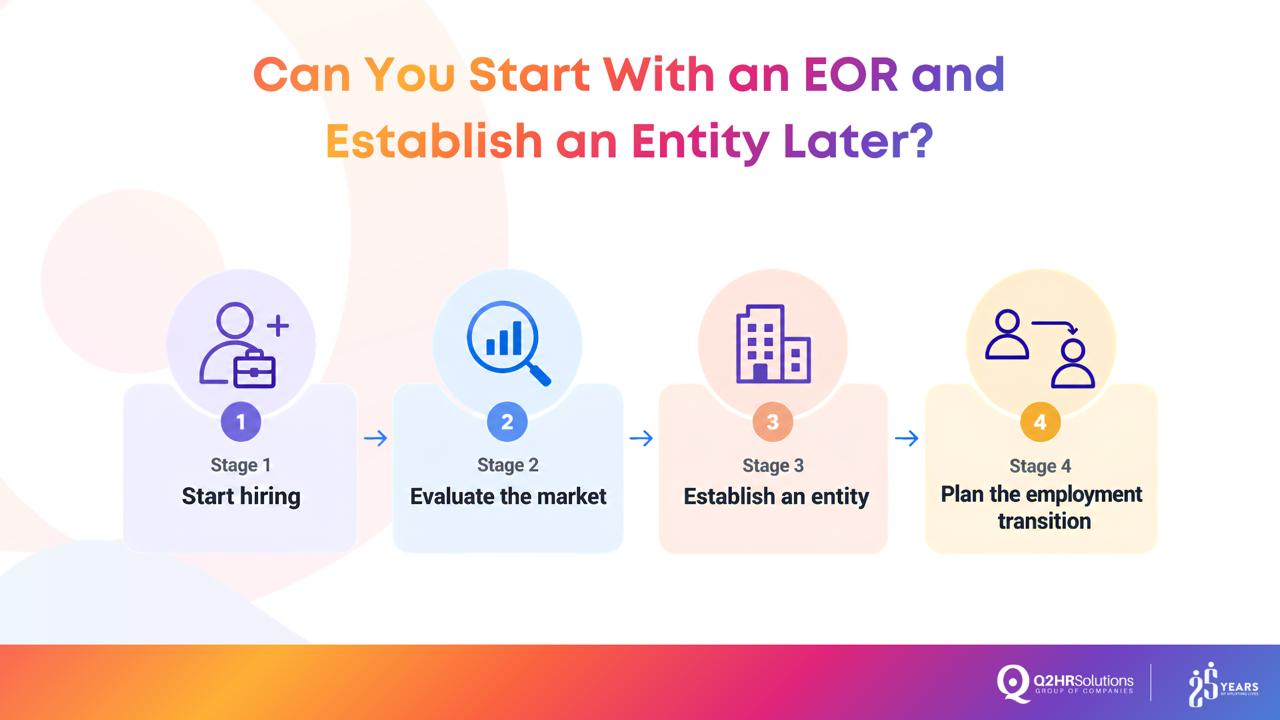
Yes, a company can use an EOR during an initial expansion phase and later establish its own Philippine entity, but the transition needs to be planned carefully.
This can be a practical progression for a growing international business.
The company uses an EOR to establish its initial Philippine workforce.
Over time, the company gains a better understanding of:
If the Philippines becomes a significant operating market, the company can evaluate establishing the appropriate Philippine entity.
This is where careful planning becomes important.
The company may need to review employment agreements, employee and payroll records, accrued benefits, seniority, tax and statutory records, confidentiality and IP agreements, data-processing arrangements, and EOR contract terms.
The transition should not be treated as simply moving employees from one payroll system to another.
Employment relationships, statutory obligations, and applicable labor requirements need to be considered.
The Philippine Labor Code‘s rules concerning security of tenure and termination are particularly relevant where an existing employment relationship is being changed or ended.
For that reason, businesses should obtain appropriate professional advice before implementing a transition.
Employer of record services can be structured for Philippine employment, but the arrangement must comply with applicable labor and contracting rules. Businesses should review the EOR’s legal structure, employment agreements, compliance processes, and allocation of responsibilities before signing.
There is no single government-set price for employer of record services.
EOR fees are commercially determined and can vary according to the provider, employee location, services included, benefits, and other contractual factors.
The more useful calculation is total employment cost:
Salary + employer statutory costs + benefits + EOR service fees + applicable additional charges.
Compare that against the cost of maintaining your own Philippine entity and its HR, payroll, accounting, tax, and compliance infrastructure.
Qualifying companies can complete the corporate-registration portion through the SEC’s OneSEC system, which provides one-day submission and e-registration. Becoming a fully operational employer still requires tax, employer, payroll, accounting, HR, and employment infrastructure.
An EOR can handle payroll administration as part of its employment services, depending on the agreement. Businesses should confirm exactly which payroll and statutory responsibilities are included.
Philippine employees may be entitled to a range of statutory benefits and protections depending on their employment circumstances.
These can include:
Choosing between an employer of record services and setting up your own Philippine entity ultimately comes down to what your company needs today and where you expect the business to go next.
An EOR can be practical for early-stage hiring, market testing, and international expansion, while an entity may make more sense when the Philippines becomes a long-term strategic operation requiring greater direct control.
Neither eliminates the need to understand Philippine employment requirements; the key difference is where the employment infrastructure sits and who manages it.
If you’re considering hiring in the Philippines but aren’t sure whether an EOR or your own entity is the right fit, Q2 HR Solutions can help you evaluate your options and build a compliant, practical hiring strategy.
Ready to build your Philippine team? Contact Q2 HR Solutions to discuss your hiring plans and explore the right employment solution for your business.
______________________________________________________________________________________________________________________________________________________________________________________
Expert Insights By:
Ynel Nazario is a contributor for Q2 HR Solutions and a Public Relations and Strategic Communications professional with 10 years of experience. She writes about human resources, global mobility, business, technology, and socio-economic trends, with a particular interest in translating complex topics into clear, accessible insights for readers.