

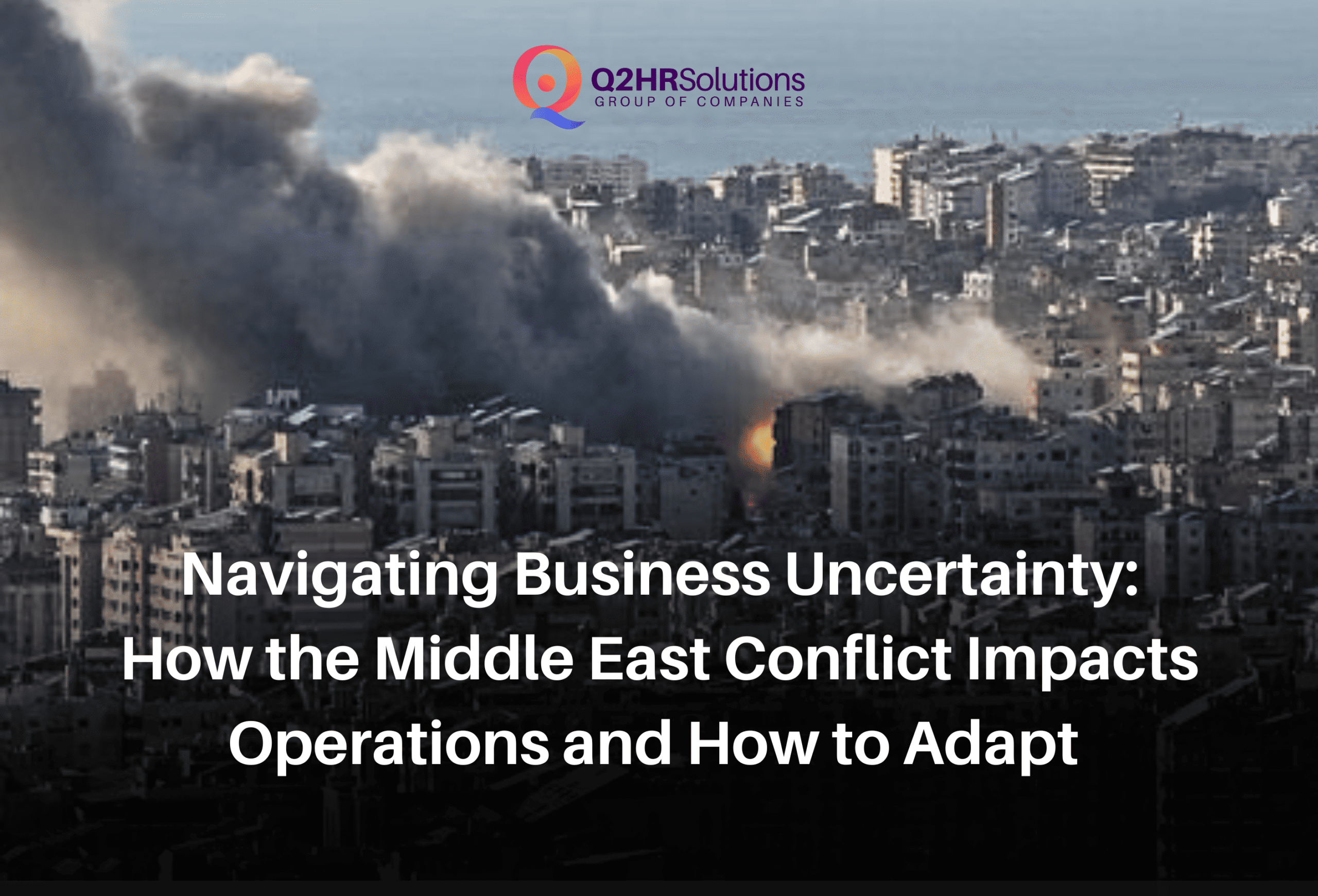
Understanding the Escalation of the Middle East Conflict
With the recent conflicts involving the United States of America and Iran, it’s only natural for business owners, especially those who are affected, to take a little step back and rethink their decisions with regards to the effects of the war on their business operations.
Last February 28, 2026, the United States and Israel launched a joint airstrike attack targeting Iran’s military base, missiles, and nuclear facility. They only have one goal– to prevent Iran’s nuclear program. The conflict did not happen overnight, there was already an ongoing tension between Israel and Iran during 2025 over the same matters until mid‑2025 when Israel launched major airstrikes against Iranian nuclear and military facilities, prompting Iranian missile and drone retaliation.
With the United States showing strong support for Israel, it’s only natural that they join hands with them, which already happened last February, killing Iran’s Supreme Leader Ali Khamenei and other military officials. This dramatically escalated the tensions between countries, causing Iran to retaliate against the United States along with its infrastructures in the region like their military base and embassy. Additionally, Iran and its network of allied groups have expanded the battlefield across Gulf countries like Saudi Arabia, UAE, Qatar, Kuwait, Oman, and Bahrain that host US bases, immediately targeting energy and shipping routes.
Strategic Trade Disruptions and the Strait of Hormuz
Iran has also reportedly closed the Strait of Hormuz and threatened to attack any ships attempting to pass through the strait. According to BBC News, the Strait of Hormuz is considered as one of the world’s most important shipping routes and handles 20% of the world’s oil. With the Strait of Hormuz being closed off, oil prices would soar and could largely hurt the economy of countries.
The conflict has been going on for 2 weeks now, not showing any signs of de-escalation. At least 1,444 people have been killed and 18,551 injured by US-Israeli attacks on Iran since February 28, Iran’s Health Ministry says. The impact of the war is also being felt in other countries like the Philippines, with oil prices reaching almost 100 pesos ($2) per liter, according to the Department of Energy. Government agencies have also ordered a shift to a four-day workweek as oil prices continue to rise while the private sector is urged to look for alternatives that would cater to the well-being of their employees.
With the Strait of Hormuz being closed off, major shipping lines have rerouted, increasing voyage times. Due to this, shipping of oil along with other goods has been severely delayed, causing inventory shortages and higher costs for businesses worldwide.
Economic Impact on Global Businesses and Energy Markets
Several Gulf countries heavily rely on the Strait for the production but with the current supply of disruptions, the cost of oil and energy is continuously rising. According to BBC News, the cost of hiring a supertanker to ship oil from the Middle East to China has almost doubled from last week’s price to a record high of more than $400,000.
Companies or businesses that are dependent on Gulf energy exports, petrochemical feedstocks, or East–West container flows have no choice but to adjust the prices of their products/services as operational and transportation costs continue to rise.
Expanding Conflict Zones and Workforce Safety Concerns
Meanwhile, Gulf countries, specifically Saudi Arabia, UAE, Qatar, Kuwait, Bahrain, and Oman that have US military bases and infrastructures are being targeted by missiles and drones, expanding the battlefield to civilized areas and business hubs. Multinational companies are now implementing safety measures like evacuation planning, temporary closures, and relocation of critical staff away from potential strike zones.
While these measures are important, it’s inevitable that business operations will be disrupted by emergency missile attacks, sudden evacuation, and ongoing war threats. Companies face the dual challenge of protecting their workforce while maintaining operational continuity, as the unpredictability of attacks and logistical bottlenecks increasingly threaten both employee safety and productivity.
Business Risks Arising from the Conflict
Beyond the immediate geopolitical implications, the rising conflict between the United States and Iran also presents multiple operational and financial risks for businesses globally. Companies that rely heavily on Gulf energy exports, regional logistics networks, or cross-border trade routes are particularly vulnerable to sudden disruptions.
Business Adaptation Strategies During Geopolitical Crisis
Given the uncertainty of the current situation between the United States and Iran right now, business owners are forced to adapt if they want their business to see the light of the day. Aside from the operations of their business, there’s a lot of factors that they need to consider including the safety of their employees. How can they protect their people while still preserving enough operational capacity to survive the crisis and rebuild afterward?
One pattern emerging in recent conflicts is that organizations with more flexible workforce structures tend to respond faster and with less disruption. This could be enabling remote work, relocating to safer work locations, or, in some cases, working with third‑party employers who can take on parts of the HR and compliance burden in other jurisdictions.
The Role of Flexible Workforce Models in Crisis Response
In practical terms, some companies are quietly diversifying where critical roles are based, so they are not wholly dependent on a single city, base, or trade corridor. Others are exploring arrangements that allow them to employ people in neighboring or entirely different regions without having to build a full legal and administrative footprint in each market. These structures—like the Employer of Record (EOR) model, can give leaders a way to relocate or add staff in safer countries while maintaining continuity for clients and colleagues on the ground.
Companies that are affected by the ongoing conflict are being asked for dual responsibilities: to protect their people and to preserve the livelihoods that depend on the business continuing to function. This could be done by flexible workforce solutions that can help leaders honor both responsibilities with as much care and humility as the moment demands.
One approach that is also gaining traction is International Staff Augmentation. This staffing model allows companies to temporarily expand or relocate parts of their workforce to safer or more stable locations. Instead of relying solely on employees within high-risk regions, businesses can distribute critical roles across multiple jurisdictions, reducing their exposure to localized disruptions. This strategy enables organizations to maintain productivity while ensuring that essential functions continue even if operations in one location are interrupted.
As the situation between the United States and Iran continues to evolve, the long-term economic consequences remain uncertain. What is becoming increasingly clear, however, is that geopolitical tensions are no longer distant risks for businesses operating globally. From energy markets to workforce safety, companies are being forced to reassess how resilient their operations truly are.
In this environment, organizations that prioritize flexibility, diversified operations, and adaptable workforce strategies may be better positioned to navigate disruption. While no company can fully control geopolitical events, those that plan and build operational resilience will likely be better prepared to withstand the uncertainty that lies ahead.