

As organizations look toward 2026, traditional workforce planning models—linear, static, and role-based—are slowly becoming outdated. The future will be shaped by the convergence of AI maturity, demographic inversion, and a skills-based economy.
Understanding these shifts is essential. Organizations that fail to adapt might struggle with skill shortages, workforce inefficiencies, and low engagement. This article explains the strategic landscape, lays out key planning pillars, and provides actionable frameworks for building a resilient workforce for 2026.
By 2026, organizations will move past the “AI experimentation” phase into full “AI integration.” At the same time, labor shortages in developed economies are expected to become structural rather than cyclical because of aging populations. Recognizing these forces is crucial to designing workforce strategies that are both flexible and future-ready.
Shift: From “AI replacing jobs” to “AI as a teammate.”
Reality: AI agents and co-pilots will take over 30–50% of task-based work in knowledge sectors. Workforce plans must now include “Super workers”—employees orchestrating multiple AI agents, amplifying their output dramatically.
Risk: “Blunt force automation”—removing roles based on expected AI efficiency without redesigning workflows—can cause burnout and operational failure.
Context: In many regions (North America, Europe, parts of Asia), the working-age population is shrinking.
Trend: A “No-Hire, No-Fire” labor market develops, where retaining older workers is essential, but mobility remains low.
Implication: Organizations cannot “hire their way out” of skill gaps. Strategies for 2026 must focus more on internal mobility and reskilling than external hiring.
Workplace: The debate on “Return-to-Office” will evolve into “Connected Ecosystems.” Offices will mainly be used for connection, socialization, and complex collaboration, while deep work remains remote or distributed.
Talent Access: Geographic boundaries for talent will continue to blur, but compliance challenges—like global payroll and taxes—will rise. Employer-of-Record (EOR) strategies will become central in workforce planning.
Considering these emerging trends, organizations must rethink how they structure, deploy, and measure talent. This naturally leads to the three strategic pillars defining workforce planning in 2026.
To respond effectively to these shifts, workforce planning must rest on three essential pillars. Each pillar addresses a different dimension of the evolving work environment, ensuring adaptability and resilience.
Reasoning: Traditional job roles are too rigid for 2026. Breaking roles into tasks and skills provides a more stable foundation.
Example: A “Marketing Manager” role changes too fast to plan for. But a skill like “Data Storytelling” remains a tradeable asset.
Strategy: Build a “Skills Ontology.” Map current skills against future needs, ignoring job titles. This allows flexible deployment of talent across projects.
Shift: Move away from static five-year plans. Adopt a dynamic “Now-Next” approach.
Focus: As machines take over logic and process, human traits become premium. Roles requiring empathy, negotiation, ethics, and complex problem-solving will see wage growth.
Culture: Prevent “Culture Atrophy”—the loss of connection in digital-first organizations—by intentionally creating moments for interaction and collaboration.
With these pillars, organizations can turn strategy into action. The following planning cycle provides a step-by-step approach to operationalizing these principles.
Approach: Evaluate tasks, not only headcount.
Action: Analyze departments and identify tasks that are “High Repetition / Low Empathy.”
Decision Matrix:
Input: Current employee skills (validated by data or assessments, not just self-report).
Forecast: Future skills needed by 2026 (e.g., Prompt Engineering, AI Ethics, Sustainability Reporting).
Output: A “Gap Report” highlighting employees to upskill immediately.
Develop three possible futures for 2026:
Following this cycle, organizations can not only react to disruption but actively shape their workforce for competitive advantage.
Traditional metrics like “Time to Fill” are insufficient. Updated KPIs should reflect capability, agility, and collaboration.
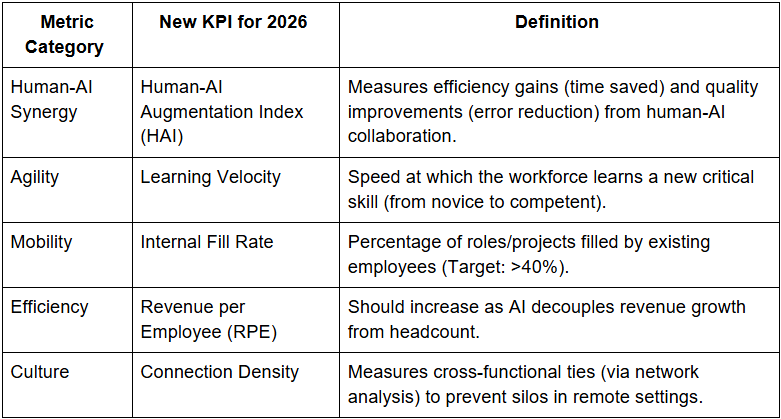
With these KPIs, leaders can track progress and make adjustments to ensure workforce investments deliver measurable value.
Preparing for 2026 requires more than adapting to trends — it demands intentional, future-ready workforce design. As organizations rethink roles, reshape skills, and integrate AI into the heart of work, having the right HR partner becomes essential.
For more than 25 years, Q2 HR Solutions has helped organizations navigate change with strategies grounded in data, technology, and human expertise. We take a holistic approach to workforce transformation, tailoring solutions to each client’s needs — from workforce planning and talent acquisition to HR technology and compliance support.
If your organization is ready to build a workforce that thrives in 2026 and beyond, we’re here to help. Get in touch with us today and let us support both your immediate needs and your long-term goals.
About the Writer
Ferdinand A. A. Limbo, Ferdie for short, is a Management Consultant and Head of Strategic Management at Q2. He has over 28 years of experience achieving winning results in the fields of HR, Facilities Services & Management, Engineering Consultancy, Wholesale – Retail and Manufacturing among others as an Executive. Ferdie attended a graduate program in one of the leading universities in the country and a Mentor at the Asian Institute of Management for three cycles.