

A lot of companies do not start looking at staff augmentation because they want to outsource work right away. Usually, it starts because hiring becomes stressful. Teams get overloaded. Projects slow down. Managers keep interviewing people for months but still cannot fill roles fast enough. At some point, businesses realize that they need help growing without blowing up costs at the same time. Often times, exploring staff augmentation and other staffing services could be the answer.
You can see this happening across the US and Australia now. Companies still want to expand, but local hiring has become expensive and unpredictable. Salaries keep going up. Competition for talent is tough. Even finding one experienced employee can take months. Because of this, more businesses are looking at the Philippines for remote staffing support.
The interesting part is that most companies are no longer looking for “cheap labor.” That idea feels outdated already. What businesses actually want is balance. They want lower costs, but they also want reliable work, good communication, and stable teams. That is where things become tricky because cost and quality do not always move together.
In this article, we’ll talk about how staff augmentation works, why companies use it, the common problems businesses run into, and why the Philippines continues to become a major hiring option for US and Australian companies.
Staff augmentation is a hiring setup where companies bring in outside professionals to support their existing teams. The company still manages the work directly. The remote staff work inside the company’s systems, meetings, and daily tasks. That is one reason many businesses prefer this setup over traditional outsourcing.
For example, a US software company may hire developers from the Philippines through a staff augmentation services provider. An Australian ecommerce company may add remote customer support staff or marketers without opening a full office locally.
The setup feels more flexible. Businesses can grow teams faster without immediately committing to large long-term costs. At the same time, they still keep control over daily work and quality standards.
This model became much more common after remote work became normal. According to Deloitte, many global companies now use hybrid staffing models because businesses need more flexibility while managing labor costs. That shift changed how companies think about hiring.
Traditional hiring still works. The problem is that it became harder to sustain.
In the US, many businesses are dealing with rising labor costs and strong competition for experienced workers. Australian companies face similar problems, especially in tech, marketing, and digital roles.
Hiring also takes longer now. A company can spend months looking for one employee. During that time, projects continue piling up. Existing workers become overloaded. Managers spend more time recruiting than running the business. This creates pressure across the whole company.
Because of this, businesses started looking at staff augmentation as a way to grow teams faster without carrying the full weight of local hiring immediately. The shift is not only about cost-efficiency. A lot of companies simply want more flexibility because growth has become less predictable. Some months are busy. Some are slower. Permanent hiring for every situation does not always make sense anymore.
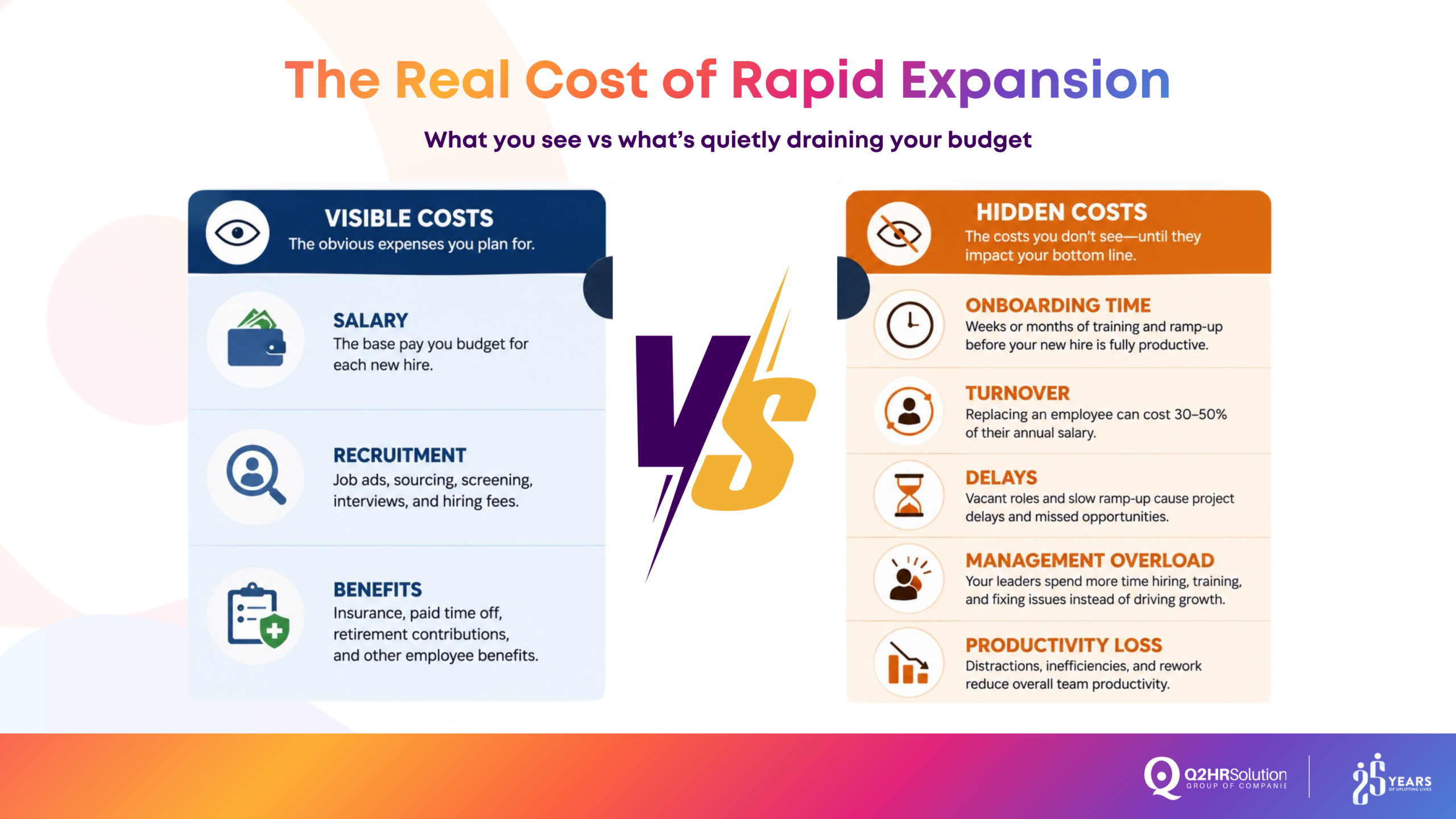
A lot of businesses underestimate how expensive growth can become. Salary is only one part of hiring costs. There are also recruitment fees, onboarding time, equipment, office space, taxes, benefits, training, and employee turnover.
Then there is the hidden cost of delays. When companies cannot hire fast enough, work slows down. Teams become stressed. Client deadlines get missed. Existing employees sometimes leave because workloads become too heavy.
Small problems slowly grow bigger. This is where staffing services usually enter the picture. Companies realize that they need more support quickly, but they also need to control spending carefully. For many US and Australian businesses, hiring in the Philippines helps lower pressure without stopping growth completely. The savings can be significant, but speed is also a major reason companies choose this route.
The Philippines has been part of the global outsourcing industry for decades already.
At first, most companies only used Philippine teams for customer support and call center work. But over time, the talent market grew much wider. Today, businesses hire Filipino professionals for software development, marketing, finance, recruitment, design, ecommerce support, and project management.
English skills are one reason for this growth. According to the EF Education First English Proficiency Index, the Philippines continues to rank among the strongest English-speaking countries in Asia. Communication matters more than companies expect. A remote employee may be highly skilled, but if communication is poor, projects become messy very quickly. Instructions get misunderstood. Revisions increase. Managers become frustrated.
Filipino professionals are also familiar with Western work culture. That helps US and Australian businesses adjust more smoothly when using staff augmentation models. Time zone overlap helps too. Australian companies usually work almost in real time with Philippine teams. US businesses often use the time difference to keep work moving even after local office hours end.
No. Lower cost does not automatically mean lower quality.
But companies still run into quality problems when they focus too heavily on finding the cheapest option available. This happens often. A business wants to reduce hiring costs fast, so they rush the process. They hire too quickly or choose the lowest-cost provider. At first, the setup looks successful because payroll spending drops.
Then problems appear later. Work quality becomes inconsistent. Deadlines get missed. Managers spend more time fixing mistakes. Employees leave after only a few months. Eventually, the company starts hiring all over again. This is why experienced providers usually focus more on long-term fit instead of simply filling roles quickly.
Good hiring still costs money. Strong developers, marketers, analysts, recruiters, and support staff in the Philippines are in demand now. Companies trying to hire at extremely low rates often struggle with retention and quality issues later on. The businesses that succeed usually focus on value instead of just low cost.
Communication issues are one of the biggest complaints companies have about remote staffing. Sometimes the issue is language. But honestly, most of the time the real problem is unclear instructions.
Remote teams rely heavily on clear communication because they cannot walk over to someone’s desk for quick clarification. If workflows are messy internally, remote work usually exposes those problems even more.
This is why businesses using staffing services often realize they need better documentation and clearer systems. The staffing model itself is usually not the issue. The company setup often is.
Some companies treat augmented staff like temporary workers instead of real team members. That usually creates problems later. Employees who feel disconnected from the company tend to leave faster. Motivation drops. Work quality slowly weakens. Teams become unstable.
This matters in the Philippines where workplace relationships are still important culturally. Companies that include remote staff in meetings, planning sessions, and team discussions usually build stronger long-term teams. Good staff augmentation works better when people feel included.
A lot of businesses expect offshore staffing to be extremely cheap. That expectation creates issues immediately. Experienced Filipino professionals are competitive talent now. Skilled developers, designers, finance specialists, and marketers are not easy to keep if salaries are far below market rates.
Companies that focus too much on low cost often end up restarting recruitment repeatedly. And repeated hiring becomes expensive too. This is one reason experienced staff augmentation services providers push clients toward more realistic salary expectations.
Remote staffing cannot fix weak leadership. If a company already has messy workflows, poor communication, or unclear expectations internally, remote teams will struggle even more.
Some businesses hire remote staff before building proper onboarding systems or clear reporting structures. Then they get frustrated when work becomes inconsistent. Good remote teams still need strong management. That part never disappears.
Some industries adapt to staff augmentation more naturally than others.
Technology companies were among the first to adopt this setup because software work already happens online. Remote collaboration tools were already part of daily operations for many developers and product teams. Marketing teams also work well remotely. Content writing, SEO, graphic design, paid ads, and social media management can usually run smoothly from different locations once workflows are clear.
Recruitment companies are using staffing services more often too. Many agencies now hire offshore recruiters and coordinators because local hiring costs became difficult to sustain long term. Finance support, ecommerce operations, and customer service teams also fit this model well because many of their tasks are process-based and digital already. The more structured the work is, the easier remote staffing usually becomes.
Some businesses hire remote staff before building proper systems internally. Processes are still unclear. Roles overlap. Managers are overloaded already. Then several remote employees suddenly get added into the mix.
That usually creates confusion. Remote teams need structure because communication happens differently online. Without clear systems, small issues spread very quickly. Some companies blame different workforce models for these problems, but the real issue often starts inside the business itself.
Hiring more people cannot fix bad strategy. Some companies expect offshore staffing to solve revenue problems, leadership issues, or poor company direction. Naturally, that rarely works.
Staff augmentation helps businesses increase capacity. It does not replace planning or leadership. The companies that succeed usually understand this early.
Some businesses constantly replace remote staff in search of lower costs. At first, that sounds financially smart. But every replacement means new onboarding, retraining, and adjustment periods. Productivity slows down every single time. Over time, instability becomes expensive. Companies that build long-term remote teams usually get much better results.
People sometimes confuse these two models because both involve outside teams. But they work very differently.
In traditional outsourcing, a company usually hands over an entire function to another provider. The vendor manages the team, workflows, and daily operations.
With staff augmentation, the company still manages the people directly. The remote staff work closely with the company’s internal teams and systems. Managers stay involved in projects, deadlines, and communication. That setup gives businesses more visibility and flexibility. But it also means companies still need good management internally.
Some businesses prefer outsourcing because they want less involvement. Others prefer staffing services because they want stronger control over work quality. The best setup usually depends on the company itself.
US companies often focus heavily on speed and growth. Many startups and tech companies are under pressure to scale quickly. Because of this, they usually look for staffing solutions that can expand teams fast.
Australian businesses sometimes move differently. Many Australian companies focus more on long-term stability and employee retention. Australia’s labor market is smaller, so finding experienced workers locally can become difficult over time.
Both markets still face the same problem though. Hiring locally became more expensive and harder to sustain. That is why both US and Australian businesses continue exploring staff augmentation and Philippine-based remote teams.
Lower labor costs are only part of the reason. Businesses also like the flexibility, communication skills, and adaptability of Filipino professionals. Many Filipino workers are already experienced in supporting Western businesses. That makes onboarding easier because employees are already familiar with US and Australian work styles.
The country also has a large young workforce. According to the Philippine Statistics Authority, the Philippines continues to maintain a strong working-age population compared to many countries dealing with labor shortages.
Another reason companies stay in the Philippines is reliability. The outsourcing industry there has been operating for decades already. Businesses can find experienced workers, established providers, and mature support systems more easily compared to newer outsourcing markets.
That helps companies feel more confident using long term.
Remote staffing sounds simple at first. Then companies realize they suddenly need better systems. Managers need clearer instructions. Teams need better documentation. Communication becomes more important because people are not physically together.
Small misunderstandings can create larger delays online.
The businesses that succeed with staff augmentation usually focus heavily on clarity and consistency. Employees need to understand priorities, deadlines, responsibilities, and reporting structures clearly.
Companies that already used hybrid or remote work setups before usually adjust faster. Businesses that relied heavily on office-based communication often struggle more at the beginning because remote work exposes weak processes quickly. The problem is rarely remote staffing itself. Most of the time, the issue is preparation.
Cheap hiring can become expensive later. At first, businesses feel happy because salary costs drop quickly. But over time, other problems start appearing. Managers spend more time correcting mistakes. Employees leave frequently. Clients ask for revisions more often. Recruitment starts over again and again.
Those costs slowly add up.
This is especially common when companies choose staff augmentation services providers based only on pricing. Strong providers usually invest more in recruitment, employee retention, compliance, and support systems. Their pricing may be higher, but team stability is often much better too.
For many companies, paying slightly more upfront saves far more money later. That is the part businesses sometimes realize too late.
The companies getting the best results from staff augmentation usually stop treating remote staff as temporary support. Instead, they build long-term teams. That changes the relationship completely.
Employees become more familiar with company goals, systems, and clients over time. Communication improves naturally. Productivity becomes more stable. Remote teams stop feeling “external.”
Many Filipino professionals now stay with international companies for years because businesses are investing more in long-term remote work relationships. This setup gives US and Australian companies more flexibility while keeping costs manageable. That balance is one reason why staffing services continue to grow.
Most companies compare providers based on price first. That makes sense at the beginning. One of the biggest reasons businesses explore staff augmentation is because hiring locally has become expensive. Naturally, companies want to lower costs while still growing their teams.
But after working with remote teams for a while, businesses usually realize there is more to consider than pricing alone.
Communication quality becomes more important. Employee retention starts affecting daily operations. Recruitment standards become easier to notice over time. Small operational issues that seemed manageable at first can slowly affect productivity, deadlines, and team stability later on. This is why experienced companies usually evaluate staff augmentation services providers more carefully after their first few hires. But how do companies ensure that they are partnering with the right provider?
A lot of providers can send resumes quickly. The real question is how carefully they evaluate candidates before endorsing them to clients.
Some providers focus heavily on speed because businesses want immediate results. But rushing recruitment often creates problems later. Candidates may look strong on paper but struggle with communication, teamwork, or adapting to the company’s workflow once daily operations begin.
Good services providers usually spend more time screening candidates properly. Technical skills matter, of course, but communication style, reliability, attitude, and culture fit also become important in remote work setups.
Companies usually notice the difference later when teams become more stable and easier to manage.
Communication problems usually start small. Instructions get misunderstood. Tasks need several revisions. Meetings become longer because expectations were unclear from the start. Over time, those small delays slowly affect the entire workflow.
Because of this, businesses should pay attention to how providers support communication after hiring. Strong staff augmentation providers usually help clients build smoother onboarding processes, clearer reporting structures, and better team coordination. Some providers stay actively involved even after employees are hired, while others disappear after recruitment is finished. That ongoing support often makes a big difference in remote team stability.
Many companies focus heavily on recruitment speed at first. Later on, they realize employee retention matters just as much.
Replacing remote employees repeatedly creates hidden costs that businesses sometimes overlook. Productivity slows during onboarding periods. Managers spend extra time retraining new staff. Team consistency becomes harder to maintain. This is why businesses should ask providers about retention rates and employee support systems.
Experienced providers usually invest more heavily in employee engagement, career growth, management support, and workplace culture because stable teams create better long-term results for clients too.
Long-term employees naturally become more familiar with systems, processes, and expectations over time. That consistency improves work quality.
Some providers only focus on recruitment. Others help businesses scale properly over time.
That difference becomes important once companies start growing larger remote teams. Businesses may eventually need support with onboarding systems, attendance tracking, equipment setup, workforce planning, or team management processes. The best staff augmentation providers usually help companies build smoother long-term operations instead of simply filling vacancies.
This becomes especially valuable for US and Australian companies entering the Philippines for the first time. Local labor practices, communication styles, and work culture may feel unfamiliar initially. Experienced providers can help businesses avoid common operational mistakes early.
Low pricing can look attractive during early discussions. But businesses sometimes discover bigger problems later when work quality becomes inconsistent or employee turnover starts increasing.
Some low-cost providers cut corners during recruitment or overload employees with unrealistic workloads. Eventually, those problems affect the client’s operations too. This is why companies should evaluate overall value instead of focusing only on pricing.
In many cases, businesses end up spending more fixing operational issues later than they would have spent choosing a stronger service provider from the start. The cheapest option does not always become the most cost-effective long term.
The best staff augmentation partnerships usually stop feeling transactional after a while. Remote employees become part of daily operations. Communication becomes smoother. Teams develop stronger trust and consistency over time.
That kind of setup rarely happens through recruitment speed alone. It usually comes from strong hiring standards, stable management support, healthy employee relationships, and clear communication behind the scenes. Companies trying to scale long term often realize that the provider itself plays a major role in whether remote staffing becomes sustainable or stressful.
Yes, in many cases, staff augmentation costs less than hiring locally in the US or Australia. However, companies still need to balance savings with work quality and employee retention.
Businesses use staff augmentation services because they want to grow teams faster, lower hiring pressure, and maintain flexibility without increasing long-term overhead too quickly.
The Philippines has strong English skills, experienced remote workers, competitive labor costs, and a long history in outsourcing and remote support industries.
Not automatically. Most quality issues happen because of weak hiring processes, unclear communication, or unrealistic expectations from companies.
Yes. Many businesses now use staff augmentation services as part of their long-term growth strategy instead of temporary support only.
A lot of companies used to think offshore hiring was only about cutting costs. That mindset changed over the years. Businesses now care just as much about flexibility, stability, communication, and team quality. Rising hiring costs in the US and Australia pushed many companies to rethink how they build teams, especially during fast growth periods.
That is one reason the Philippines continues attracting global businesses. The country offers more than lower labor costs. Companies also gain access to experienced professionals, strong English communication, and a mature remote work industry that has been operating for decades already.
Of course, staff augmentation is not perfect. Poor planning, weak management, and unrealistic expectations can still create problems. Cheap hiring shortcuts can also backfire quickly. But when companies approach it properly, this workforce model can help businesses grow faster without losing control over quality and daily operations.
If your company is currently exploring remote hiring or looking at expansion options in the Philippines, reach out to us and our team at Q2 HR Solutions can help you determine what kind of team setup makes sense for your goals and growth plans.