

An empty chair doesn’t look like much. It just sits there, quiet, waiting for someone to show up and fill it. But the longer it stays empty, the more it quietly costs you. It starts with a missed deadline here, an overworked team there, a project that keeps slipping because nobody owns it yet. That slow drip is the part of hiring most businesses forget to budget for, and it’s a big reason so many have started leaning on recruitment companies in the Philippines instead of carrying the whole load alone.
Here’s the thing, most companies don’t mess hiring because they’re careless. They fumble it because hiring quietly turned into its own full-time skill while everyone was busy running the actual business. Sourcing, screening, reading people correctly, then moving fast enough not to lose the good ones, that’s a lot to pull off on the side. Do it halfway and you usually feel it months later, in the hires that didn’t quite work out. That’s part of why recruitment firms in the Philippines have gone from a backup option to a normal line in the plan.
Hiring used to feel like something you could squeeze between other tasks. Post a job, wait for résumés, pick someone. It rarely works that cleanly anymore. In this article, we’ll walk through the top business challenges that keep showing up for local companies and how the right recruitment partner actually helps you get past them, not in theory, but in the messy, real way hiring tends to happen.
The short answer, there are plenty of people looking for work, just not enough of the right people for the roles you’re trying to fill. The Philippine Statistics Authority pegged unemployment at around 5% in early 2026, with underemployment closer to 12%. The problem isn’t a shortage of bodies, it’s a mismatch between the skills companies need and the skills that are actually easy to find.
And that gap isn’t only local. Talent Shortage Survey found 77% of employers across Asia-Pacific struggling to fill roles, way up from 45% a decade earlier. SHRM also reported much the same on its side, with 83% of recruiters saying the shortage has made hiring genuinely harder. Because of all this, more businesses now treat recruitment as something to partner on, and recruitment companies in the Philippines have stepped into that gap.
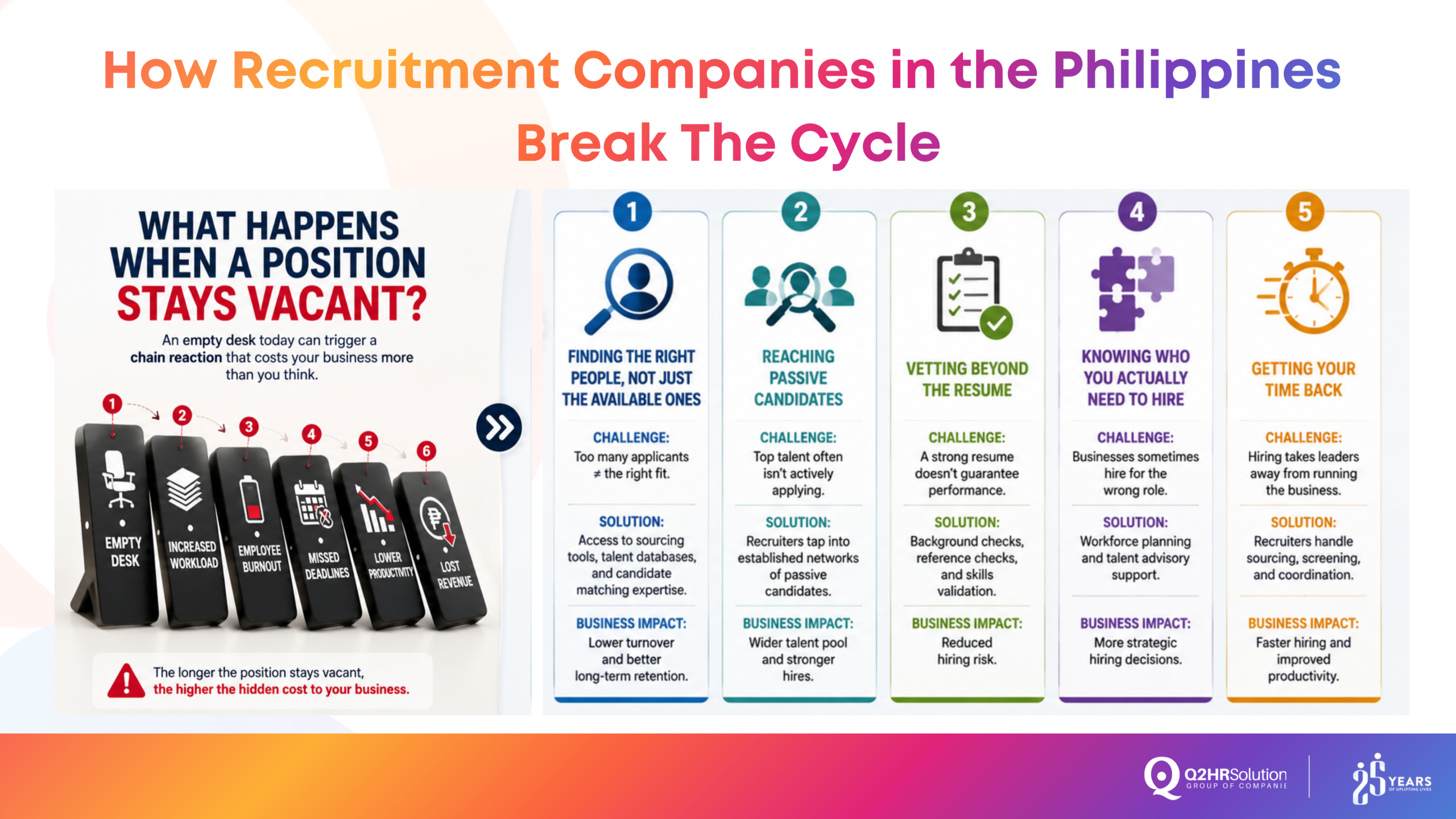
None of these challenges are new, exactly. They’ve just gotten heavier over the years. Here’s where an outside recruitment team tends to earn its keep.
There’s a real difference between someone who can do the job and someone who actually fits it. Recruitment companies in the Philippines spend their whole day on that distinction. They’ve got the tools, the analytics, and frankly the practice at reading between the lines of a résumé to spot who’ll stick around.
What you get from that is fewer wrong hires. And wrong hires are pricey. Industry estimates put the cost of turnover at 150% to 200% of the role’s annual salary once you add up lost time and rehiring. Dodging even one of those pays for a lot.
You usually can’t on your own, but a recruiter can. The strongest fit for your role is often someone already employed and content, not the person refreshing job boards at midnight. These are passive candidates, and they don’t answer job posts because they simply aren’t looking.
Recruitment companies in the Philippines keep warm networks of exactly these people, built up over years of staying in touch. So instead of fishing in the small pond of active applicants, you reach a much wider pool including the ones your competitors haven’t even thought to call.
Let’s be honest, anybody can look great on paper. The harder question is whether the person behind the document is who they claim to be, and a good recruitment partner digs into that long before you shake a hand.
Background checks, reference calls, and skills validation are part of the slow, careful work that most internal teams just don’t have the hours for. Handing it over to a trusted recruitment partner means you bring in people you can actually trust, which counts for a lot once they’re inside your operation.
Sometimes the real problem isn’t filling a role, it’s not being sure which role to fill. An outside set of eyes helps here, because recruiters can look at your team without the blind spots that come from living inside it every day.
They tend to spot where the gaps really are. From who you need, which skills are missing, and when to bring those people in. That kind of read is tough to get from the inside, and it saves you from hiring for the wrong thing entirely.
Hiring eats hours. Screening, scheduling, chasing down follow-ups, it pulls leaders away from running the actual business, which is the thing they’re meant to be doing in the first place. Hand the heavy lifting to a recruitment team and that time comes back to you.
This is where outsourcing quietly pays off. Companies that use recruitment process outsourcing report cutting their time-to-hire by roughly 40%, according to industry data compiled by Genius, and the recruitment outsourcing market is growing fast for the same reason. Technavio projects it to expand by more than $16 billion between 2025 and 2030. People are clearly noticing it works.
Not at all. Smaller and mid-sized businesses often get the most out of them. They rarely have a full in-house talent team, so a recruitment partner hands them that capability without the cost of building a whole department.
It also flexes with you. You can lean on them hard during a hiring push and ease off when things go quiet, which is a lot harder to manage with permanent headcount.
An RPO works like an extension of your own HR team, not a one-off vendor. A traditional agency usually fills a single role and moves on, while recruitment process outsourcing takes over part or all of your hiring on an ongoing basis.
That difference really matters if you’re hiring at volume or hiring continuously. You get consistency in how candidates are sourced and assessed, instead of starting from zero every single time.
It depends on the role, but it’s usually faster than going it alone. Because recruitment firms in the Philippines already have the networks and screening systems in place, much of the early legwork is done before you’d even finish writing the job post.
For senior or hard-to-fill roles it can still take a while, since the right fit is worth the wait. But for most positions, partnering noticeably shortens the time you spend waiting.
For most, yes, especially once you weigh it against the cost of a bad hire or a seat sitting empty for months. The fee you pay recruitment companies in the Philippines often looks small next to what an unfilled or mis-filled role quietly drains from the business.
So it’s less an added expense and more a trade-off. You spend a little to sidestep the bigger, hidden losses that come from getting hiring wrong, and recruitment firms in the Philippines tend to frame it exactly that way.
Hiring was never really about filling seats. It’s about keeping the business moving without burning out the people already in it. That’s the thread running through all five of these challenges, and it’s why working with recruitment companies in the Philippines has shifted from a nice-to-have into something a lot of local businesses now simply plan for.
That’s the space Q2 HR Solutions works in. The challenges up top, from finding the right fit, reaching people who aren’t job-hunting, vetting properly, to freeing your team from the hiring grind, perfectly lines up with what we do day to day. Q2 HR provides end-to-end recruitment process outsourcing, executive search for the tougher roles and background screening so companies know exactly who you’re bringing in. The point isn’t to hand you a stack of résumés and disappear. It is to take the parts of hiring that slow you down off your plate.
So if your team is stretched thin and the open roles keep stacking up, it’s worth talking it through with people who do this full-time. Reach out to our team of experts and we’d be glad to help you figure out what your hiring actually needs, with no pressure either way.