

It usually starts in a very ordinary moment inside a growing business. A team looks at the workload, and something just doesn’t add up. Too much work, but not enough people. Deadlines start slipping a bit, and hiring suddenly becomes urgent, but internal recruitment moves slower than the pace of the work itself. This is often where staffing services come into the picture. Not as a big strategic shift at first, but as a practical response to pressure building inside day-to-day operations.
In simple terms, this staffing model helps businesses fill roles faster by handling parts of the hiring process that normally take time. The process includes sourcing candidates, screening applicants, and presenting shortlisted talent.
But as businesses continue to grow, especially across borders, the conversation doesn’t always stop at hiring. For companies expanding into new markets without setting up a legal entity right away, models like Employer of Record (EOR) start to become part of the equation. It’s a different layer of support that goes beyond recruitment, helping businesses legally employ talent in other countries while staying focused on operations.
In this article, we’ll discuss how staffing services work in Australia, how recruitment and labour hire differ, and how the same logic extends into international hiring through partners like Q2 HR Solutions.
Staffing services refer to companies that help employers find and place workers based on specific job requirements. Instead of businesses handling everything internally, they outsource parts of the hiring process such as sourcing, screening, and candidate matching.
In many cases, this acts as a bridge between employers and job seekers. Staffing companies do not just forward resumes. They actively interpret job requirements, filter candidates, and present only those who are likely to fit both the role and the workplace.
Over time, staffing solutions have expanded into multiple forms of employment support, including permanent recruitment, temporary staffing, contract roles, and labour hire arrangements. Each of these serves a different type of business need, especially when workforce demand becomes unpredictable.
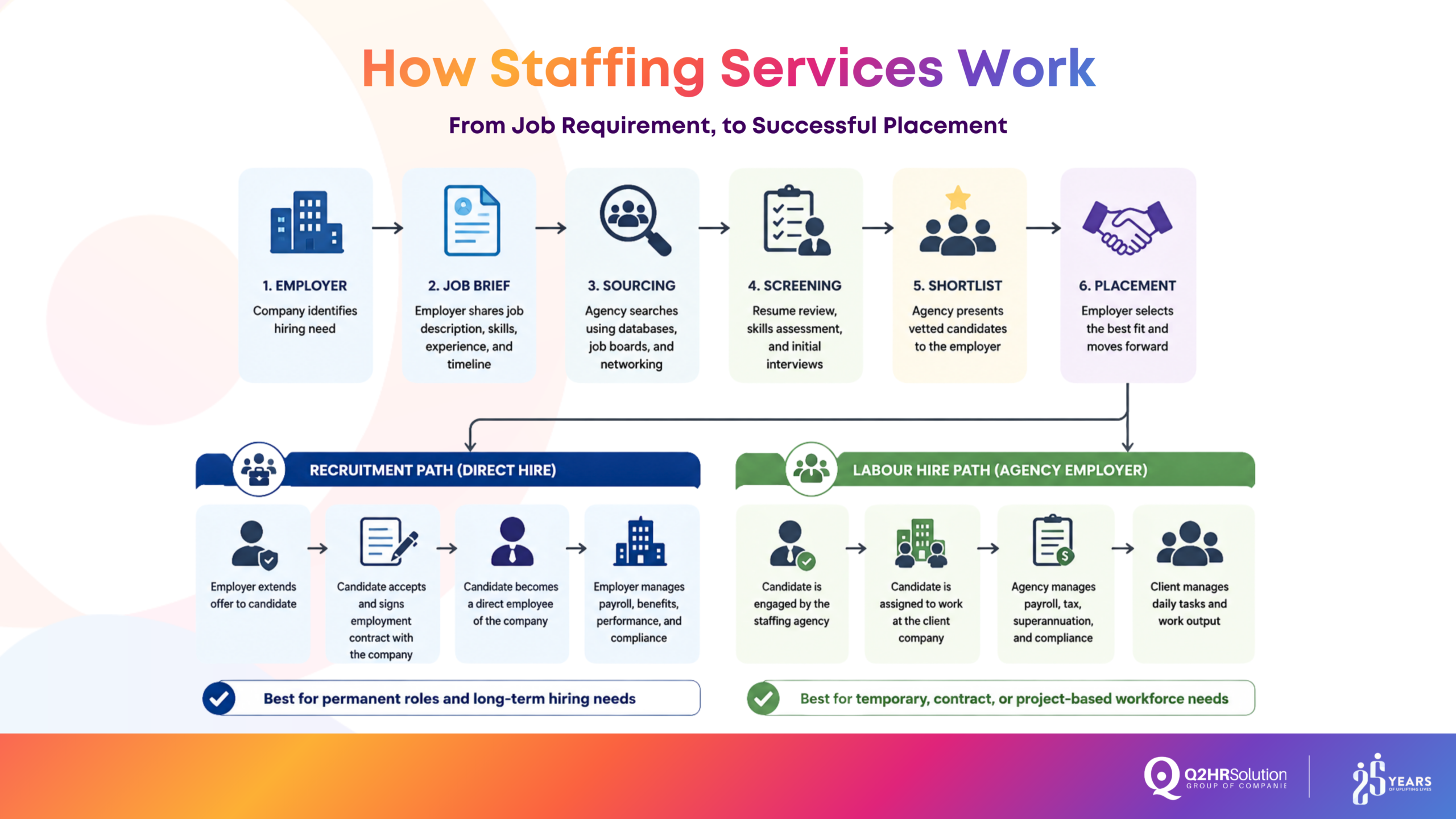
At a practical level, staffing services begin when a company defines a role it cannot fill internally. This usually includes details like skills required, expected experience, salary range, and urgency of hire. From there, the agency translates that requirement into a search strategy.
Most staffing and recruitment solutions rely on a mix of talent databases, job advertising, and direct outreach to passive candidates. Passive candidates are particularly valuable because many experienced professionals are not actively applying for jobs but may still be open to better opportunities.
What makes this stage critical is not just generating applicants, but narrowing them down early so employers are not overwhelmed with unsuitable profiles. In practice, effective staffing is less about sending large numbers of resumes and more about improving hiring precision. The better the early filtering process, the lower the likelihood of wasted interviews and delayed hiring decisions.
Before any candidate reaches the employer, the partner agencies conduct screening through CV reviews, interviews, and sometimes technical assessments. This step often determines the overall quality of the hiring outcome because it filters out mismatches before they reach decision-makers.
Many companies underestimate how costly poor hiring decisions can become. Research from Society for Human Resource Management has previously highlighted that a bad hire can cost several times the employee’s salary once productivity loss, rehiring, onboarding, and turnover costs are considered. Because of this, screening is not just an administrative step, it directly impacts operational stability and hiring ROI.
Once candidates are shortlisted, employers review and select who they want to move forward with. Depending on the model, the candidate is either hired directly or placed under agency employment. This is where staffing solutions split into recruitment or labour hire structures.
This process is also valuable for businesses hiring at scale, where managing dozens or even hundreds of applicants internally can slow down operations significantly. Instead of handling every administrative step manually, companies can focus more on evaluating final candidates and making strategic hiring decisions.
Recruitment is the more traditional form of staffing services where the candidate becomes a direct employee of the company. The agency’s role is to find, assess, and recommend the right fit, while the employer takes over employment responsibility.
This model is commonly used for permanent roles, leadership positions, and specialized skills. The outcome tends to focus on long-term alignment rather than short-term coverage. However, services under recruitment can take longer and usually involve higher upfront fees compared to other models.
Labour hire works differently because the agency becomes the legal employer of the worker. The worker is then assigned to a client company to perform the role while the agency manages payroll, tax, superannuation, and compliance obligations.
This form of staffing model is widely used in industries like construction, logistics, manufacturing, and hospitality where workforce demand changes quickly. It allows businesses to scale up or down without long hiring cycles.
The trade-off is that employers have slightly less direct control over the employment relationship since the agency remains the official employer.
One of the most common reasons companies use staffing services is speed. Agencies already maintain active talent pools, which reduces the time it takes to fill roles compared to traditional hiring.
This becomes especially important in competitive industries where delays in hiring can directly affect productivity, revenue, or customer delivery timelines. In fast-moving sectors, losing qualified candidates due to slow hiring processes has become increasingly common.
Hiring involves far more than interviewing candidates. Internal teams often spend significant time on resume screening, interview scheduling, salary coordination, onboarding documentation, and compliance checks.
Recruitment companies take over much of this administrative workload, allowing HR and leadership teams to focus on strategic priorities such as workforce planning, employee engagement, and organizational development.
Because candidates go through multiple layers of screening before endorsement, businesses often receive more qualified and better-aligned applicants. This reduces the likelihood of poor hiring decisions and improves long-term retention outcomes.
In many cases, the value of staffing services is not just filling vacancies faster, but improving the overall quality and consistency of hires over time.
Many businesses also rely on flexible workforce services when demand is inconsistent or difficult to predict. Instead of committing immediately to permanent hires, companies can adjust workforce size based on current operational requirements.
As workforce models continue shifting globally, flexibility has become one of the primary reasons organizations invest in staffing partnerships rather than relying entirely on traditional recruitment methods.
Recruitment is usually the better choice when businesses are building permanent teams, strengthening internal culture, or hiring for leadership and highly strategic positions. These are roles where long-term alignment matters far more than immediate availability.
For businesses focused on stability, recruitment-based staffing services generally provide stronger long-term workforce outcomes compared to short-term labour hire arrangements.
Specialist and senior-level positions usually require deeper evaluation processes, multiple stakeholder interviews, and more detailed competency assessments. In these situations, flexible staffing services through recruitment provide stronger long-term value because the focus is on precision and fit rather than hiring speed alone.
Executive, technical, and niche roles often carry greater operational impact, which means hiring mistakes become significantly more expensive. A rushed placement may solve an immediate vacancy but create long-term performance and retention issues later.
Many businesses using staffing and recruitment services locally eventually look at offshore expansion, especially in the Philippines where talent is strong and cost efficiency is attractive. The challenge is not hiring talent. The challenge is employment structure.
You can find great Filipino professionals, but the questions appear quickly. Who is the legal employer? How do payroll and compliance work? Do you need to register a company locally?
This is where Employer of Record (EOR) solutions extend the idea of staffing solutions into international hiring. Instead of setting up a local entity, a company partners with an EOR provider who becomes the legal employer while the business manages day-to-day work.
It works in a similar way to labour hire, but across borders.
Staffing services are solutions that help businesses hire employees through recruitment or labour hire depending on the role and urgency.
They reduce hiring complexity and connect businesses to EOR solutions that allow offshore hiring without setting up a local entity.
Recruitment leads to direct employment, while labour hire involves agency employment with workers assigned to client companies.
Yes, many small businesses use staffing services to save time and reduce the cost of building internal recruitment teams.
EOR extends the same concept globally by handling legal employment while the business manages work output.
At its core, staffing services are about making hiring more flexible, faster, and less operationally heavy. Whether through recruitment or labour hire, businesses use these models to adapt to changing workforce needs without slowing down growth.
But as companies expand to a new market, especially into the Philippines, the same challenge appears again in a different form. Hiring is no longer just about finding talent. It becomes about managing legal structure and compliance across borders.
This is where EOR solutions naturally extend the role of staffing solutions, giving companies a way to build offshore teams without setting up a local entity. For businesses exploring expansion into the Philippines, Q2 HR Solutions can serve as an EOR partner that handles employment, compliance, and onboarding while you focus on building and managing your team.
If you’re looking at offshore hiring or scaling your workforce, feel free to reach out to us and explore how we can support your setup in the Philippines.