

A lot of US companies start their expansion plans with a simple assumption. They think the hardest part will be finding talent. But once they begin hiring overseas, companies realize that the bigger challenge is building the operation itself. Setting up teams, creating local processes, managing compliance, and establishing leadership structures often take far more effort than expected. That’s usually when the conversation shifts from finding people to figuring out how the operation itself will be built, which is where build own transfer enters the picture.
The idea isn’t entirely new. In many ways, it can be viewed as a modern variation of the traditional Build Operate Transfer approach. Both models help companies establish operations in a new market with support from a local partner. The difference is that build own transfer places greater emphasis on client involvement from the beginning. Instead of waiting until later stages to take ownership and control, companies participate more closely as the operation is being built, with the expectation that it will eventually become a direct extension of their business.
For companies expanding into the Philippines, that distinction matters. Many want local expertise to help with recruitment, compliance, and operational setup, but they also want visibility into how teams are being built and managed. In this article, we’ll break down what build own transfer is and why some companies see it as a natural evolution of the traditional BOT concept. Nothing too technical, just a practical look at how businesses use these arrangements when building teams and operations in markets like the Philippines.
A build own transfer arrangement is a business expansion model where a local partner helps establish an operation on behalf of a company, with the expectation that the company will ultimately take full control of that operation.
In practical terms, the partner may recruit employees, establish infrastructure, support compliance, and help create operational processes. The client company remains closely involved throughout the process because the goal is to build something that will eventually function as part of its own organization.
Think of it like hiring a contractor to help build a house that you intend to live in. The contractor brings expertise, labor, and project management, but the house is being built for you from the beginning.
That comparison isn’t perfect, but it captures the basic idea. The local partner helps create the foundation while the client gradually prepares to assume full ownership and management responsibilities.
In many ways, yes. The rise of this modern approach reflects changes in how businesses think about global expansion.
Before, many companies were comfortable giving providers substantial operational responsibility while overseas operations were being established. That arrangement worked well because communication across countries was often slower and collaboration tools were more limited.
Today, the situation looks different.
Remote work technologies, cloud-based systems, and global collaboration tools make it easier for leadership teams to stay involved regardless of location. Because of this, many organizations want earlier visibility into hiring decisions, operational processes, and team development.
According to research from McKinsey & Company, remote collaboration and distributed workforce models have become significantly more common across industries, reshaping how organizations manage international teams.
As a result, some providers began offering structures that allow clients to become more integrated from day one. Rather than waiting for a later handover, companies can participate more actively while still benefiting from local expertise. This is why many industry observers describe this arrangement as a natural progression from Build Operate Transfer rather than a complete replacement.
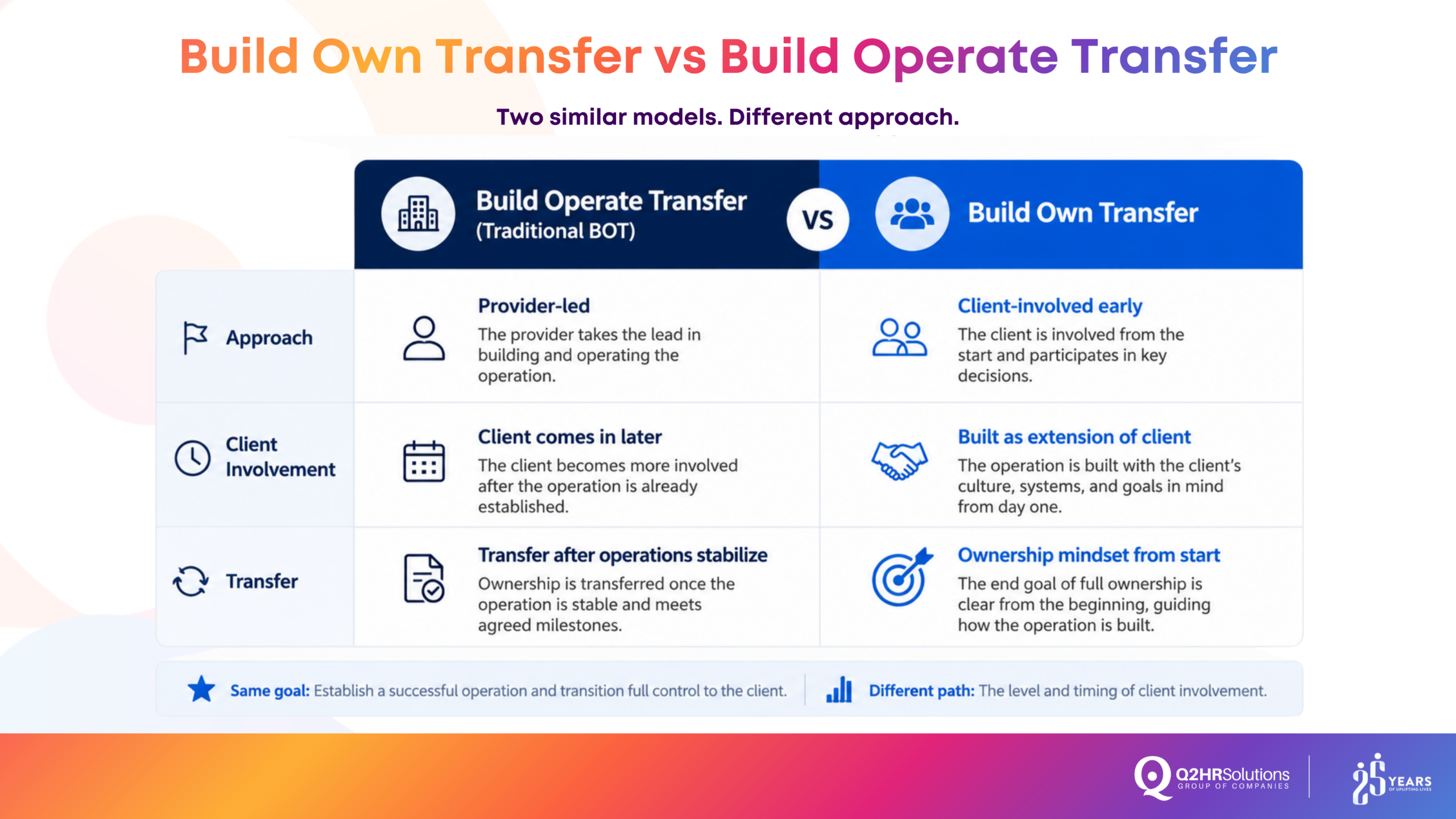
In a traditional Build Operate Transfer arrangement, the provider typically takes a larger role in operating the business during the early stages.
The provider helps build the operation, manages day-to-day activities, and eventually transfers the operation to the client once certain milestones have been reached.
A build own transfer model often involves earlier client integration. The operation is built with the expectation that it will become a direct extension of the client’s business, which leads to greater involvement from the client throughout the process.
The distinction is often about degree rather than category. Both models share similar goals. One simply places more emphasis on client ownership and integration from the beginning.
A build own transfer agreement serves as the framework that governs the relationship between the client company and the local partner. The agreement typically outlines responsibilities during the build phase, expectations for operational support, ownership arrangements, compliance obligations, and transfer conditions.
Without clear documentation, confusion can develop later in the relationship.
A strong agreement also helps both parties align expectations from the beginning. Recruitment responsibilities, reporting structures, intellectual property protections, and transition timelines are often addressed in detail. As the operation grows, this model becomes increasingly important because it provides clarity on how and when responsibilities shift from one party to another.
Like any expansion model, there are practical realities that companies need to acknowledge.
One challenge involves maintaining alignment between the client and the local partner. Even when both sides share the same objectives, differences in expectations can emerge around hiring, operational standards, or growth timelines.
Knowledge transfer can also become a major consideration. The transition phase only works smoothly when information, processes, and leadership responsibilities are documented effectively. Otherwise, the client may inherit an operation without fully understanding how it functions.
This is one reason many organizations spend significant time evaluating providers before entering an agreement. The quality of the partnership often influences the success of the eventual transition.
While the structure itself is important, the success of any expansion initiatives often depends on the partner behind it.
Building an overseas operation involves more than recruitment alone. Companies need support across hiring, compliance, payroll, HR administration, operational setup, and eventually the transfer process itself. When those services come from different providers, coordination can become more complicated and timelines can slow down.
This is where providers like Q2 HR Solutions offer a distinct advantage. As a partner with extensive experience supporting foreign companies entering the Philippines, Q2 can support workforce arrangements depending on a client’s goals and preferred level of involvement.
Because Q2 also provides recruitment, payroll, compliance, and workforce management services, clients can work with a single partner throughout multiple stages of expansion. That continuity helps create a smoother experience as teams grow and operational responsibilities evolve.
For companies evaluating different expansion models, having access to both Build Operate Transfer and build own transfer capabilities provides greater flexibility. Rather than forcing businesses into a single structure, the approach can be tailored to the organization’s long-term plans, operational preferences, and growth objectives in the Philippines.
A build own transfer model allows a company to work with a local partner to establish an overseas operation before eventually assuming direct control and ownership of that operation.
Both models are very similar. The main difference is that build own transfer generally places greater emphasis on client integration, ownership, and involvement much earlier in the process.
The Philippines offers a large English-speaking workforce, strong business services expertise, and an established environment for international operations.
Not necessarily. Many organizations still use Build Operate Transfer successfully. However, some businesses prefer the higher level of involvement and integration that build own transfer arrangements often provide.
Global expansion rarely fails because companies lack ambition. More often, the challenge comes from building the infrastructure needed to support growth in a new market.
The build own transfer model emerged as a way to address that challenge. It combines local expertise with a clear path toward long-term ownership, giving companies an opportunity to establish operations without carrying the full burden alone from day one.
While the differences between Build Own Transfer and the traditional Build Operate Transfer model can sometimes seem subtle, the shift toward earlier client involvement reflects how modern businesses increasingly want to manage international growth. Rather than treating overseas teams as separate operations, many organizations want them to feel like part of the company from the start.
For businesses expanding into the Philippines, understanding these models can help clarify which approach aligns best with long-term goals. If you’re exploring options for building a team in the country, talk our team at Q2 HR Solutions and discuss what that journey could look like.