


Something unusual happens inside growing companies when hiring starts becoming a weekly problem instead of a quarterly one. The first signs usually look harmless. Recruiters suddenly have too many open roles. Hiring managers start following up more aggressively. Candidates disappear midway through the process because interviews take too long. Then eventually, leadership starts asking the uncomfortable question why the hiring process takes a lot slower? Maybe the team’s capacity isn’t the issue. At some point, companies begin exploring outsourced recruitment, and that’s where exploring the rpo recruitment process starts becoming part of the conversation.
According to JobStreet by SEEK, talent shortages remain one of the biggest hiring concerns among employers across Southeast Asia, including the Philippines. At the same time, reports continues to show how candidate expectations around speed, flexibility, and communication have changed dramatically over the past few years. Companies are now competing for talent in a market where delays are expensive. A role left open for months does not only affect recruitment anymore. It slows operations, stretches existing employees thinner, and quietly affects revenue targets too.
This is partly why more businesses are reassessing how hiring is structured internally. Some companies discover they do not necessarily need a larger recruitment department. Others realize their hiring process simply was not built for rapid expansion in the first place. In this article, we’ll discuss how RPO companies help businesses choose the right recruitment outsourcing model, what makes certain setups work better for different growth stages, and why the right hiring structure can make scaling feel far less chaotic than it usually does.
A lot of companies assume operational problems begin after expansion becomes too large to manage. In reality, recruitment infrastructure usually starts struggling much earlier. It often begins quietly. Recruitment timelines become longer. Hiring managers start requesting constant follow-ups. Candidates suddenly accept competing offers because the process took too long. Internal recruiters become stretched thin trying to handle sourcing, interviews, onboarding coordination, and reporting all at once.
This is common in fast-growing industries across the Philippines, especially within BPO, technology, healthcare, logistics, and shared services. Growth creates pressure on hiring systems very quickly because workforce demand increases faster than recruitment processes can realistically adapt.
According to a report from the Society for Human Resource Management (SHRM), prolonged vacancies create both direct and indirect business costs, including productivity loss, operational strain, and reduced employee morale. Because of this, recruitment delays eventually become broader business problems.
The issue is not always recruiter performance either. Sometimes the recruitment structure itself was simply not designed to support aggressive scaling.
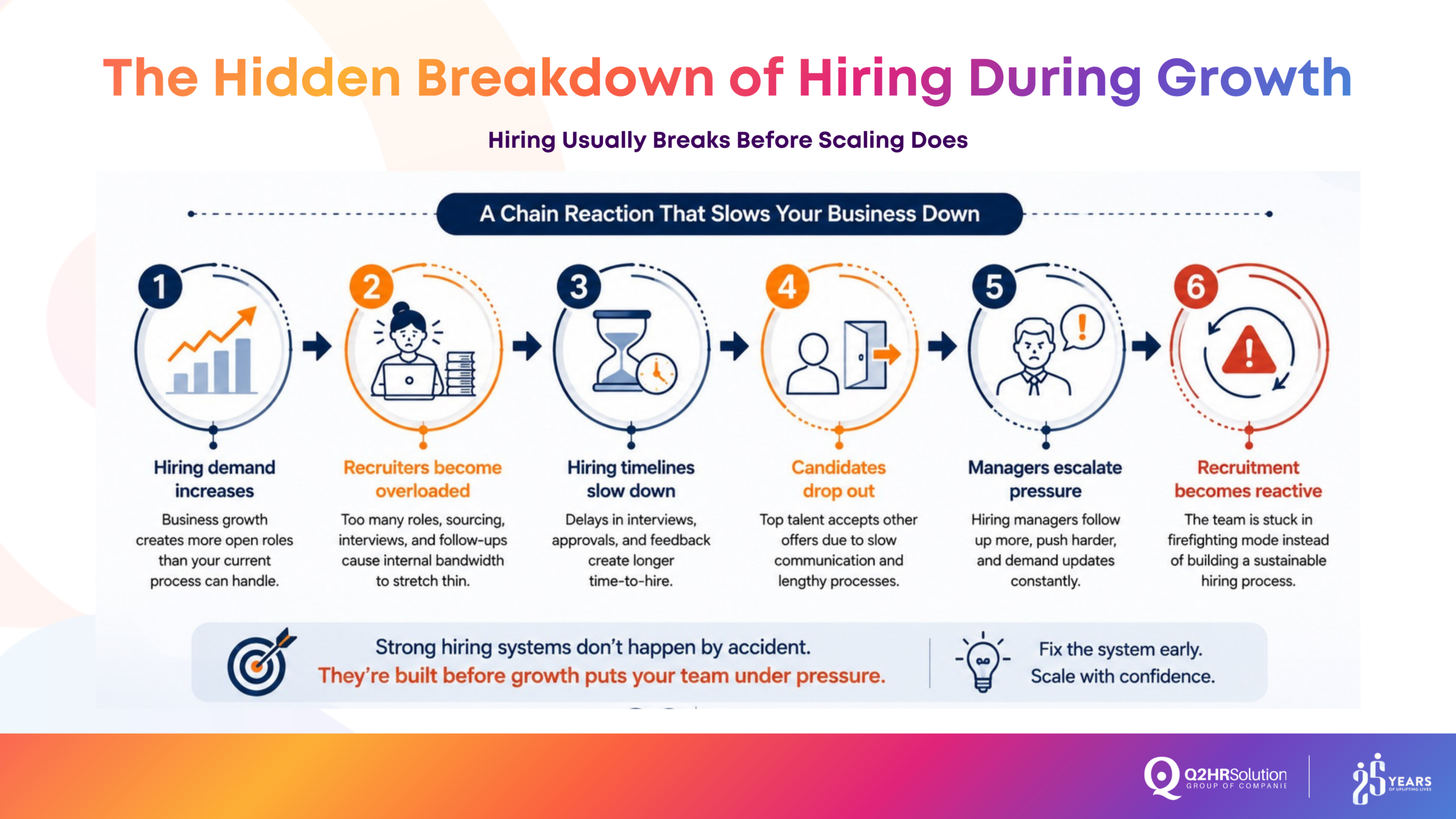
Recruitment bottlenecks rarely stay isolated within HR departments. Eventually, operational teams begin feeling the effects too.
When important positions remain vacant for long periods, existing employees absorb additional workloads temporarily. Managers spend more time interviewing candidates instead of focusing on strategic responsibilities. Project timelines become harder to maintain because workforce capacity remains unstable.
This creates a chain reaction operationally. Overworked teams become more prone to burnout, which can increase attrition. Attrition then creates even more hiring pressure internally, which leads to recruitment becoming increasingly reactive instead of structured.
For customer-facing industries, hiring instability can also affect service quality directly. Delayed staffing means longer onboarding timelines, inconsistent workforce readiness, and heavier pressure on existing employees.
This is partly why businesses are paying closer attention to the rpo recruitment process now. Companies are beginning to recognize that recruitment is not simply an HR function anymore. It has become closely tied to operational continuity and long-term growth planning.
Reactive hiring usually feels manageable at first because companies focus mainly on filling vacancies quickly. But over time, it becomes expensive in ways that are less visible immediately.
Recruiters are forced to move faster than the process realistically allows. Hiring managers lower screening standards because teams urgently need manpower. Candidate communication becomes inconsistent because recruitment teams are overloaded operationally.
This often leads to poor-fit hires, which creates turnover risk later on. According to the U.S. Department of Labor, a bad hire can cost up to 30% of an employee’s annual salary when considering recruitment expenses, onboarding costs, productivity impact, and replacement hiring.
Many businesses also become overly dependent on multiple staffing agencies during aggressive hiring periods. While agencies can provide short-term hiring support, relying too heavily on fragmented recruitment channels sometimes creates inconsistent candidate experiences and weak employer branding.
The challenge is that reactive hiring usually looks productive from the surface because roles are being filled quickly. But internally, the hiring process becomes harder to sustain over time. This is one reason the rpo recruitment process has become more relevant among scaling businesses. Companies are looking for recruitment structures that create consistency, visibility, and scalability instead of constant hiring firefighting.
One of the most common assumptions companies make is that hiring delays automatically mean they need more recruiters internally. Sometimes that helps temporarily. But in many situations, adding recruiters into an inefficient hiring structure only increases operational complexity further.
If approval processes remain slow, recruiters still cannot move candidates efficiently. If workforce planning is unclear, recruiters end up prioritizing roles inconsistently. If employer branding is weak, sourcing becomes harder regardless of recruiter headcount. This is why some companies continue struggling with hiring despite continuously expanding recruitment teams.
The problem is often structural rather than individual. Recruitment workflows become fragmented when hiring processes evolve too quickly without operational alignment. Different departments follow different hiring standards. Interview turnaround times vary heavily. Reporting becomes inconsistent.
Because of this, recruitment scalability becomes difficult to maintain internally without a more organized hiring framework supporting growth. Strong recruitment systems usually rely on process clarity as much as recruiter capability. This includes sourcing strategy, approval efficiency, candidate communication, workforce forecasting, and hiring visibility across departments.
The right rpo recruitment process usually changes far more than recruitment capacity alone. It creates operational structure around hiring itself.
One major difference is visibility. Businesses gain clearer oversight into hiring timelines, sourcing performance, candidate drop-offs, and workforce demand patterns. That visibility becomes valuable because leadership teams can identifyhiring bottlenecks earlier instead of reacting after delays worsen.
Recruitment workflows also become more standardized. Interview coordination, candidate communication, screening processes, and reporting structures become more consistent across departments. For growing companies, scalability becomes easier operationally because recruitment support can adjust depending on workforce demand. Businesses do not always need to expand internal recruitment headcount aggressively during temporary hiring spikes.
Specialized recruitment expertise also becomes more accessible. Difficult-to-fill roles involving technology, finance, healthcare, engineering, or multilingual support often require more targeted sourcing strategies and talent mapping capabilities. At the same time, internal HR teams regain operational bandwidth. Instead of spending most of their time managing hiring pressure, they can focus more on workforce development, employee engagement, and organizational planning.
For many companies, the biggest change is that hiring becomes less reactive overall.
Experienced RPO providers usually spend significant time understanding hiring environments before recommending recruitment solutions. That assessment stage matters because companies experiencing similar hiring symptoms may actually have very different operational problems underneath.
Some organizations struggle because hiring demand increased too quickly. Others face sourcing limitations due to highly specialized talent requirements. In some cases, the issue is internal approval bottlenecks rather than candidate availability.
RPO providers normally evaluate several operational areas first. Workforce growth projections are reviewed to understand long-term hiring demand. Internal recruitment bandwidth is assessed to identify where hiring strain exists most heavily. Candidate drop-off points are also important. If applicants consistently leave during certain stages of recruitment, that often signals process inefficiencies or communication gaps internally.
Recruitment reporting maturity matters too. Some businesses lack clear hiring visibility entirely, which makes workforce planning much harder during expansion.
At Q2 HR Solutions, recruitment outsourcing engagements are typically aligned around actual operational needs rather than generic recruitment packages. Different businesses naturally require different hiring structures depending on industry demands, workforce growth, and recruitment complexity.
Hiring demand today changes faster than many companies expect.
Expansion plans shift. Market conditions fluctuate. Client demands increase suddenly. Workforce requirements evolve depending on operational priorities. Because of this, rigid hiring structures have become more difficult to sustain long-term.
This is one reason flexible recruitment support continues growing globally. According to Grand View Research, the global recruitment process outsourcing market is projected to expand steadily as businesses prioritize scalable workforce solutions and operational flexibility.
For companies in the Philippines, this flexibility is especially important because hiring demand can fluctuate significantly depending on outsourcing activity, project-based work, and regional expansion efforts. A scalable rpo recruitment process allows businesses to adjust hiring support without constantly rebuilding recruitment operations internally. That adaptability becomes increasingly valuable for organizations planning long-term growth while trying to maintain hiring efficiency sustainably.
More importantly, it allows leadership teams to focus more on business expansion instead of continuously reacting to recruitment pressure.
Hiring delays usually happen when workforce demand grows faster than recruitment systems can handle. Common causes include overloaded recruiters, slow hiring approvals, inconsistent sourcing strategies, and unclear workforce planning.
The rpo recruitment process improves efficiency by creating more structured recruitment workflows, scalable hiring support, better sourcing strategies, and clearer visibility into recruitment performance.
Companies usually consider RPO support when hiring demand becomes difficult to manage internally, recruitment timelines continue increasing, or workforce expansion begins affecting operations.
Yes. Many growing companies in the Philippines use recruitment outsourcing to improve hiring scalability, reduce operational strain, and access specialized recruitment expertise during expansion.
Scaling increases hiring volume, operational pressure, and workforce complexity simultaneously. Without structured recruitment systems, hiring processes often become reactive and inconsistent.
Most companies focus heavily on scaling operations, increasing revenue, and expanding teams. But somewhere in the middle of growth planning, recruitment infrastructure quietly becomes one of the biggest operational pressure points internally. The challenge is that hiring problems do not always appear dramatic immediately. They build gradually through delayed hiring timelines, overloaded recruiters, inconsistent workflows, and workforce gaps that slowly affect the rest of the business.
This is why the right rpo recruitment process matters before expansion becomes too aggressive. Sustainable growth depends heavily on whether the hiring structure underneath the business can realistically support workforce demand over time.
For companies reassessing how recruitment fits into long-term scaling plans, working with an experienced RPO provider can help create a hiring setup that feels more structured, adaptable, and operationally sustainable. If your organization is currently evaluating recruitment outsourcing strategies, Q2 HR Solutions can help assess what kind of recruitment structure may best support your growth goals.