


The aptitude test has become increasingly common in hiring processes, and its for a fairly simple reason. Resumes only tell part of the story. Two candidates can have similar experience, comparable qualifications, and even perform equally well during interviews, yet their performance on the job can look completely different a few months later.
Spend enough time in any workplace and you’ll notice this interesting situation. Some people adapt quickly when priorities change, learn new systems with little guidance, and solve problems as they appear. Others need more time to process information or adjust to unfamiliar situations. Understanding those differences is exactly why many organizations have started looking beyond credentials alone.
In this article, we’ll walk through what these assessment tests actually measure, why they’ve quietly become a normal part of hiring, and the kinds of questions a candidate can expect to face. Nothing too academic, just a clear look at a tool doing more heavy lifting in recruitment than people give it credit for.
An aptitude test is a structured way to measure how a person reasons, solves problems, and handles new information. It’s not about what they already know, but how well they can pick things up and put them to use. That distinction matters more than it sounds because a diploma tells you someone studied accounting, but it doesn’t tell you whether they can spot the odd number in a messy spreadsheet at 4pm on a deadline.
According to research from the Society for Industrial and Organizational Psychology (SIOP), aptitude test is among the strongest predictors of job performance across various industries. Multiple studies have also shown that individuals who score higher on cognitive and reasoning assessments often learn faster and perform more effectively in complex roles.
Because of this, companies run these tests early, as a filter that sits alongside the résumé rather than replacing it. Someone can call themselves “detail-oriented” on paper, but a short reasoning exercise shows it instead of just claiming it. The test becomes a second opinion that doesn’t get tired or distracted halfway through a long shortlist.
Aptitude test carries more weight than ever because hiring decisions have become more complex, and honestly that’s the short version of the whole story. The U.S. Department of Labor pegs the cost of a bad hire at around 30% of that person’s first-year salary. When the math looks like that, the gut feel starts to feel like a luxury nobody can afford.
But beyond the financial impact, there’s also the time spent recruiting, onboarding, training, and managing performance issues. This is why employers are looking for more ways to reduce guesswork during hiring. Most companies aren’t just trying to fill a vacancy anymore. They’re trying to find people who can adapt, learn quickly, solve problems, and keep up with changing business needs. Those are things that don’t always show up clearly on a résumé or even during a one-hour interview.
The shift is already happening. According to SHRM’s 2025 research, 56% of employers now use some form of pre-employment assessment, and 78% report a better quality of hire because of it. The numbers themselves are interesting, but what they really suggest is that more companies are finding value in gathering objective data before making hiring decisions. As hiring becomes more competitive, relying solely on interviews and résumés isn’t going to cut it.
The biggest win, oddly enough, is fairness. A well-built aptitude assessment test scores everyone against the same yardstick, so the quiet candidate who interviews badly but thinks sharply doesn’t get knocked out for nerves. That’s how you stop hiring the best talker in the room and start hiring the best fit for the work.
There’s a speed benefit right next to it. Instead of reading hundreds of résumés that all sound the same, recruiters can use a short aptitude test to narrow the pile to people who can genuinely handle the reasoning the role demands. Harvard Business Review research found that pairing cognitive tests with personality assessments noticeably raises the odds of a good hire, since you measure both capability and fit at once. Which leads to fewer surprises later, and fewer three-weeks-in disappointments.
And the value doesn’t stop at the offer. The same results can also highlight where a new hire might need support. For example, someone may be strong with numbers but weaker in writing, which gives a manager a head start on coaching instead of dealing with a quiet headache six months later.
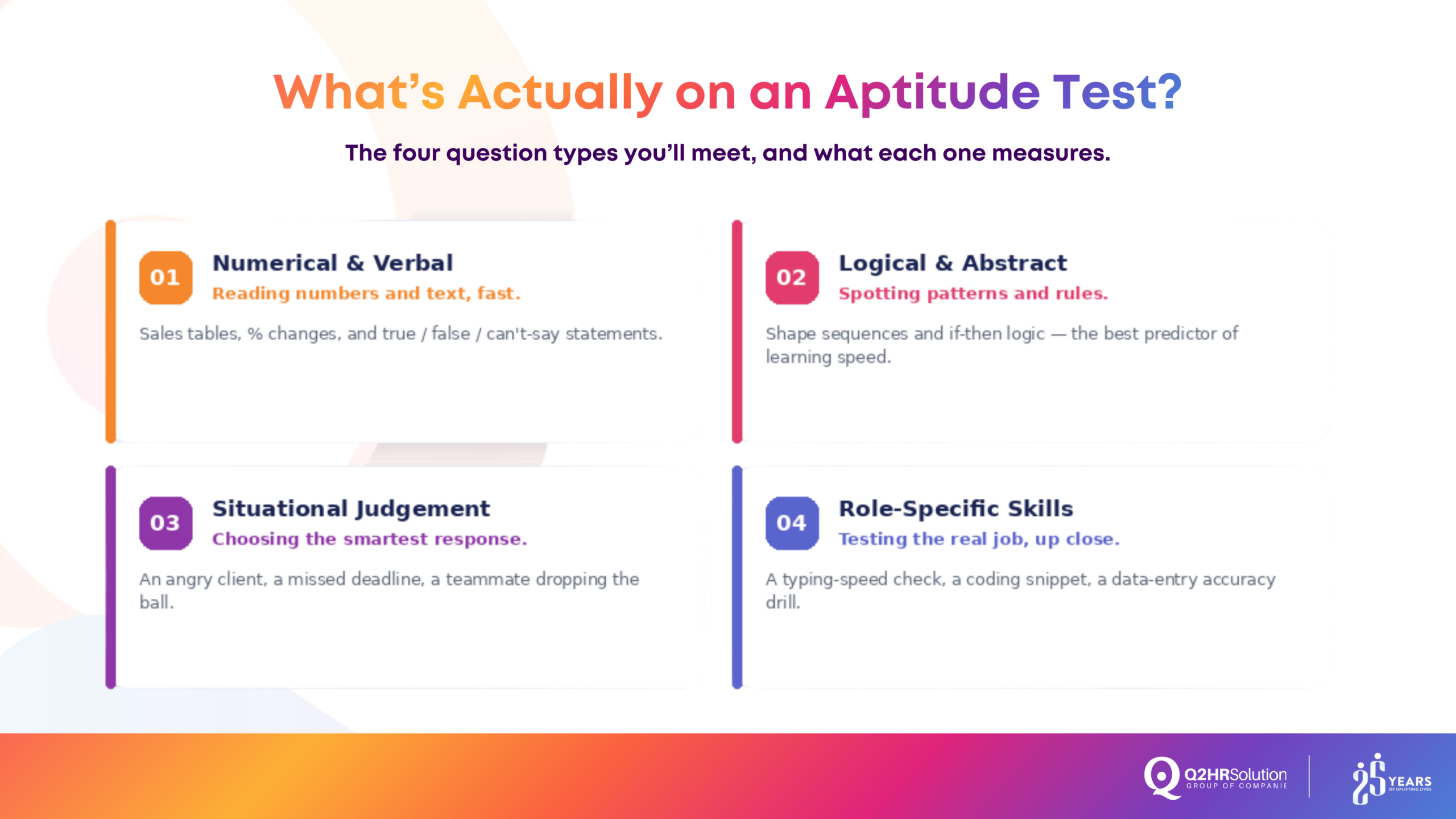
Most aptitude tests pull from a handful of question families, and which ones you’ll see depends on the role you are applying. A finance analyst and a call-center agent are measured for very different things, so the questions shift to match. Here are some common categories that come up most often.
Numerical reasoning throws data at you such as a table of sales figures, a percentage change, a currency conversion, then asks you to draw the right conclusion fast. It’s less about heavy math and more about whether you can read numbers without freezing up.
Verbal reasoning does the same with words. You’ll get a paragraph and a few statements, then decide what’s true, false, or not stated. Roles that live in email and reports, like most office jobs, honestly, lean on this a lot, because misreading a brief is how small mistakes turn into big ones.
Logical reasoning is the pattern-spotting family. You might see a sequence of shapes and predict the next, or untangle a small web of “if this, then that” rules. Because of this, it’s a favorite for tech and engineering roles, where the work is structured problem-solving all day.
Abstract reasoning sits beside it and predicts learning speed better than almost anything else. It strips away language and numbers entirely, which makes it one of the fairer sections for candidates who didn’t grow up speaking English at home, something that matters in a market as multilingual as ours.
Then there’s the situational stuff, which feels less like a test and more like a “what would you do” moment. You’re handed a realistic dilemma like an angry client, a missed deadline, a teammate dropping the ball, and then asked to pick the smartest response. An aptitude assessment test built for customer-facing roles leans heavily on these.
Role-specific questions go a layer deeper, checking the actual skills a job needs like a typing-speed check for a VA, a coding snippet for a developer, a data-entry drill for back-office work. The closer the question mirrors the real job, the more useful the result, which is why good employers customize this part instead of running one generic aptitude test for every opening.
Local context turns this from a nice-to-have into something closer to a necessity. Aon’s 2025 Salary Increase and Turnover Study projects a 20% attrition rate in the Philippines for 2026, the highest in Southeast Asia, meaning roughly one in five skilled workers is expected to switch employers. When people move on that fast, every hire has to count, and guessing gets pricey.
For the BPO, shared-services, and tech firms that drive a huge chunk of local employment, volume hiring makes the case even stronger. Screening hundreds of applicants by hand is slow and wildly inconsistent, but a well-designed aptitude test handles that first pass in minutes while keeping the standard identical for everyone. That consistency is hard to put a price on when you’re filling 50 seats at once.
There’s a fairness angle too that fits the local talent pool nicely. Filipino professionals come from a wide spread of schools and backgrounds, and a good aptitude assessment test judges them on how they think rather than which university name sits at the top of the CV. Because of this, it often surfaces strong candidates who would otherwise get quietly overlooked.
Most aptitude tests run between 20 and 60 minutes, depending on how many sections are involved. Employers keep them short on purpose through a test that drags on frustrates good candidates, and in a tight market like ours, candidate experience matters nearly as much as the score.
Not in the usual pass/fail sense. An aptitude test has no universal cutoff. Results usually get compared against a specific role’s demands and against other applicants. A score that’s perfect for an entry-level post might fall short for a senior analyst, so “good enough” always depends on the job.
Short version: aptitude looks at potential, a skills test at what you can already do. The first measures how quickly you’d pick up a new system; the second checks whether you can use it today. Most employers blend both, since potential and proven ability answer different questions.
They’re built to be, and that’s a big part of the appeal. A properly validated assessment trims the gut-feel bias that creeps into interviews. But fairness depends on using a tool that’s been tested itself. A poorly made one can do the opposite, so quality really matters.
Strip away the jargon and the idea is simple, hiring on instinct alone is a gamble, and the stakes keep climbing as turnover rises. A good test won’t make the call for you, but it hands you a clearer, fairer picture of who’s actually sitting across the table. Exactly what you want before betting a salary and a seat on someone new.
As Philippine companies continue building stronger and more capable workforces, the aptitude assessment test remains a practical tool for making smarter talent decisions. It helps organizations look beyond credentials and better understand potential.
If you’re weighing whether structured assessments belong in your hiring process, it’s worth a real conversation rather than a rushed yes or no. Schedule a consultation with our team today, we’re happy to talk through what would genuinely fit your roles and your hiring volume.