

A lot of US companies expanding into the Philippines eventually hit the same quiet problem. The local talents looks great on paper, interviews feel smooth, but something still feels uncertain once people are onboarded. Usually, this is where the importance of having an employment screening services are mostly felt, especially when teams are being built remotely and managers don’t have direct visibility into local hiring history.
In simple terms, employment background screening helps companies verify who they are actually hiring before the contract is signed, which reduces risk and avoids costly surprises later. Most companies don’t think hard about screening until a hire goes wrong, and by then it’s already expensive. That matters even more for cross-border hiring, because you can’t just walk down the hall to verify something yourself.
In this article, we’ll walk through what these services actually cover, why they look a little different when you’re hiring in the Philippines, and how they fit alongside an Employer of Record (EOR) workforce model. For a lot of US companies, this big step is what decides whether an expansion starts on solid footing or on a hopeful guess.
At their core, employment screening services are a set of background checks meant to verify a candidate’s claims. Some are obvious, like confirming someone worked where they said they did. Others go deeper, depending on the role and the risk involved.
The usual starting point is identity, employment history, and education verification. A provider confirms the person is who they claim, that their past jobs and titles check out, and that their degree is real. These sound basic, but they’rewhere most problems surface. According to research, when discrepancies show up in a background check, around 87% of them sit inside employment and academic verification, the two areas people most often stretch.
From there, criminal record checks and reference checks tend to follow. The point isn’t to dig for dirt. It’s to make sure there’s nothing that would put the team, customers, or company at real risk. A solid round of employment background screening usually combines several of these so no single check has to carry the whole decision.
Some positions need more. A finance lead, someone handling sensitive data, or a senior hire with budget authority might also go through credit history checks, professional license verification, or drug testing where it’s legal and relevant. These aren’t standard for every role, and forcing them everywhere just slows hiring down.
This is why good employment screening services are scoped to the job rather than applied as a blanket. Because of this, what you screen for a warehouse coordinator and what you screen for a controller should look pretty different, andthe risk profile drives the package.
Hiring locally in the US already comes with verification challenges, but things get more layered when companies expand into another country. In the Philippines, for example, talent pools are strong, especially in BPO, marketing, and tech roles, but verification systems don’t always look the same as what US HR teams are used to.
This is where employment screening services start to matter more than usual. Society for Human Resource Management (SHRM) stated that 92% of employers globally conduct some form of background check before hiring. And the reason is simple. Hiring mistakes are expensive, and cross-border hiring increases the risk of mismatched information. Because of this, companies rely on structured checks to confirm identity, employment history, and education before moving forward.
Another layer is trust. Remote hiring removes the “in-office validation” that managers naturally rely on. So companies lean more on verification processes, which makes these screening services a quiet but important part of scaling teams offshore.
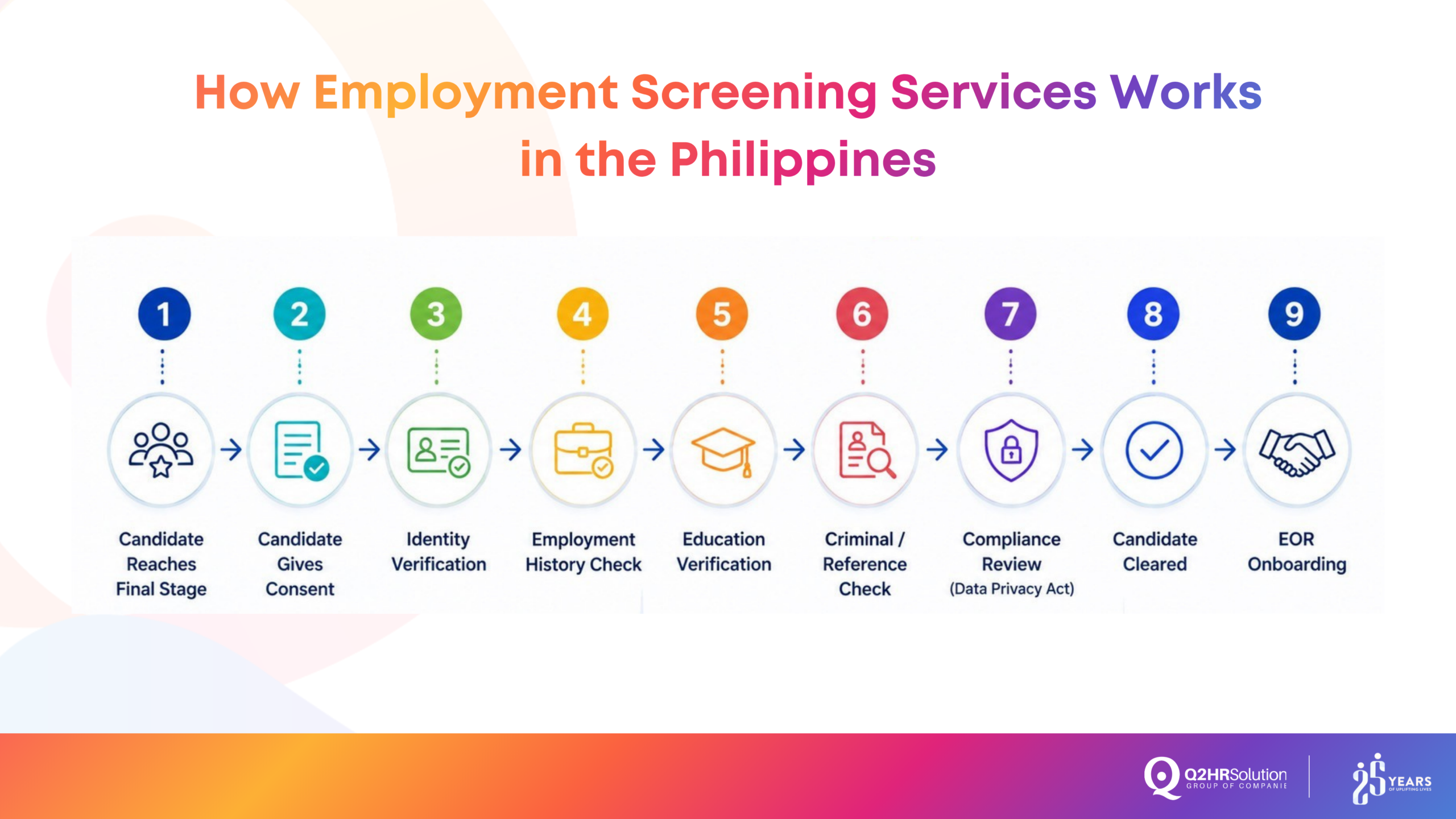
Once a candidate reaches the final stage, employment background screening typically begins through a third-party provider that coordinates directly with previous employers, schools, or certifying bodies. In the Philippines, this process can take longer compared to US domestic checks because responses are often manual and not always centralized.
This is why US companies expanding into the Philippines usually build extra time into their hiring pipelines. It’s not necessarily slower in quality, just different in structure.
Another factor is compliance. The Philippines’ Data Privacy Act of 2012 regulates how personal data is collected and verified, which affects how employment screening services are conducted locally. Companies need to ensure consent, proper data handling, and secure processing throughout the verification stage.
Because of these nuances, background screening is often handled alongside local HR or even an Employer Of Record (EOR) partners who already understand the regulatory environment and vendor landscape. What often gets missed is how naturally screening and EOR fit together. If a partner is already going to employ and pay your hire under Philippine law, having that same partner run the background checks first just makes sense.
The local knowledge behind the compliance work also makes the employment screening step more reliable, because they already know which records are trustworthy and how to verify them. This leads to a cleaner handoff as the person who clears the check is the same person the EOR onboards. Used this way, employment screening services stop being a one-off task and become the front door of a compliant hire.
Employment screening services in the Philippines are more complex than in US. Because the records, the systems, and the labor rules aren’t the same and where US companies usually tends to trip. Verifying a Philippine candidate means working with local universities, the right government records, and previous employers who may not respond the way a US HR department would. A provider who knows the ground saves you weeks of dead ends.
There’s real reason to get this right, because the Philippines has become a top destination for US hiring. Data from Multiplier suggests around 30% of overseas hires by US companies land in the Philippines, making it the single most popular country they hire from. That’s driven by a deep, English-fluent talent pool and salaries that stretch a US budget further.
But the same things that make the country attractive, like the distance, unfamiliar systems, a different legal framework, are what make employment background screening harder to do well from afar. Local data privacy rules, consent requirements, and document norms all matter, and getting them wrong can create compliance headaches before you’ve even hired anyone. This is one reason a lot of expanding companies don’t run employment screening services alone. They lean on a partner already operating inside the country.
This is where things become more practical for companies expanding into the Philippines.
Q2 HR Solutions operates not only as an EOR provider but also as a background screening partner, which is not always common in the market. Many EOR providers focus only on employment and payroll compliance after hiring decisions are made. Screening is often handled separately, usually through another vendor.
With Q2 HR, employment screening services are already embedded into the broader hiring and onboarding process. That means companies don’t have to coordinate between multiple providers just to complete one hire. The screening layer and the EOR layer sit within the same ecosystem.
This also reduces friction during onboarding. Instead of waiting for separate vendors to complete verification before employment setup begins, everything flows in a more connected way. The result is faster hiring cycles with fewer gaps between screening, approval, and employment.
For US companies scaling teams in the Philippines, this combination is particularly useful because it removes one of the common bottlenecks like vendor fragmentation. You’re not just getting background screening services, and you’renot just getting EOR support, you’re getting the best of both worlds working together in one structure.
It usually includes identity verification, employment history checks, education verification, and sometimes additional checks depending on the role. These screening services are used to confirm candidate accuracy before hiring.
Companies use employment background screening to reduce hiring risks and ensure that candidates have the experience and credentials they claim, especially in remote or cross-border hiring setups.
Not always required, but highly recommended. Even if an EOR handles legal employment, background screening services ensure that the right candidate is selected before onboarding.
It varies, but typically a few days to a couple of weeks depending on how quickly previous employers or schools respond during employment background screening.
Unlike many providers that only handle employment compliance, Q2 integrates both EOR and background screening, reducing the need for multiple vendors and simplifying the hiring process.
Hiring across borders always looks simple at first, but the complexity usually shows up after the first few hires. That’s where employment screening services quietly do most of the heavy lifting, making sure companies are not just hiring fast, but hiring correctly.
For US companies expanding into the Philippines, combining employment screening with an EOR setup helps create a more stable hiring foundation. It reduces uncertainty, improves compliance, and makes scaling less fragmented.
And instead of treating screening and employment as separate problems, providers like Q2 HR Solutions bring them together in one system. That combination is what makes the expansion process feel less like managing vendors and more like actually building a team. If you’re weighing an expansion into the Philippines and want a clearer picture of how screening and EOR can work together, work with our team and we’ll be happy to provide a tailored solutions that supports your business.