

Table of Contents
Expanding into the Philippines gives businesses access to one of Southeast Asia’s most talented and English-proficient workforces. Whether you’re hiring remote professionals, building a local team, or testing a new market, the Philippines offers significant opportunities for growth. However, employing workers in another country also means navigating unfamiliar labor laws, payroll requirements, statutory benefits, and tax obligations.
For many organizations, establishing a local legal entity simply isn’t practical during the early stages of expansion. This is where Employer of Record (EOR) services in the Philippines provide a strategic advantage.
An Employer of Record enables companies to legally hire employees in the Philippines without creating a local business entity. The EOR becomes the legal employer responsible for payroll administration, statutory contributions, employment contracts, and regulatory compliance, while your business continues to direct the employee’s daily work and performance.
This guide explains how Employer of Record services work, their benefits, how to evaluate providers, and what businesses should consider before choosing an EOR partner.
An Employer of Record (EOR) is a third-party organization that legally employs workers on behalf of another company. While the EOR manages employment administration, payroll, taxes, statutory benefits, and compliance with local labor regulations, the client company maintains full control over the employee’s responsibilities, performance, and day-to-day work.
This arrangement allows businesses to expand internationally without establishing a local subsidiary, reducing administrative complexity while supporting compliance with country-specific employment laws.
In the Philippines, an Employer of Record typically manages:
Meanwhile, your organization continues to oversee business operations, employee performance, and strategic direction.
For companies entering the Philippine market, this arrangement significantly shortens hiring timelines while reducing legal and administrative burdens.
Businesses choose Employer of Record services because they simplify international hiring while reducing operational risks.
Setting up a legal entity in another country requires time, legal documentation, government registrations, and ongoing administrative responsibilities.
An Employer of Record removes this barrier by allowing companies to hire employees immediately through an existing legal employer.
Instead of waiting months to establish operations, businesses can focus on recruiting talent and growing their presence in the Philippine market.
Employment laws differ across countries, and non-compliance can result in financial penalties, operational delays, and legal disputes.
In the Philippines, employers must comply with labor regulations covering wages, working hours, mandatory government contributions, employee benefits, and employment documentation.
An experienced Employer of Record helps businesses manage these responsibilities while remaining aligned with applicable Philippine labor regulations.
Managing payroll involves much more than paying salaries.
Employers must calculate taxes, process government contributions, administer leave benefits, and maintain accurate payroll records.
By outsourcing these responsibilities to an Employer of Record, organizations can reduce administrative workload and improve payroll accuracy.
Employees expect timely salary payments, accurate benefits administration, responsive HR support, and compliant employment documentation.
A reliable Employer of Record helps deliver a consistent employee experience while allowing business leaders to focus on workforce development instead of administrative tasks.
Not all Employer of Record providers offer the same level of expertise, technology, or support.
Choosing the right partner requires looking beyond pricing and evaluating how well the provider can support your long-term business objectives.
When hiring in the Philippines, local knowledge matters.
Choose an Employer of Record that understands Philippine employment regulations, payroll requirements, statutory contributions, and HR practices.
A provider with strong local expertise can help businesses navigate compliance challenges while supporting employees throughout their employment lifecycle.
A comprehensive Employer of Record should provide more than payroll processing.
Look for services such as:
The broader the service offering, the more administrative work your internal HR team can delegate.
Technology should make employment management easier—not more complicated.
An effective EOR platform should provide:
Digital tools improve efficiency while giving employers greater visibility into workforce operations.
Pricing is important, but choosing the lowest-cost provider isn’t always the best business decision.
Consider the provider’s:
A provider that delivers reliable service and strong compliance support often provides greater long-term value than one chosen solely because of a lower monthly fee.
One of the most important decisions when selecting an Employer of Record (EOR) is whether to work with a local or global provider. The right choice depends on your hiring strategy, operational needs, and long-term business goals.
A local EOR specializes in Philippine employment laws, payroll administration, statutory benefits, and workforce management. Businesses expanding primarily within the Philippines often benefit from a provider with in-depth local knowledge and an established support network.
A local EOR may be the right fit if you:
For businesses focused on the Philippine market, a local EOR can provide practical insights and hands-on support that help reduce compliance risks and improve the employee experience.
A global EOR is designed for organizations managing employees across multiple countries. These providers typically offer centralized platforms for payroll, HR administration, and workforce reporting across different jurisdictions.
A global EOR may be appropriate if you:
While global providers offer broader geographic coverage, businesses should still verify that the provider has strong local expertise and resources in the Philippines to ensure compliance with local employment requirements.
There is no universal “best” Employer of Record. The right solution depends on your company’s expansion strategy, workforce size, operational complexity, and compliance needs.
For organizations focused primarily on hiring in the Philippines, a provider with extensive local knowledge often delivers greater value. Companies with broader international expansion plans may benefit from a global platform, provided it offers reliable local support where employees are based.
As businesses grow, their workforce requirements also evolve. Some organizations decide to change EOR providers to improve service quality, gain access to better technology, or receive more comprehensive HR support.
A successful transition requires careful planning to avoid payroll disruptions and maintain employee confidence.
Before making a switch, evaluate your existing provider by asking:
Understanding your current challenges helps identify the capabilities your next provider should offer.
Changing providers should never happen without a structured implementation plan.
A successful transition should include:
Planning ahead minimizes disruptions and helps ensure continuity throughout the transition.
Payroll and HR records contain confidential employee information. During any migration, businesses should verify data accuracy and implement appropriate safeguards to protect sensitive information.
Conducting payroll testing before full implementation also helps identify discrepancies early and supports a smoother transition.
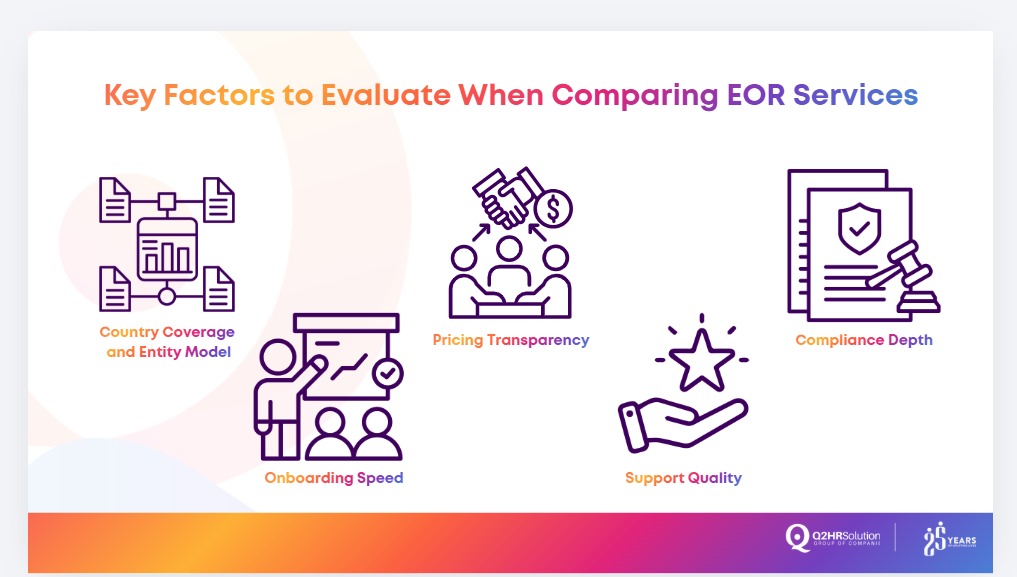
Selecting an Employer of Record involves more than comparing monthly fees. Businesses should evaluate providers based on the overall value they deliver.
Compliance should be one of the primary considerations.
An experienced EOR should understand Philippine employment regulations, statutory contributions, payroll obligations, and documentation requirements. Their ability to manage these responsibilities accurately helps reduce administrative burdens and supports legal compliance.
Employer of Record providers use different pricing models. Some charge a fixed monthly fee per employee, while others calculate fees based on a percentage of payroll.
When requesting a proposal, ask for a clear breakdown of:
Transparent pricing makes budgeting easier and helps avoid unexpected costs.
Customer Support
Reliable customer support is essential for both employers and employees.
Consider whether the provider offers:
Strong support can make a significant difference when addressing payroll concerns, employment questions, or regulatory changes.
Modern EOR providers should offer secure and user-friendly technology that simplifies workforce administration.
Look for features such as:
Digital solutions improve operational efficiency while providing better visibility into workforce data.
An Employer of Record is a third-party organization that legally employs workers on behalf of another company. The EOR manages payroll, statutory contributions, employment contracts, and compliance, while the client company oversees employees’ day-to-day work and performance.
Yes. Employer of Record services are a legitimate workforce solution when they comply with Philippine labor laws and government regulations. Businesses should always partner with providers that have strong local compliance expertise.
No. One of the main advantages of an Employer of Record is that businesses can legally hire employees in the Philippines without establishing their own local company.
Evaluate providers based on their local expertise, compliance capabilities, service offerings, technology, pricing transparency, customer support, and experience managing Philippine employment requirements.
Expanding your workforce in the Philippines should be an opportunity—not a compliance challenge.
With Q2 HR Solutions’ Employer of Record services, your business can hire employees efficiently while simplifying payroll administration, managing statutory obligations, and maintaining compliance with Philippine employment regulations.
Our experienced HR professionals understand the local employment landscape and provide practical support throughout the employee lifecycle—from onboarding and payroll administration to compliance and workforce management.
Whether you’re hiring your first employee in the Philippines or scaling an established team, Q2 HR Solutions offers the expertise, local knowledge, and responsive service needed to help your business grow with confidence.
Contact Q2 HR Solutions today to learn how our Employer of Record services can support your expansion into the Philippine market.
__________________________________________________________________________________________________________________________________________________________________________________
Expert Insights By:
Ferdinand A. A. Limbo (Ferdie) is a Consultant at Q2 HR Solutions. He has more than 20 years of executive experience in Human Resources, Facilities Services and Management, Retail, Wholesale, Engineering Consultancy and various other industries. Ferdie attended a Master of Business Administration (MBA) program at the University of Santo Tomas.