

If you are building a team in Saudi Arabia — whether through a new entity, a joint venture, or a Build-Operate-Transfer model — one of the first practical questions that needs answering is this: who is going to manage HR, and how? It sounds operational. But in a market like KSA, where employment law is specific, compliance obligations are non-negotiable, and the workforce is split between Saudi nationals and expatriates, the answer shapes everything.
The five core HR functions do not change from market to market. What changes is the complexity of delivering them — and the consequences of getting them wrong. In Saudi Arabia, that complexity is real. Understanding what each HR function involves in a KSA context, and how a BOT model can support the delivery of all five from day one, is where most successful market entries begin.
Hiring in Saudi Arabia is not simply a matter of posting a role and reviewing applications. The Kingdom’s Saudisation (Nitaqat) programme means that recruitment strategy must account for national-to-expatriate ratios from the outset — the composition of your workforce directly affects your business licence status, your ability to sponsor visas, and your Nitaqat band classification.
This is one of the most strategically loaded HR functions in KSA. Talent acquisition here requires a clear understanding of which roles can be filled by expatriate talent and which must be reserved for or actively prioritised for Saudi nationals — and a sourcing capability that spans both talent pools effectively.
In a BOT arrangement, the operating partner manages recruitment compliantly from day one — building a pipeline that meets both business capability needs and Saudisation obligations, without the client having to navigate that balance alone.
Payroll is one of the most regulated HR functions in Saudi Arabia. The Wage Protection System (WPS) mandates that employer payments are made through approved electronic channels by defined deadlines each month. GOSI contributions — split differently for Saudi nationals and expatriates — must be calculated and filed correctly. End-of-service gratuity accrues throughout employment and must be provisioned for from the start.
The HR tasks involved in running compliant payroll in KSA are not trivial. They require knowledge of the system, registered accounts, and consistent execution month after month. Errors — even administrative ones — attract penalties and can trigger restrictions on business operations.
A BOT model with embedded payroll capability ensures that this HR function is handled by people who run KSA payroll every day — not by a generalist team learning the system as they go
Saudi Labour Law governs everything from working hours and overtime entitlements to termination procedures, probationary periods, and mandatory leave. For foreign businesses operating in KSA, the gap between home-country HR practice and Saudi legal requirements can be significant — and assuming equivalence is a common and costly mistake.
Core HR functions in compliance include drafting contracts that meet KSA standards, managing disciplinary and grievance processes within the legal framework, ensuring working conditions meet statutory requirements, and handling terminations in a way that limits legal exposure and meets end-of-service obligations.
In a BOT structure, the operator takes on the compliance risk during the build and operate phases — meaning the client business benefits from a legally sound employment framework without having to build that expertise internally from scratch.
Workforce development in KSA carries a dimension that most other markets do not: it is both a people investment and a regulatory requirement. The Human Resources Development Fund (Hadaf) supports programmes that upskill Saudi nationals, and businesses that actively invest in national talent development are rewarded with stronger Nitaqat positioning.
This HR function sits at the intersection of people strategy and regulatory compliance. The HR roles responsible for learning and development in KSA need to understand both the individual development needs of the workforce and the broader Saudisation landscape — and design programmes that serve both.
For businesses entering KSA through a BOT model, embedding a Saudisation development strategy early — rather than retrofitting one later — is one of the most commercially intelligent moves available. It builds local talent pipeline, improves Nitaqat standing, and demonstrates commitment to the Kingdom’s Vision 2030 objectives.
The fifth of the core HR functions covers the day-to-day operational fabric of employment: onboarding, contract management, leave administration, performance management, employee queries, and offboarding. These are the HR tasks that keep the employment relationship running — and in Saudi Arabia, they all carry specific regulatory dimensions.
Onboarding expatriate workers requires Iqama processing and visa coordination. Leave entitlements are defined by KSA Labour Law and must be tracked and administered accordingly. Offboarding must account for end-of-service gratuity calculations and final settlement obligations. None of these are areas where improvisation is appropriate.
Strong employee relations in KSA also means understanding the cultural context of the workforce — building an environment where Saudi nationals and expatriate employees work effectively together, and where HR operates as a genuine support function rather than a compliance gatekeeper.
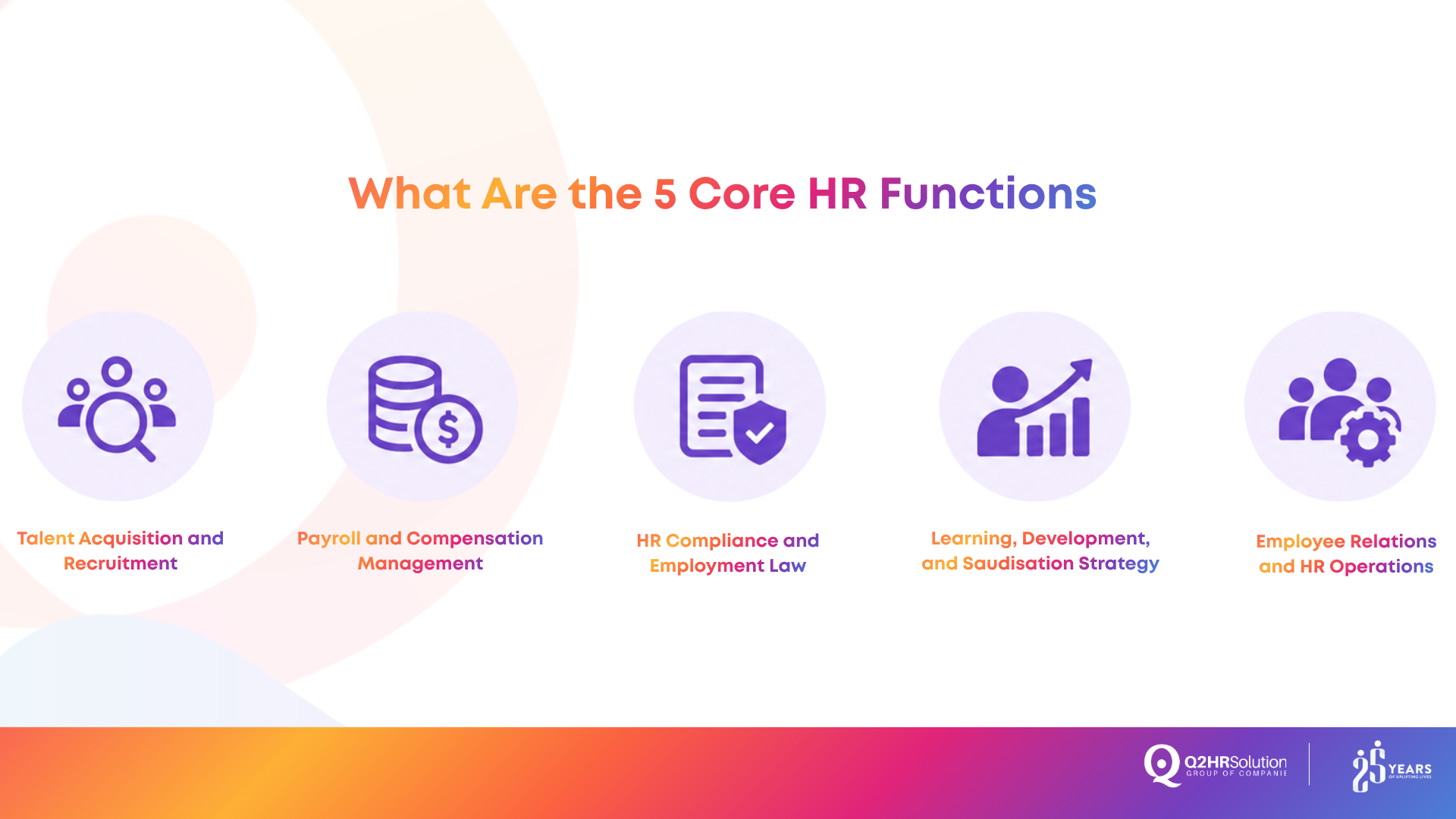
Talent acquisition (with Saudisation compliance), payroll and compensation (WPS and GOSI), employment law compliance, learning and development (linked to Nitaqat strategy), and employee relations and HR operations. All five are interconnected in KSA in ways they are not in most other markets.
In a Build-Operate-Transfer arrangement, the operating partner delivers all five HR functions during the build and operate phases — managing compliance, payroll, recruitment, and employee relations on behalf of the client. As the operation matures, those functions are progressively transferred to the client’s own in-country team. It is the most effective way to enter the KSA market without carrying the full compliance burden from day one.
At minimum: an HR generalist with KSA labour law knowledge, a payroll specialist with WPS and GOSI experience, and a recruiter with both expatriate and Saudi national sourcing capability. In a BOT model, all of these HR roles are embedded within the operator’s team and available to the client from the outset — without the client needing to hire and manage them directly.
Saudi Arabia’s Vision 2030 places significant emphasis on nationalisation, workforce development, and private sector employment of Saudi nationals. Every core HR function is touched by these objectives — from how you recruit, to how you develop talent, to how you structure compensation. Businesses that align their HR strategy with Vision 2030 priorities are not just being compliant — they are positioning themselves as long-term partners in the Kingdom’s growth.
The five HR functions are not complicated in concept. But in Saudi Arabia, delivering them correctly — within a complex regulatory environment, across a mixed national and expatriate workforce, and in alignment with the Kingdom’s evolving employment landscape — requires genuine local expertise.
A BOT model gives businesses the fastest, most compliant route to operational HR capability in KSA. Rather than building that expertise from scratch, you step into a structure where all five core HR functions are already being managed by people who have been doing this in the Kingdom for years.
Q2HR Solutions brings close to 25 years of HR expertise to businesses entering and operating in markets across Asia and the Gulf. Our BOT model is designed specifically for organisations that want to build in Saudi Arabia with confidence — with recruitment, payroll, compliance, development, and HR operations handled from day one.
Ready to build your Saudi Arabia operation the right way? | Talk to our BOT team at https://www.q2hrsolutions.com/contact-us/.