

What happens after a new employee accepts the offer shapes how quickly they settle in and become productive.
That is where HR onboarding comes in. For Australian businesses and startups, a well-planned onboarding process covers everything from employment documentation and workplace health and safety to team introductions, role expectations and ongoing feedback. It is the foundation for successful employee onboarding and integration.
It is the structured process of preparing, welcoming, training and integrating a new employee into a business. It can begin before an employee’s first day and continue through their first weeks or months in the role.
Onboarding is broader than induction. An induction introduces someone to workplace policies, safety procedures and their immediate environment, while onboarding covers the wider employee experience, including:
The Australian Government’s business.gov.au recommends a thorough induction covering the employee’s role, colleagues, employment conditions and workplace health and safety.
Effective onboarding of new employees helps them become informed, productive and connected while giving businesses a more consistent way to manage new starters.
The Department of Employment and Workplace Relations says a positive onboarding experience can affect employee productivity, retention and safety. It also notes that up to 20% of employee turnover can occur within the first 45 days of employment.
That early period matters in a competitive labour market. According to the Australian Bureau of Statistics, 7.2% of employed people changed employers in the year to February 2026, just over one million people.
The onboarding recruitment process should not end when the candidate accepts. It should bridge recruitment into employment.
Get the practical details sorted in advance:
Fair Work Ombudsman says employers must provide new employees with the Fair Work Information Statement before, or as soon as they start. Casual and fixed-term employees may also need additional information statements.
The first day should answer three questions: Where am I? What am I here to do? Who can help me?
Introduce the employee to their team, explain their role and immediate priorities, cover policies and safety information, and make sure they can access the tools they need.
Move from orientation into participation with role-specific training, introductions to key stakeholders and an initial set of achievable tasks. Schedule a manager check-in so questions surface early.
Use regular check-ins to:
The Department of Employment and Workplace Relations onboarding guidance covers an employee’s first six months.
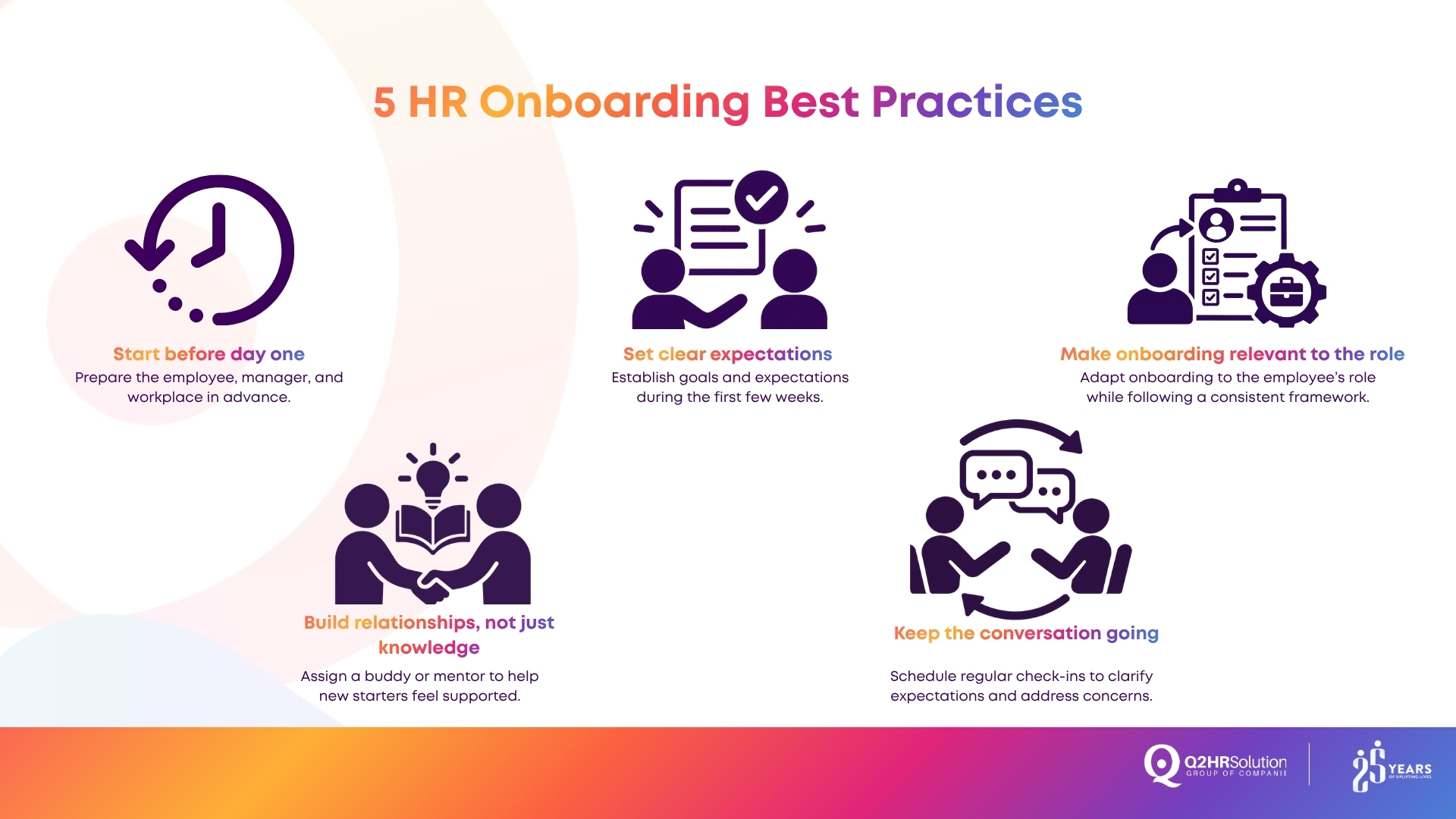
Prepare the employee, manager and workplace in advance.
Fair Work recommends using the first few weeks to establish goals and expectations.
A startup hiring its first finance employee has different needs from a construction business hiring a site worker. Use a consistent framework, but customise the details.
A buddy or mentor gives new starters someone to approach with questions they might hesitate to ask their manager.
Regular check-ins let managers clarify expectations and employees raise concerns.
This process supports employee integration across four connected areas:
Role integration: The employee knows what they are responsible for and what success looks like.
Team integration: They know their colleagues, how to collaborate and where to go for help.
Cultural integration: They understand the organisation’s values and ways of working.
Operational integration: They can navigate the systems, processes and tools their job requires.
Onboarding and recruitment should be viewed as connected stages. Recruitment brings the right person in; onboarding turns that hire into a productive working relationship.
The process can start before day one and run for several months, depending on the role, and the employee’s experience.
Administrative requirements, role training, workplace policies, systems access, introductions, expectations, feedback and ongoing support, plus any applicable Australian employment and workplace obligations.
Induction is one part of onboarding. Induction introduces employees to the workplace, policies and immediate requirements, while onboarding also covers longer-term integration, training and development.
Create a simple repeatable checklist, assign clear ownership and standardise recurring tasks.
Employee integration helps new starters see how their role fits the wider organisation, supporting clearer expectations, stronger working relationships and a smoother transition.
Effective HR onboarding creates a structured bridge between recruitment and becoming a confident, contributing team member.
For Australian businesses, the best approach balances employment requirements with clear expectations, useful training, strong relationships and ongoing support.
Need help improving your HR processes, speak to the Q2 HR Solutions team at https://www.q2hrsolutions.com/contact-us/.
______________________________________________________________________________________________________________________________________________________________________________________
Expert Insights By:
Ynel Nazario is a contributor for Q2 HR Solutions and a Public Relations and Strategic Communications professional with 10 years of experience. She writes about human resources, global mobility, business, technology, and socio-economic trends, with a particular interest in translating complex topics into clear, accessible insights for readers.