

Expanding into a new market can be complicated. Companies need to recruit talent, establish processes, manage compliance, and build infrastructure while keeping the business moving.
Build operate transfer outsourcing offers another path. A provider establishes and operates the business first, then transfers ownership to the client when the operation is ready.
Build-operate-transfer outsourcing is a model in which an outsourcing provider builds and operates a business function or team before transferring ownership and control to the client.
The model has three stages:
BOT can be useful for companies establishing offshore teams, technology operations, shared services, customer support, or other business functions.
The BOT model moves an operation through three phases: build, operate, and transfer.
The provider establishes the operational foundation, including:
The operation should be designed with its eventual ownership in mind.
In this phase, the provider manages day-to-day activities and helps the team reach consistent performance through quality assurance, employee development, process improvement, and KPI tracking.
Documentation and knowledge management also prepare the operation for transition.
Once agreed-upon milestones are reached, ownership can transition to the client.
Depending on the agreement, this may include employees, equipment, technology, processes, documentation, intellectual property, and management responsibilities. Transfer readiness should be planned from the very beginning.
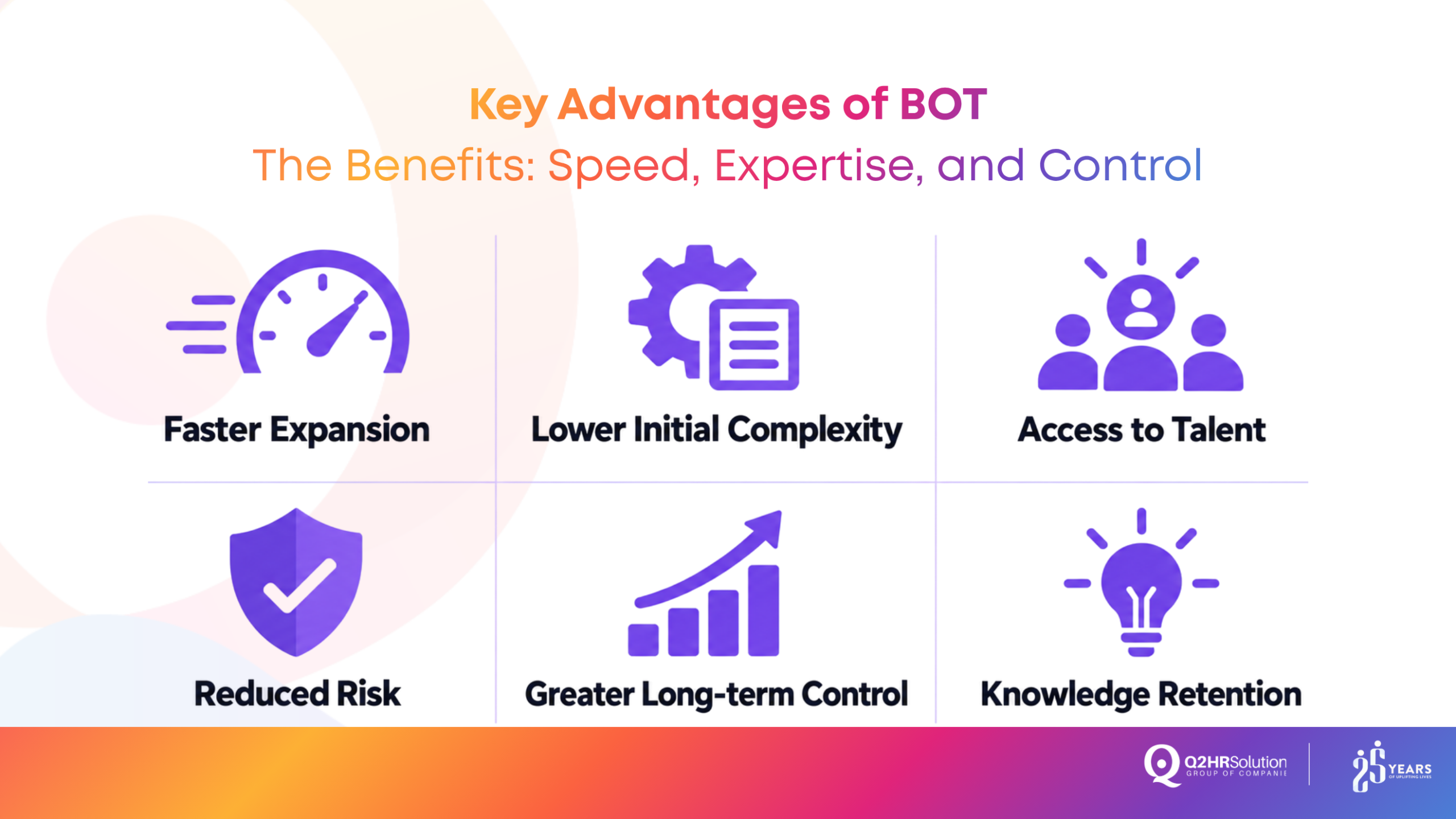
The main benefit of BOT outsourcing is that it combines the speed and local expertise of outsourcing with the long-term control of an internally owned operation.
Key advantages:
Outsourcing strategies are also becoming more flexible. Deloitte’s 2024 survey found that 80% of executives planned to maintain or increase their investment in third-party outsourcing, while 70% had insourced work previously handled by external providers.
This highlights why BOT can be attractive: companies can leverage external expertise while building toward greater internal control.
The biggest difference is the intended end state: traditional outsourcing continues as an external service, while BOT is designed for eventual client ownership.
|
Factor |
Traditional Outsourcing |
BOT Outsourcing Model |
| Primary goal | Ongoing external delivery | Build long-term capability |
| Initial setup | Provider-led | Provider-led |
| Ownership | Usually remains external | Eventually transfers |
| Client control | Typically defined by contract | Increases over time |
| Best suited for | Ongoing outsourced functions | Companies planning eventual ownership |
The right choice depends on whether the company wants an ongoing outsourcing relationship or plans to eventually bring the operation in-house.
BOT outsourcing is a strong option when a company wants to establish an offshore operation but eventually intends to own and manage it.
It may be appropriate for businesses that:
It may be less suitable for short-term projects or companies seeking a completely permanent outsourced function.
The biggest challenge is ensuring the client is prepared to take ownership when the transfer occurs.
Companies should plan for:
A well-designed BOT agreement should define how the operation will be built, managed, and transferred.
Build-operate-transfer means an outsourcing provider establishes and manages an operation before transferring ownership to the client.
It is designed around eventual ownership, while traditional outsourcing generally involves an ongoing relationship with an external provider.
BOT can be useful for companies establishing offshore teams they eventually want to own and manage, providing support during complex setup and early operations.
Build operate transfer outsourcing provides a middle ground between traditional outsourcing and building an offshore operation from scratch. It gives companies access to talent, infrastructure, and local expertise while creating a path toward long-term ownership.
The key is choosing the right partner and defining the eventual transfer before the operation is built.
If you’re exploring whether a BOT strategy makes sense for your business, Contact Q2 HR Solutions to help you evaluate your options and build a practical path toward your offshore operation.
______________________________________________________________________________________________________________________________________________________________________________________
Expert Insights By:
Ynel Nazario is a contributor for Q2 HR Solutions and a Public Relations and Strategic Communications professional with 10 years of experience. She writes about human resources, global mobility, business, technology, and socio-economic trends, with a particular interest in translating complex topics into clear, accessible insights for readers.