

Businesses often need additional talent to meet deadlines, fill skill gaps, or keep operations running smoothly. But should you bring external professionals into your existing team or delegate the work to an outside provider?
Understanding staff augmentation vs. outsourcing can help you choose a workforce strategy that fits your budget, management capacity, and business goals. Both models provide external expertise, but differ in management, responsibilities, and delivery.
This guide explains the key differences, costs, benefits, and situations where each model makes sense for US businesses.
Staff augmentation allows businesses to add external professionals to their existing teams without committing to permanent hires. It is ideal for filling skill gaps while retaining daily control.
For example, a US software company can add developers for a product launch while its project manager directs their work.
Common benefits include:
The trade-off is that your business remains responsible for managing the augmented professionals, coordinating tasks, and maintaining productivity.
Outsourcing involves hiring an external provider to deliver a specific project, service, or business function. Your company sets expectations while the provider manages delivery.
For example, a growing business might outsource customer support to a provider that manages staffing, scheduling, and service delivery.
The US Small Business Administration identifies accounting, marketing, customer service, and human resources among the functions small businesses can outsource. These arrangements can help companies access expertise while focusing on their core operations.
Key benefits include:
Clear contracts and ongoing oversight help maintain service quality.
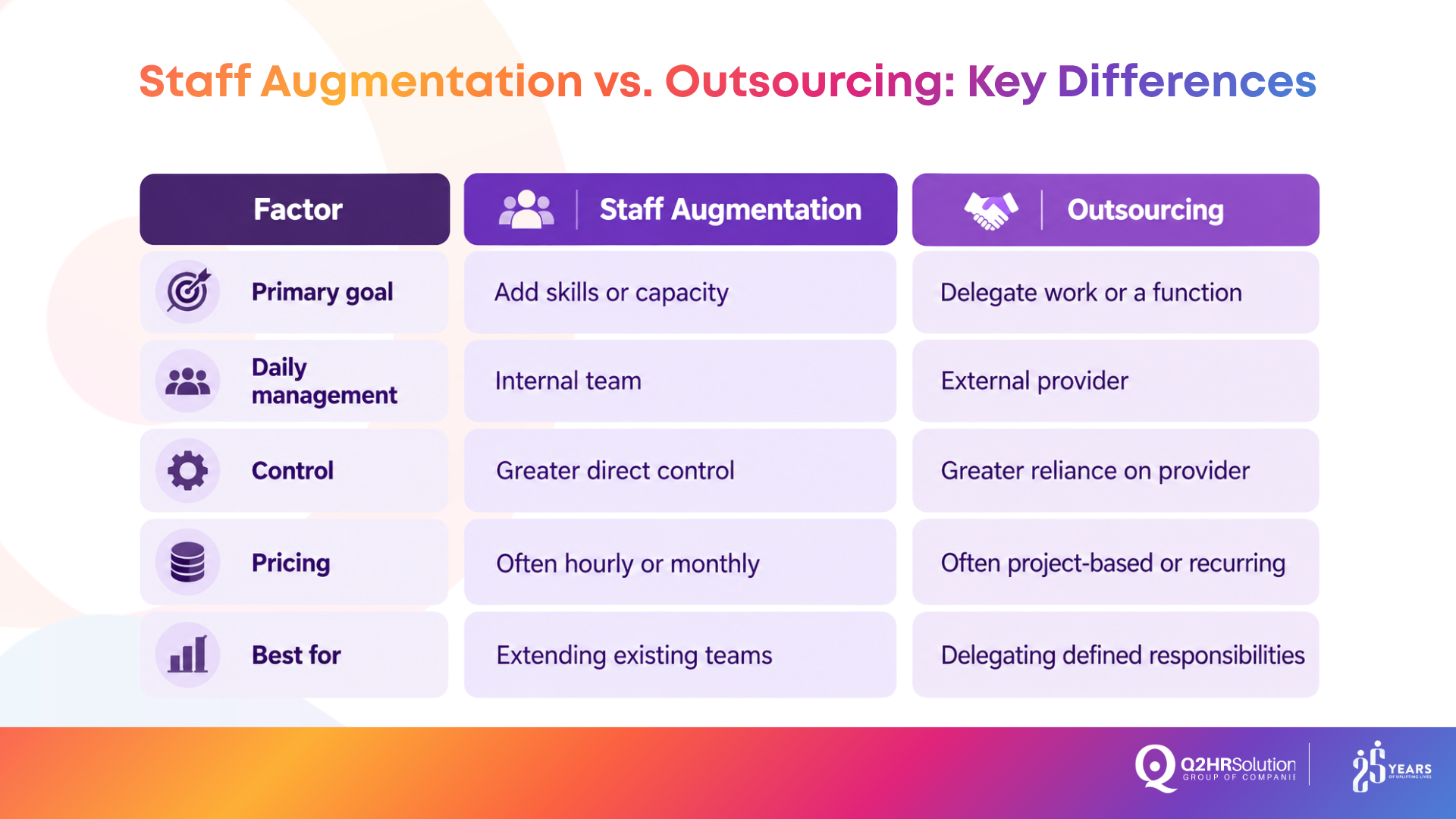
The main difference is who manages the work: your internal team generally directs augmented staff, while an outsourcing provider typically manages delivery.
| Factor | Staff Augmentation | Outsourcing |
| Primary goal | Add skills or capacity | Delegate work or a function |
| Daily management | Internal team | External provider |
| Control | Greater direct control | Greater reliance on provider |
| Pricing | Often hourly or monthly | Often project-based or recurring |
| Best for | Extending existing teams | Delegating defined responsibilities |
Neither model is automatically cheaper, it depends on the total cost of delivery.
Staff augmentation may be cost-effective when you already have managers and processes in place. Outsourcing may make more sense when an external provider can handle an entire function more efficiently.
Consider these costs before deciding:
Compare total costs, not just hourly rates or project fees.
Choose staff augmentation when you need additional people to work under your direction, and outsourcing when you want a provider to manage defined responsibilities.
The workforce landscape also supports the importance of understanding different arrangements. The U.S. Bureau of Labor Statistics reported that 945,000 people worked through temporary help agencies in 2023. This only describes a specific employment arrangement, but it illustrates one established way US businesses access flexible labor.
Project-based staffing services can help businesses secure talent for a defined initiative without building a permanent team for every workload. Depending on the arrangement, this may involve augmentation or managed delivery.
A company launching a product might augment its team with specialists or outsource a specific deliverable.
Staff augmentation suits businesses that need additional skills under internal direction. Outsourcing suits those delegating a defined project or function. The best option depends on your operation needs.
Outsourcing may reduce operating costs, but compare provider fees, transition costs, and service quality before deciding.
Yes. Small businesses can augment internal teams for specialized projects, while outsourcing functions such as customer support, accounting, or administrative services.
Look for relevant industry experience, transparent pricing, clear responsibilities, reliable communication, appropriate security practices, and the ability to scale with your business. Confirm contract terms and performance expectations before committing.
Choosing between staff augmentation and outsourcing comes down to how much control you want to retain, the expertise you need, and the responsibilities you’re ready to delegate. Both models can help businesses respond to changing workloads without relying exclusively on permanent hiring.
If you’re exploring flexible staffing options, Q2 HR Solutions can help you evaluate workforce solutions that align with your business needs. Whether you’re filling temporary skill gaps or considering project-based staffing services, the right approach starts with understanding your goals.
Ready to explore your options? Contact Q2 HR Solutions to discuss your staffing requirements and find a solution that supports your business.
______________________________________________________________________________________________________________________________________________________________________________________
Expert Insights By:
Ynel Nazario is a contributor for Q2 HR Solutions and a Public Relations and Strategic Communications professional with 10 years of experience. She writes about human resources, global mobility, business, technology, and socio-economic trends, with a particular interest in translating complex topics into clear, accessible insights for readers.