

Staff augmentation is a workforce model that allows a business to add external professionals to its existing team for a specific period, project, or business need.
Instead of immediately creating permanent positions, a company can bring in people with the skills it needs and integrate them into an existing project or department. This can be useful when a business is facing a temporary workload increase, has a specific skills gap, or needs additional people to meet an important deadline.
The International Labour Organization (ILO) describes temporary agency work as a type of arrangement involving a worker, an employment agency, and a user company. The exact legal relationship between these parties varies by country, which is why businesses need to understand the employment and contracting rules that apply in their location.
In a typical staff augmentation arrangement, the client company remains closely involved in the day-to-day work. The external professional may attend the same meetings, use the same project-management tools, follow the client’s processes, and work toward the same project objectives as the internal team.
The important point is that staff augmentation is about adding capacity or expertise without necessarily expanding the permanent workforce.
This makes the model particularly relevant when business needs change quickly. The OECD has noted that companies are increasingly dealing with changing skill requirements and skill gaps as digitalization and new technologies reshape the workplace.
For Philippine businesses, however, the structure of the engagement should also be reviewed carefully. Contracting and subcontracting arrangements are subject to Philippine labor regulations, including Department Order No. 174, Series of 2017. DOLE states that the rules cover contracting and subcontracting arrangements and prohibit labor-only contracting.
So, staff augmentation should not simply be viewed as “hiring people temporarily.” It is a structured workforce arrangement that needs clear responsibilities, proper documentation, and appropriate legal and operational safeguards.
Although the details can vary from one organization to another, a well-managed staff augmentation engagement generally follows seven stages:
Let’s look at each step.
The first step is understanding why additional staff are needed.
Before contacting a staffing partner, business leaders should determine whether the problem is a lack of people, a lack of specific skills, or both.
For example, a company may already have a capable software development team but suddenly need additional cybersecurity expertise for a new product. Another business may have the required skills internally but not enough people to complete a major project on schedule.
The OECD identifies skill gaps as an ongoing challenge for businesses and notes that companies use several approaches to address them, including training, recruitment, changes in work practices, and outsourcing.
A practical workforce assessment should answer questions such as:
It is also important to distinguish between a temporary requirement and a permanent business need. If a position will be needed indefinitely, direct hiring may ultimately make more sense. If the requirement is tied to a project, seasonal demand, or a temporary skills shortage, augmentation may provide greater flexibility.
Once the business understands what it needs, the next step is finding an appropriate partner.
This is more than comparing hourly rates or monthly fees. A good partner should be able to understand the client’s requirements and provide professionals whose skills match the actual work.
When evaluating potential providers, consider:
For businesses operating in the Philippines, compliance deserves particular attention. DOLE’s rules on contracting and subcontracting include registration requirements for covered contractors and subcontractors and establish standards for lawful contracting arrangements.
Businesses should therefore evaluate both commercial capability and compliance before entering into an engagement.
Once a partner has been selected, the company needs to define exactly what the augmented professional will do.
A vague request such as “we need a software developer” is unlikely to produce the best results.
Instead, provide details about:
A clear role description also helps the provider identify candidates more accurately.
This step is particularly important for project-based work. PMI materials on resource management emphasize the importance of planning for the right people, with the right skills, at the right time and for the right projects.
The more clearly the business defines the work, the easier it becomes to evaluate candidates against actual requirements rather than general qualifications.
After the requirements are defined, the staffing partner begins sourcing and screening potential candidates.
Depending on the agreement, the provider may conduct the initial screening while the client conducts the final interview, technical assessment, or selection.
For specialized positions, businesses should look beyond resumes.
A candidate may have the right job title and years of experience but still lack the practical skills needed for a particular project. A skills-first approach can help employers focus on what a person can actually do rather than relying exclusively on formal qualifications.
The OECD has increasingly highlighted skills-first approaches as a way for employers to better match available talent with changing business requirements.
For example, instead of simply asking for a “senior data engineer,” a company could specify that the person must have experience with:
For technical positions, a practical assessment can also be useful because it provides evidence of how the candidate approaches real work.
The final selection should be based on a combination of technical capability, communication skills, experience, availability, and ability to work within the client’s environment.
Selecting the right candidate is only part of the process. The next challenge is getting that person integrated into the team.
External professionals should receive enough information to understand:
They should also receive access to the systems, documentation, communication channels, and other resources necessary to perform their work.
This is where businesses sometimes make a mistake: they assume that because an external professional is experienced, onboarding is unnecessary.
In reality, experience with the job is not the same as experience with your company.
A highly qualified developer can still lose time if they do not understand the organization’s codebase, approval process, security requirements, or project priorities.
A practical onboarding process can include:
The objective is simple: make sure the external professional understands not only what to do, but also how the organization works.
Once onboarding is complete, the augmented professional becomes part of the working project or team.
This is where the distinction between staff augmentation and a managed service becomes particularly important.
In a staff augmentation arrangement, the client generally remains closely involved in assigning work, setting priorities, reviewing results, and coordinating the project. However, the precise allocation of responsibilities depends on the contractual arrangement and applicable law.
The team should establish clear expectations around:
Augmented professionals should also be included in appropriate team activities. If they are working on the same project as internal employees, excluding them from important meetings or communication channels can create unnecessary barriers.
Regular check-ins are useful, particularly during the early stages of an engagement.
Instead of waiting until the end of a project to identify problems, managers should address issues as they arise.
A simple management cycle can be:
Set expectations → Assign work → Review progress → Give feedback → Adjust priorities → Measure results.
This makes staff augmentation an active management process rather than simply adding names to a project roster.
The final step is completing the engagement properly.
When the project ends, the business may:
Before an engagement ends, the company should complete knowledge transfer and documentation.
This may include:
Proper offboarding protects both the business and the project.
It also makes future scaling easier because the company has a documented process for bringing external professionals into and out of its workforce.
Staff augmentation can be structured in different ways depending on the company’s location, project requirements, and expected duration.
| Model | Description | Best For |
| Onshore Staffing | Professionals located in the same country as the client | Close communication, local market knowledge, and easier coordination |
| Nearshore Staffing | Professionals located in a nearby country or region | Businesses seeking geographic proximity while accessing a broader talent pool |
| Offshore Staffing | Professionals located in another country or distant market | Access to specialized or larger talent pools and extended operating hours |
There is no universally “best” location.
The right choice depends on the nature of the work. A position requiring frequent face-to-face collaboration may benefit from geographic proximity, while a project that can be managed digitally may be suitable for offshore talent.
The Philippines is already an important participant in global services and digital work. The ILO has documented the growth of the Philippine business-process outsourcing sector and, at the same time, highlighted the importance of addressing skills development and decent-work considerations.
Current Philippine labor data also shows the importance of the services sector. In May 2026, services accounted for 61.8% of total employment in the Philippines, according to the PSA.
This may be appropriate for:
This may be more suitable when:
Used for relatively straightforward work where the company needs additional capacity.
Used when the business requires expertise that is not readily available within its current workforce.
Used for complex or technical requirements such as cybersecurity, artificial intelligence, advanced software engineering, data architecture, or specialized financial or engineering functions.
The key is not to select a model simply because it is cheaper. The model should match the work, risk, timeline, skill requirements, and level of management involvement.
These terms are often used interchangeably, but they describe different approaches to obtaining external expertise or capacity.
The most important distinction is who is responsible for managing the work and delivering the outcome.
| Model | What It Means | Who Typically Manages the Work? | Best For |
| Staff Augmentation | External professionals are added to an existing team | Client’s internal management structure, subject to the agreement | Filling skills or capacity gaps |
| Consulting | External specialists provide advice, analysis, or recommendations | Consultant provides expert guidance; client makes business decisions | Strategy, diagnosis, transformation, or specialized advice |
| Managed Services / Outsourcing | An external provider takes responsibility for a defined service or function | Service provider | Ongoing functions or defined business outcomes |
The ILO makes a useful distinction between temporary agency work and subcontracting. In temporary agency arrangements, workers may be supplied to a user company, while subcontractors generally perform a service or produce an outcome and manage their workforce themselves.
In simple terms:
Staff augmentation: “We need additional people on our team.”
Consulting: “We need specialized advice or expertise.”
Outsourcing/managed services: “We want another organization to handle this function or deliver this outcome.”
The boundaries can become more complicated in practice, particularly when contracts are structured differently across countries. Businesses should therefore avoid relying on terminology alone and should examine the actual responsibilities, reporting relationships, and contractual arrangements.
For Philippine operations, businesses should also consider applicable DOLE rules when structuring contracting or subcontracting arrangements.
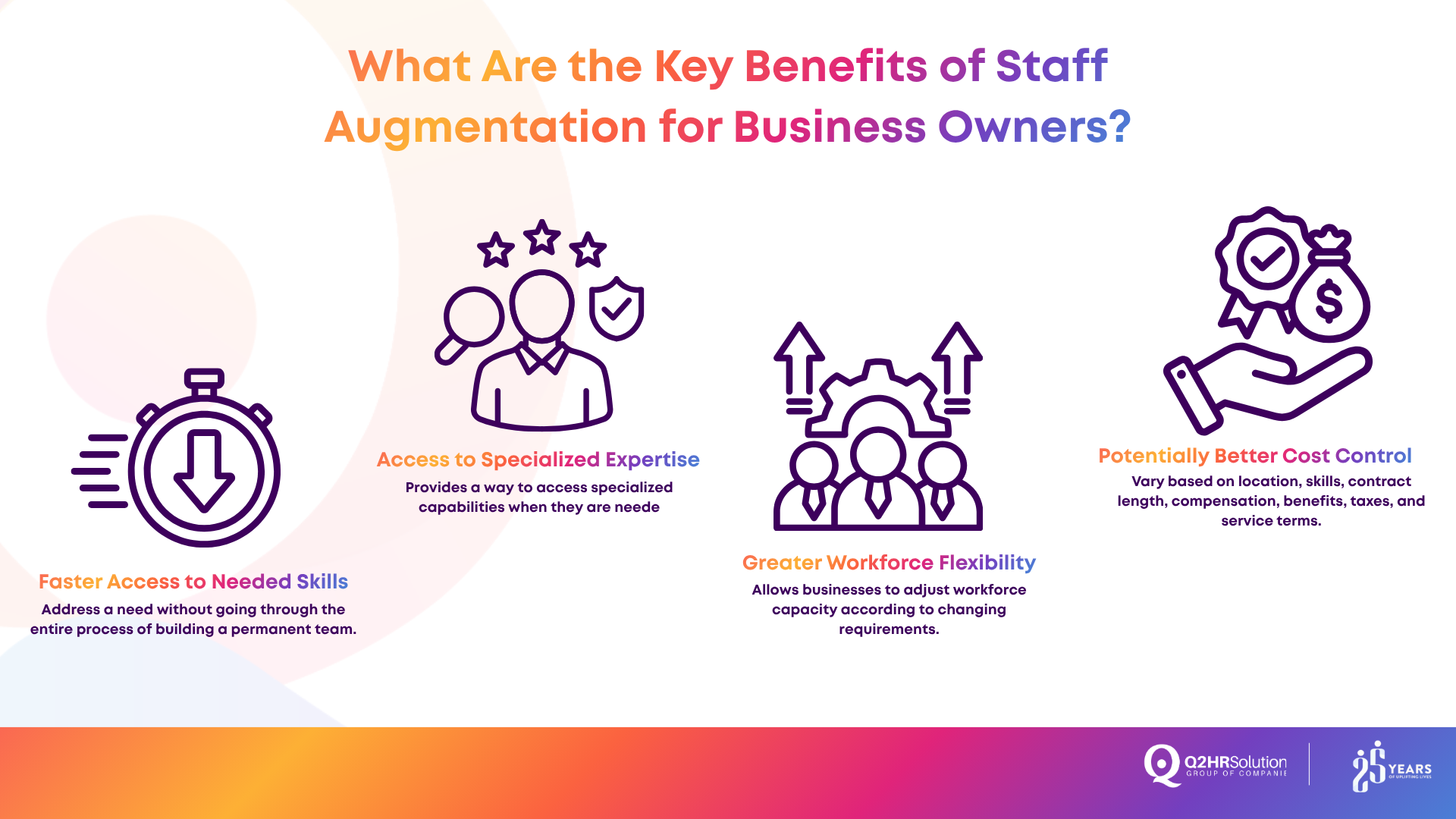
Staff augmentation can provide several practical benefits when the model is properly designed and managed.
One of the main reasons businesses use staff augmentation is to address a need without going through the entire process of building a permanent team.
This can be particularly useful when a company needs a specialized skill for a specific project.
The OECD reports that firms continue to experience skill gaps, particularly as digitalisation and technological change alter the skills businesses require.
Instead of waiting until the existing workforce develops the required capability, a business can consider bringing in external expertise while continuing to develop its internal team.
Business demand does not always remain constant.
A company may need additional developers during a product launch, additional finance professionals during a major implementation, or additional customer-support capacity during a seasonal period.
Staff augmentation allows businesses to adjust workforce capacity according to changing requirements.
This can be especially valuable for companies that do not want every temporary increase in workload to result in a permanent increase in headcount.
Some skills are difficult to maintain internally when the business only needs them occasionally.
For example, a company may not need a full-time cybersecurity specialist, cloud architect, or data engineer throughout the year.
Staff augmentation provides a way to access specialized capabilities when they are needed.
The OECD’s research on skills-first hiring similarly emphasizes the importance of helping businesses identify and access specific capabilities as skill requirements change.
Cost savings should not be treated as an automatic result of staff augmentation.
The actual financial benefit depends on factors such as location, skill level, engagement length, compensation, infrastructure, taxes, benefits, recruitment costs, and the terms of the service agreement.
However, the model can give businesses greater control over when and where workforce spending is committed.
Rather than immediately creating a permanent position for a short-term requirement, a company can align the engagement with the period in which the additional capacity is actually needed.
For this reason, business leaders should evaluate staff augmentation based on total cost and business value, rather than simply comparing salaries.
A successful staff augmentation project is not simply one where the company fills an open position.
It is one where the additional professional becomes productive within the team’s working environment and contributes to the intended business objective.
Example: Accelerating an AI Product Launch
Consider a fintech company preparing to launch an AI-powered fraud-detection feature.
The company’s internal team has strong data-science capabilities but does not have enough production-level MLOps experience to complete the project within the required timeframe.
Instead of delaying the project while building a permanent MLOps team, the company decides to augment its existing team with two experienced MLOps professionals.
The augmented professionals:
The project is then reviewed based on measurable outcomes such as:
Once the specialized work is complete, the company can reassess whether it still needs the additional MLOps capacity.
This illustrates an important principle: the success of staff augmentation should be measured by business and project outcomes, not simply by the number of people deployed.
A successful engagement generally starts with four things:
There is no universal timeline.
The process depends on the role, skill requirements, availability of candidates, screening process, client interview schedule, documentation, and onboarding requirements.
Straightforward roles may be filled relatively quickly, while highly specialized positions can take considerably longer.
The best approach is to establish the required start date early and communicate the hiring criteria clearly to the staffing partner.
The primary difference is the management and delivery structure.
With staff augmentation, external professionals are added to an existing team and generally work within the client’s project environment.
With outsourcing or managed services, the external provider typically assumes responsibility for delivering a defined service, function, or outcome.
The ILO also distinguishes temporary agency work from subcontracting based partly on who manages the work and how the contractual relationship is structured.
Common models can be categorized by:
The right model depends on the company’s project requirements, budget, timeline, management structure, and availability of talent.
Integration starts before the person begins work.
Businesses should provide:
Most importantly, businesses should avoid creating an unnecessary divide between “internal” and “external” workers when both groups are contributing to the same project.
There is no reliable universal percentage that applies to every staff augmentation arrangement.
The financial impact depends on the role, location, engagement length, compensation, infrastructure, statutory obligations, provider fees, and other costs.
Rather than assuming a fixed percentage of savings, businesses should compare the total cost of the engagement against the cost of hiring, maintaining, and eventually reducing a permanent position.
This gives decision-makers a more realistic picture of the financial value.
Staff augmentation can give businesses a practical way to respond to changing workforce requirements without immediately committing to permanent headcount.
Whether the business needs additional technical expertise, temporary project support, or access to specialized skills, the model can provide flexibility while allowing the company to remain closely involved in its projects and day-to-day operations.
But successful staff augmentation does not happen simply by adding people to a project.
It starts with identifying the actual workforce gap, defining the role clearly, selecting qualified professionals, establishing an effective onboarding process, managing performance, and planning for the eventual completion or extension of the engagement.
Businesses should also pay close attention to the legal and contractual structure of the arrangement. In the Philippines, contracting and subcontracting arrangements must be considered in light of applicable labor regulations, including DOLE Department Order No. 174.
Ultimately, the best staff augmentation strategy is one that connects people, skills, timing, and business objectives.
If your business needs to fill a skills gap, increase project capacity, or bring in specialized professionals without immediately expanding permanent headcount, Q2 HR Solutions can help you explore a staff augmentation approach suited to your requirements.
From identifying the skills you need to sourcing qualified professionals and supporting the onboarding process, Q2 HR Solutions can help businesses build the additional capacity they need while keeping their project objectives in focus.
[Hiring in the Philippines gives companies access to a deep pool of skilled, English-proficient talent, but lasting success depends on far more than filling vacancies. A clear, well – structured approach, supported by local market knowledge, helps businesses attract the right people, avoid costly delays, and build teams ready to grow alongside the business.
As your operations expand, recruitment and compliance should move together. Finding great candidates is only the beginning. Contracts, payroll, statutory benefits, and labor law will all shape whether your expansion runs smoothly. A partner that understands both talent and Staff Augmentation (SA) services makes the shift from hiring people to building a fully compliant workforce far easier.
Whether you are planning your first Philippine hire or scaling an existing team, Q2 HR Solutions is ready to support you at every stage. Get in touch with our team today to see how our recruitment and EOR expertise can help you hire smarter, expand faster, and grow your workforce in the Philippines with confidence.
Contact Q2 HR Solutions today to discuss your staff augmentation requirements and find the right talent for your next project.
___________________________________________________________________________________________________________________________________________________________________________________
Written by:
Ferdinand A. A. Limbo (Ferdie) is a Consultant at Q2 HR Solutions. He has more than 20 years of executive experience in Human Resources, Facilities Services and Management, Retail, Wholesale, Engineering Consultancy and various other industries. Ferdie attended a Master of Business Administration (MBA) program at the University of Santo Tomas.