

Knowing when and how to add employees is integral to running a growing business. Hire too early, and labor costs can rise before the additional capacity is needed. Wait too long, and employees may face excessive workloads, overtime, and burnout. That is why analyzing staffing needs should come before making a hiring decision.
69% of organizations reported difficulty recruiting for full-time positions over the previous 12 months, according to SHRM research. This makes it even more important to understand workforce needs before hiring.
This analytical process determines how many employees a business needs, what skills they should have, and when that capacity will be required.
It considers three key areas:
The analysis identifies workforce requirements, while a staffing plan determines how to meet them through hiring, training, internal mobility, contractors, or workforce augmentation.
A staffing analysis helps businesses balance workforce capacity with actual demand. It can help organizations:
It also helps businesses avoid treating every capacity problem as a hiring problem.
Begin by identifying what the business needs to accomplish.
Consider upcoming:
Evaluate the people and capacity you already have before determining what you need.
Review:
Compare the amount of work your business needs to complete with what your current workforce can realistically handle.
Useful measures include:
If employees are spending significant time on inefficient processes, duplicated work, or manual tasks, the underlying issue may be capacity rather than headcount.
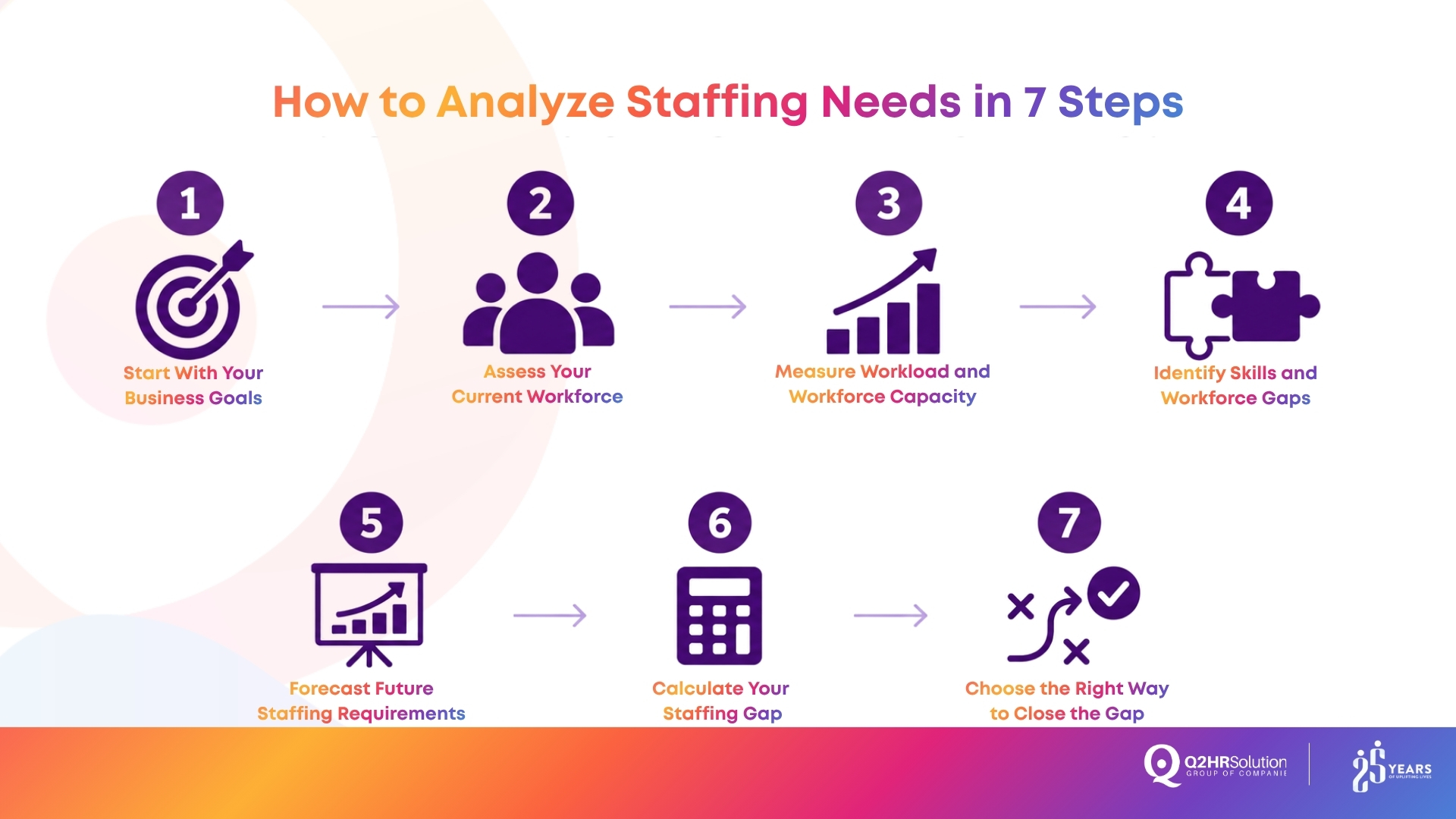
A business can have enough employees and still have a staffing problem. Compare the capabilities your business needs with those currently available. Look for:
Not every gap requires a new hire. Depending on the situation, businesses can use training, internal mobility, contractors, or workforce augmentation.
Hiring needs should reflect where the business is going. Use available data such as:
A simple way to frame the problem is:
Staffing gap = Required workforce capacity − Available workforce capacity
For example, if projected demand requires capacity equivalent to 12 employees but the current workforce provides the capacity of nine, the business has a gap equivalent to three employees.
That does not automatically mean hiring three full-time employees. The next step is determining the most practical way to close the gap.
The appropriate staffing solution depends on the type and duration of the need.
|
Business situation |
Potential solution |
| Permanent increase in workload | Full-time hiring |
| Short-term increase in demand | Temporary staffing |
| Specialized project | Contract workers |
| Existing skills gap | Training or upskilling |
| Uneven workload distribution | Reallocation |
| Excessive manual work | Process improvement or automation |
| Seasonal demand | Flexible staffing or workforce augmentation |
| Critical vacancy | Targeted recruitment |
This supports cost effective staffing by addressing the need before choosing an employment model.
Several patterns can indicate that your workforce does not have enough capacity:
Workforce needs should be reviewed regularly and whenever there is a significant change in business demand, structure, or capacity. An annual review can support budgeting and long-term workforce planning, while growing businesses may benefit from quarterly reviews.
Businesses should consider workload, employee capacity, skills, business goals, projected demand, turnover, seasonality, budget, and timing.
Estimate the staffing capacity required to complete projected work and compare it with the capacity currently available.
No. A gap may be addressed through training, internal transfers, workload redistribution, automation, temporary workers, contractors, or other workforce solutions.
Workforce augmentation is the use of external or flexible workers to supplement an existing team when additional capacity or specialized skills are needed. It can be useful for temporary situations where permanent headcount is not the right fit.
A staffing needs analysis is not simply a headcount exercise. A practical process is to identify the work, measure required capacity, assess the current workforce, forecast future demand, identify the gap, and choose the right combination of hiring, training, workforce augmentation, or process improvements.
If you need help evaluating your workforce requirements and finding the right staffing solution, speak to the Q2 HR Solutions team at https://www.q2hrsolutions.com/contact-us/.
______________________________________________________________________________________________________________________________________________________________________________________
Expert Insights By:
Ynel Nazario is a contributor for Q2 HR Solutions and a Public Relations and Strategic Communications professional with 10 years of experience. She writes about human resources, global mobility, business, technology, and socio-economic trends, with a particular interest in translating complex topics into clear, accessible insights for readers.