


A candidate may have an impressive résumé and strong interview skills, but can they interpret data, calculate percentages, and make sound decisions under pressure? A numerical reasoning test helps employers evaluate these abilities during recruitment.
Understanding the format can make preparation less intimidating. HR professionals can use results to evaluate for roles that involve numerical skills.
Here’s what to know about question types, sample questions, and preparation strategies.
A numerical reasoning assessment measures a person’s ability to interpret numerical information, perform calculations, and draw logical conclusions from data.
Unlike a basic mathematics exam, it uses practical contexts such as sales tables, financial summaries, and workplace scenarios.
Employers may use these assessments when recruiting for positions in finance, accounting, operations, administration, analytics, and other roles requiring numerical accuracy.
According to the U.S. Office of Personnel Management (OPM), cognitive ability tests assess skills such as mathematical ability and problem-solving, which can help predict job performance and training success. However, results should be considered alongside other relevant selection methods.
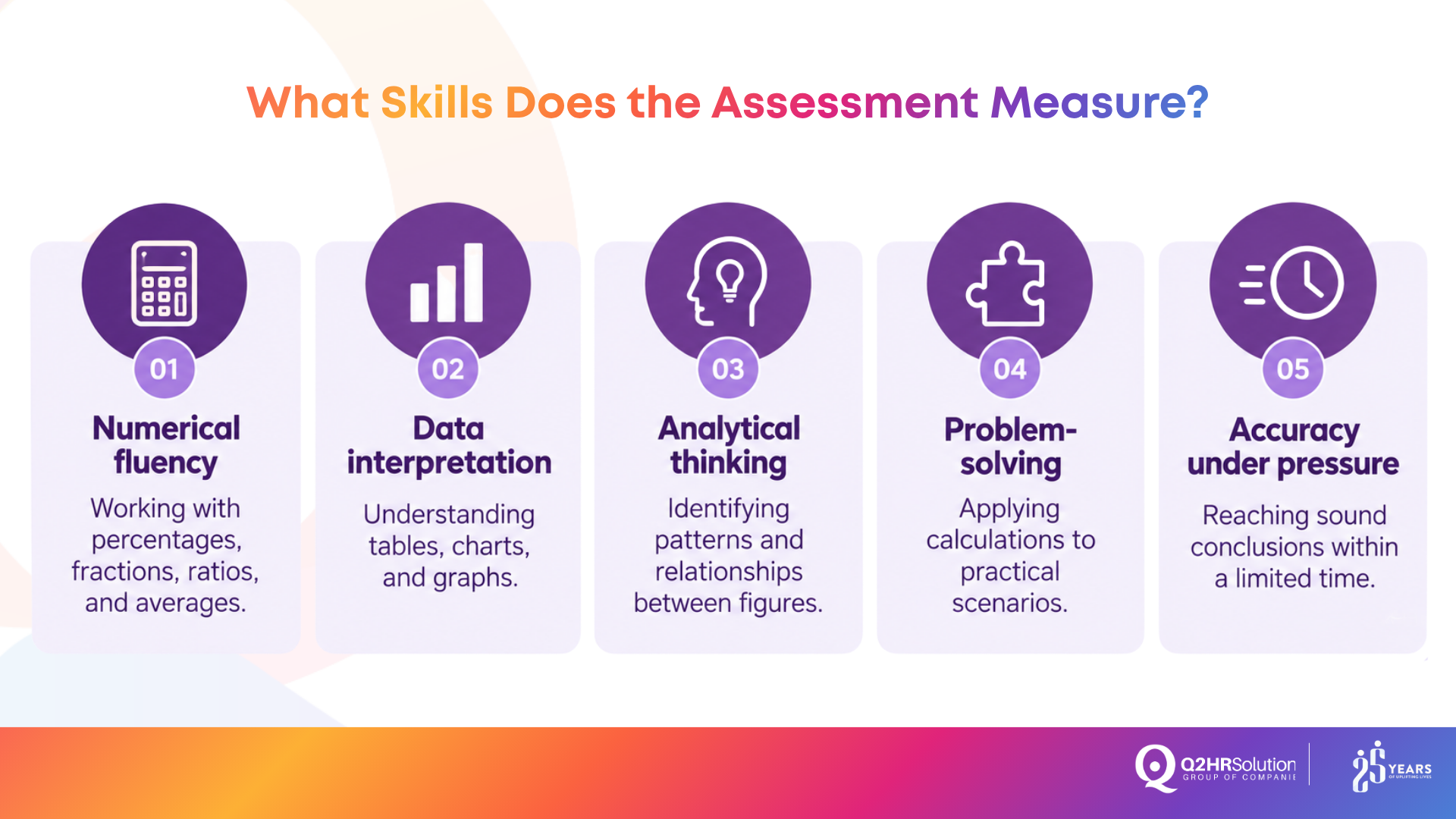
It typically evaluates several skills:
The skills emphasized depend on the assessment provider and the job requirements. For example, a finance position may require more detailed numerical analysis than a role focused primarily on customer relationships.
Candidates may encounter several types of questions, including:
Most questions rely on fundamental mathematical concepts. The challenge is often interpreting the information correctly and selecting the appropriate calculation.
Try these sample questions to see how it works.
Example 1: Percentage increase
A company’s monthly revenue increased from ₱200,000 to ₱230,000. What was the percentage increase?
Solution:
Example 2: Ratios
A department has 24 employees. The ratio of analysts to coordinators is 3:1. How many analysts are there?
Solution:
The ratio has four parts in total. Divide 24 by 4 to get 6 employees per part, then multiply 6 by 3.
Answer: 18 analysts.
Example 3: Averages
A team processes 120, 150, and 180 applications over three days. What is its average daily output?
Solution:
Add the values and divide by three: (120 + 150 + 180) ÷ 3 = 150 applications per day.
These examples show why candidates should practise calculations and data interpretation. Always check the original values, units, and wording before choosing an answer.
Preparation does not necessarily require advanced mathematics. A structured approach can help candidates identify weaknesses and improve their performance.
During the test, read each question carefully, focus on the relevant information, and avoid spending too much time on a single difficult problem when the format allows you to move on.
Difficulty depends on the assessment, time limit, and candidate’s familiarity with the question types. Practising percentages, ratios, averages, and data interpretation can make the questions more manageable.
There is no universal passing score. Employers may use minimum thresholds or compare results against a relevant candidate group. Check the employer’s requirements rather than relying on a general benchmark.
Some assessments allow calculators, while others do not. Always follow the instructions provided by the employer or assessment provider.
Employers can use results to evaluate job-related numerical skills, particularly in roles involving data or calculations. Assessments should align with the role’s requirements and complement other evaluation methods, such as structured interviews and practical skills tests.
These tests can help candidates prepare for recruitment assessments and give employers additional insight into job-related skills, but it works best as part of a well-designed selection process.
For support with your workforce and recruitment needs, contact Q2 HR Solutions to discuss practical staffing solutions tailored to your business.
______________________________________________________________________________________________________________________________________________________________________________________
Expert Insights By:
Ynel Nazario is a contributor for Q2 HR Solutions and a Public Relations and Strategic Communications professional with 10 years of experience. She writes about human resources, global mobility, business, technology, and socio-economic trends, with a particular interest in translating complex topics into clear, accessible insights for readers.