


Choosing a recruitment partner is a business decision, not simply a search for CVs. The right recruitment companies in the Philippines should understand your roles, industry, workforce plans and hiring goals.
The Philippine Statistics Authority reported a 64.1% labor force participation rate in 2025, representing about 51.16 million people in the labor force. For employers, this broad market creates opportunity, but finding the right people still requires a disciplined approach.
The best recruitment companies in the Philippines are those that fit your needs, so define those needs before approaching agencies. Identify vacancies, job levels, skills, locations, salary parameters and deadlines. Also decide whether you need one-off hiring, recurring recruitment or support for a major expansion.
Look for relevant expertise, a structured process, transparent communication and measurable results. A credible partner should explain how it sources, screens and reports progress.
A Philippines recruitment company should be assessed against clear criteria, including defining requirements, checking expertise, researching reputation, assessing recruitment processes and reviewing contractual terms.
Compliance should be non-negotiable. The Department of Labor and Employment (DOLE) lists Department Orders 216-20 and 217-20 among the rules governing recruitment and placement by private employment agencies for local employment.
Before appointing an agency, verify its authority or registration with DOLE-NCR. It provides an online facility for checking registered private employment agencies by name, address or registration number.
Review how the provider handles candidate information, references and background checks. A reputable agency should be willing to explain its safeguards and responsibilities rather than treating compliance as an afterthought.
A strong process should be clear from vacancy intake through sourcing, screening, interviews, selection and offer. Ask the provider to explain each stage rather than simply claiming a “large talent pool.”
Ask:
Recruitment performance should also be measurable. SHRM’s 2025 recruiting benchmarking report found median time-to-fill for both executive and non-executive positions was about a month and a half. This demonstrates why employers should discuss realistic timelines and identify where delays occur.
Candidate quality matters just as much as speed. Ask how recruiters assess technical qualifications, communication, cultural fit and motivation. A shortlist that arrives quickly but requires extensive re-screening may create more work for your internal team.
RPO means outsourcing all or part of recruitment to an external provider. Local Buy describes models ranging from on-demand and project-based support to full or end-to-end RPO.
The RPO recruitment process can be scaled to the employer’s needs. Ongoing hiring may support end-to-end RPO, while short-term expansion may call for project support.
When evaluating RPO recruitment process outsourcing, ask what remains with internal HR, how reporting works and which metrics are tracked. The right model should increase capacity without adding unnecessary complexity. A Philippines recruitment company offering RPO recruitment process outsourcing should also explain how technology, sourcing and reporting support delivery.
Do not compare agencies on fees alone. Review the total commercial arrangement, including payment triggers, replacement provisions, service scope, turnaround expectations and reporting.
Ask shortlisted providers to respond to the same requirements. This makes comparisons fairer and can reveal differences in sourcing, screening, account management and candidate care.
For larger programs, consider time-to-shortlist, time-to-fill, offer acceptance, quality of hire and retention. These measures help determine whether recruitment support is creating business value instead of simply increasing the number of CVs received.
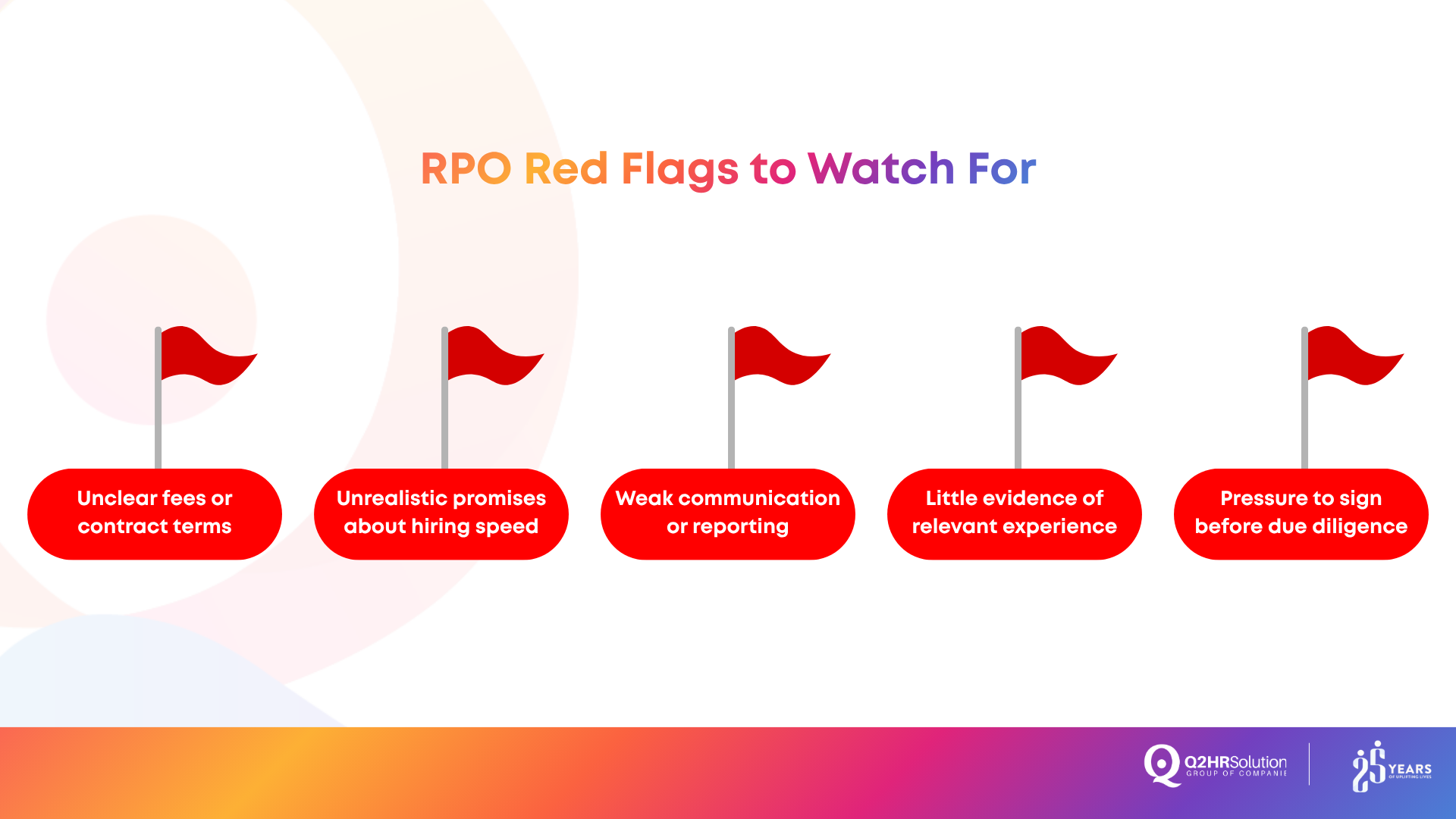
Be cautious when a provider cannot explain its process, avoids compliance questions or gives vague answers about screening. Other warning signs include:
A professional recruiter should welcome reasonable questions. Transparency early can indicate how the relationship will operate later.
Choose based on role expertise, compliance, sourcing capability, communication, measurable performance and commercial fit—not brand recognition alone.
Ask about sourcing, screening, timelines, replacement terms, fees, reporting, responsibilities and escalation procedures. Confirm important commitments in writing.
The provider manages an agreed portion or all recruitment activities, while the employer retains decision-making responsibilities defined in the engagement.
No. End to end RPO is most useful when an organization has sustained or complex hiring requirements and wants an external partner to manage the broader recruitment function.
Finding the right recruitment partner means reducing hiring friction while improving talent acquisition quality and consistency. The strongest recruitment companies in the Philippines combine local market knowledge, disciplined processes, compliance awareness and accountability.
As your organization requires scalable hiring support, Q2 HR Solutions can help. Our RPO recruitment process services can support employers seeking additional recruitment capacity and a more consistent hiring approach.
Contact Q2 HR Solutions to discuss an RPO solution designed around your workforce requirements.
___________________________________________________________________________________________________________________________________________________________________________________
Expert Insights By:
Ferdinand A. A. Limbo (Ferdie) is a Consultant at Q2 HR Solutions. He has more than 20 years of executive experience in Human Resources, Facilities Services and Management, Retail, Wholesale, Engineering Consultancy and various other industries. Ferdie attended a Master of Business Administration (MBA) program at the University of Santo Tomas.