

When US companies first look offshore, the default move is to hire a freelancer and “see how it goes.” Legally, that person is an independent contractor, and the arrangement brings limits and risks from day one.
There is a better way to test the water: start with one employee through an Employer of Record (EOR), then scale when you are ready. This guide covers the distinction between employee and independent contractor, the benefits of hiring independent contractors, and why one EOR hire gives you all of them, without the trade-offs.
An EOR is a licensed local partner that legally employs your chosen person on your behalf. It handles the contract, payroll, taxes, statutory benefits and compliance. You choose the hire, set their goals and manage their work, just as you would your own staff.
You don’t need a team to begin. One person is enough to start, with no local entity and no setup costs.
US law uses several tests to decide whether someone is genuinely self-employed:
The more you direct someone, the harder it is to call them a freelancer. With an EOR the question never arises: your hire is properly employed from day one.
The legal difference between employee and independent contractor shapes who carries the risk, who controls the work and who owns it:
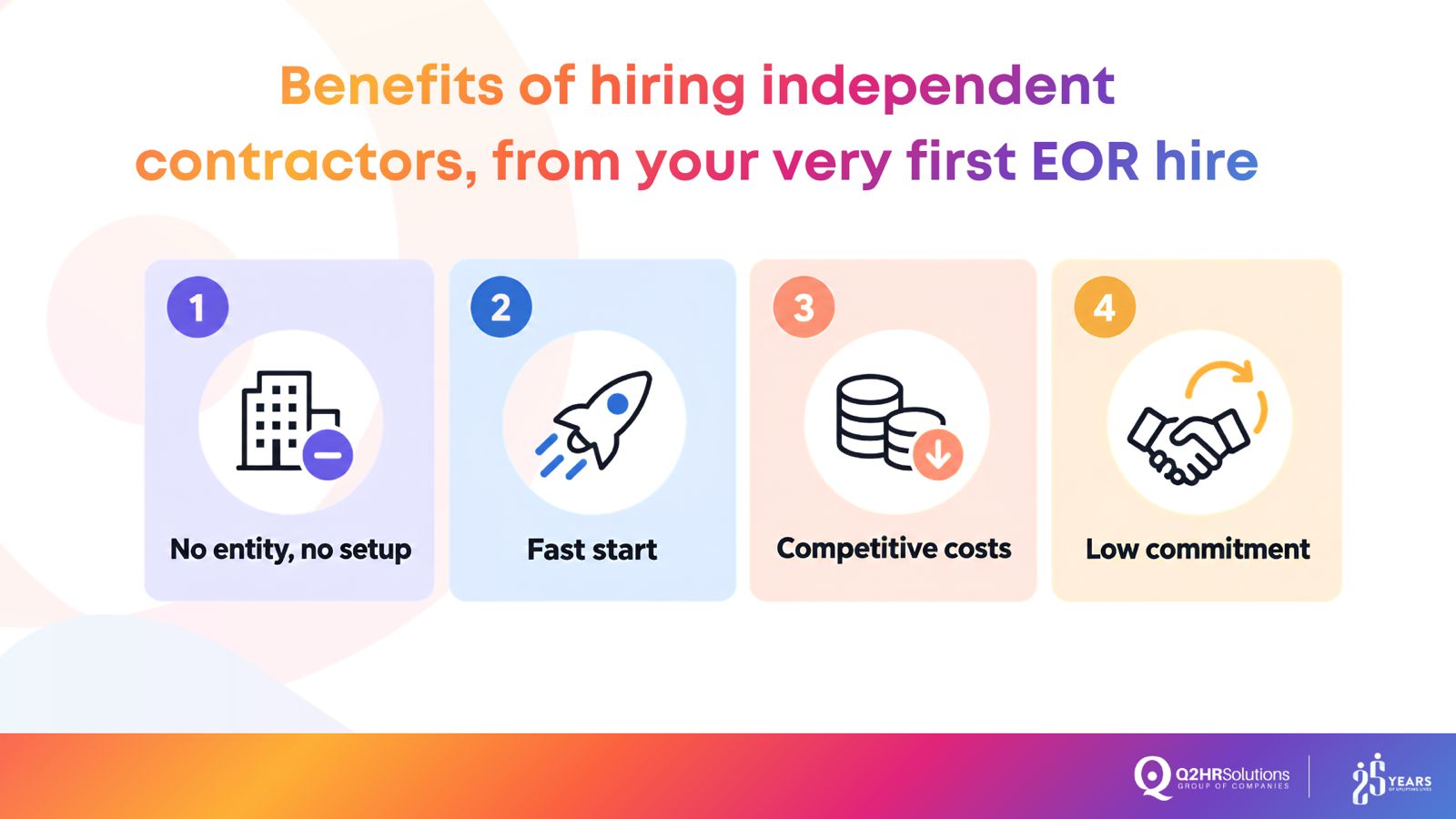
The benefits of hiring independent contractors are speed, low commitment and access to global talent. One EOR hire gives you every one of them:
You keep the freelancer advantages, and add compliance, loyalty and full management control.
Unlike an independent contractor, an EOR employee is a foundation you can build on. A typical growth path looks like this:
There is no restart along the way. You never need to unwind freelance arrangements or rehire people you have already trained.
The Philippines offers a large, skilled, English-speaking workforce with strong alignment to US business culture. It is also where many US companies default to hiring independent contractors, often without realizing the local rules.
Philippine labor law applies a four-fold test: selection, payment of wages, power of dismissal and, above all, power of control. A Philippine-based independent contractor who works like an employee may be treated as one, with mandatory 13th-month pay and contributions to SSS, PhilHealth and Pag-IBIG. Starting with EOR avoids that risk entirely.
Q2HR Solutions Group has supported international companies in the Philippines for nearly 25 years. As a DOLE-licensed, ISO-certified and Investors in People–accredited partner, Q2HR combines EOR with recruitment and BOT, so you can find, employ and grow your team with one local partner. It is a smarter alternative to hiring independent contractors one by one.
In practice, yes. “Freelancer” is the everyday term for the same legal classification.
Yes. One hire is a low-risk way to test a role or market, and you can add people as you grow.
The monthly cost is usually higher because it includes benefits and compliance. In return you remove misclassification risk and gain an employee who is more likely to stay.
Yes. An existing independent contractor can move onto an EOR and keep working for you, now as a properly employed team member.
Your first offshore hire doesn’t have to be a freelancer. Talk to Q2HR about starting with one compliant EOR employee in the Philippines, and growing your team from there.
[Book an EOR consultation with Q2HR]
______________________________________________________________________________________________________________________________________________________________________________________
Ready to hire smarter, not harder?
Talk to Q2HR Solutions about recruitment services for your startup →
Q2HR Solutions Group of Companies | 25 Years of HR Excellence in the Philippines & Beyond
______________________________________________________________________________________________________________________________________________________________________________________
Expert Insights By:
Sarah McLeod is the Managing Director of Q2 HR Solutions and a seasoned HR and business leader with more than 30 years of experience across Europe and Asia. Drawing on 20 years in the HR industry, she shares practical insights on workforce strategy, talent challenges, client partnerships, and how organizations can build people strategies that support sustainable business growth.