

A Cognitive Ability Test evaluates how effectively an individual understands information, identifies patterns, applies logic and solves problems. In recruitment, it can form part of a psychometric assessment, giving employers insight beyond qualifications, experience and interviews.
For business leaders, this can make selection more evidence-based when applicants appear similarly qualified on paper. It is especially useful when employers need a consistent way to compare applicants against the capabilities required for successful performance in a role.
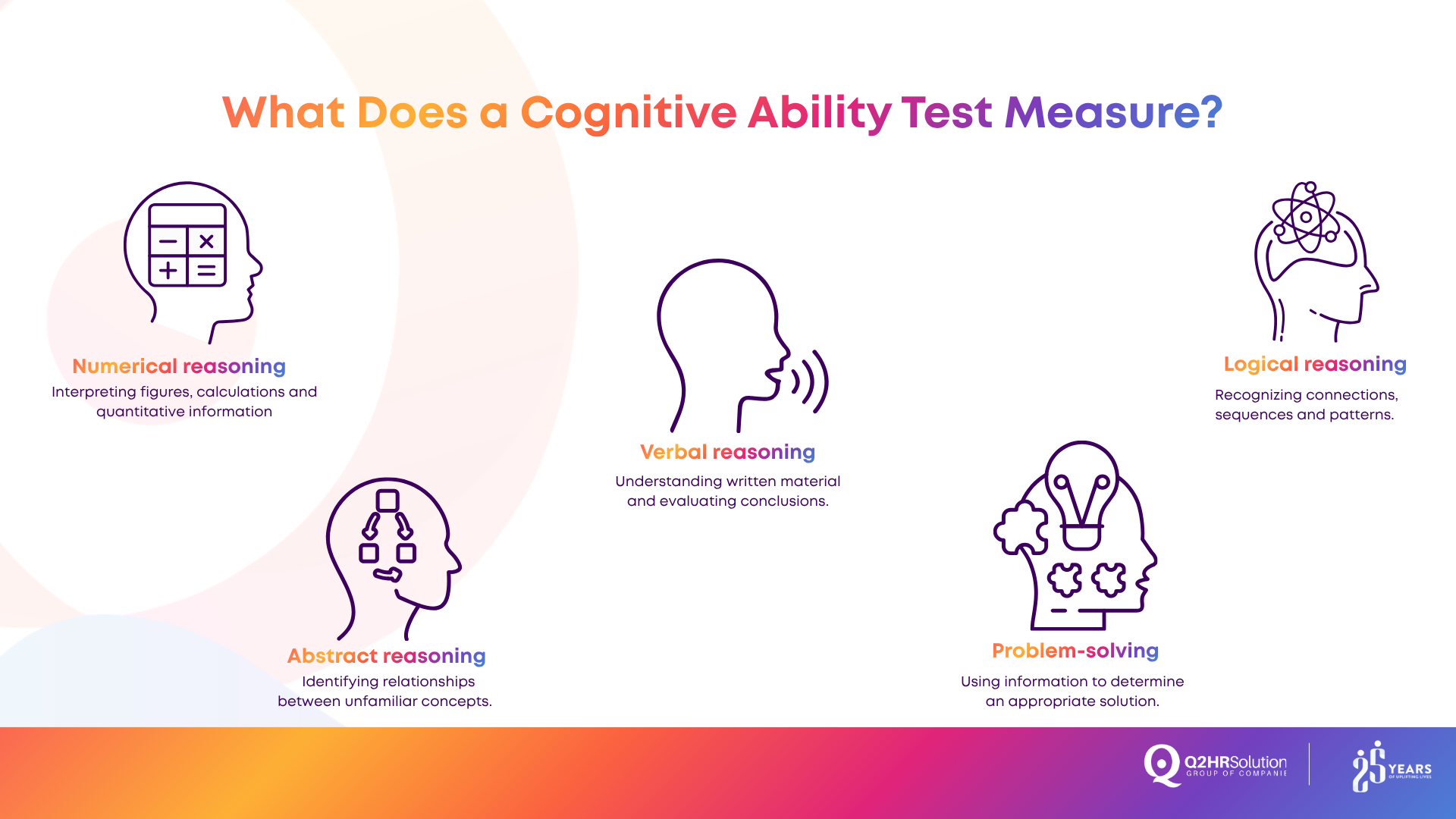
A Cognitive Ability Test can examine several areas of mental processing, depending on the position and assessment design. Common areas include:
These capabilities may be assessed through a Mental Ability Test. An Aptitude Test may focus on a person’s potential to learn or perform particular tasks.
The right assessment depends on the position and its requirements.
A psychometric assessment can bring greater consistency to recruitment by giving candidates an objective measure against defined criteria. This is useful when applicants have comparable qualifications or when a CV cannot show how effectively someone analyses information or handles unfamiliar problems.
Research supports the value of cognitive measures. The NSW Public Service Commission, drawing on Schmidt and Hunter, reports a validity estimate of 0.51 for cognitive ability testing alone and 0.63 when combined with a structured interview or work sample. By comparison, the reported figures for years of experience and education were 0.18 and 0.10.
These figures show why structured assessment can add evidence when combined with other selection methods.
Not every recruitment assessment measures the same capability. Psychometric Testing can cover different dimensions of a candidate’s potential, behavior and job-related abilities. A Personality Assessment Test can provide insight into behavioral preferences and workplace tendencies. A competency test can check capabilities linked to a specific role. A skills assessment can focus on practical or technical proficiency. A situational judgement test can explore responses to realistic workplace scenarios.
A Numerical reasoning test can assess confidence with quantitative information, while a Verbal reasoning test can measure the ability to interpret and evaluate written material. A Logical Reasoning Test can examine how effectively someone identifies relationships and reaches conclusions.
A well-designed selection process can combine assessments to create a broader picture of suitability.
The American Psychological Association (APA) stresses appropriate test selection and responsible administration. The Standards for Educational and Psychological Testing, developed by AERA, APA and NCME, provide professional guidance for developing and using psychological and educational tests.
A useful psychometric assessment should be relevant to the position, supported by evidence of reliability and validity, and administered consistently.
Before selecting an assessment, employers should consider:
Test security also matters because poor handling can compromise assessment integrity. Employers should use reputable processes.
Assessment results should support—not replace—professional judgement. Scores should be considered alongside relevant experience, interviews, work samples, references and other evidence.
Start with the job: identify the capabilities needed for success and select methods that measure them.
For example, Pre-Employment Testing for a financial analysis role may include numerical reasoning, while a position involving extensive written communication could place greater emphasis on verbal ability.
Used appropriately, Pre-Employment Testing can support structured decisions while reducing reliance on instinct.
No. A Cognitive Ability Test is one assessment that may sit within a wider psychometric assessment. A broader program can also examine personality, competencies, judgement or specific skills.
Yes. When properly designed and job-related, cognitive measures can provide useful evidence of reasoning and problem-solving. They work best alongside other selection methods.
A Mental Ability Test generally examines cognitive functions such as reasoning and information processing. An Aptitude Test often assesses potential or capacity to learn particular tasks or skills.
No. Assessment should reflect the demands of the role. A Numerical reasoning test may suit one position, while a Verbal reasoning test, Logical Reasoning Test or situational judgement test may be more relevant elsewhere.
A Cognitive Ability Test can give employers useful insight into how candidates analyze information, approach problems and learn new concepts. As part of Psychometric Testing, it can complement interviews and other selection tools while providing a structured basis for decision-making.
The goal is not to identify the highest score. It is to determine whether a candidate’s capabilities match the role and can contribute to long-term organizational performance.
Q2 HR Solutions provides trusted assessment services to help employers make informed workforce decisions. Contact Q2 HR Solutions now to discuss an approach suited to your organization.
___________________________________________________________________________________________________________________________________________________________________________________
Expert Insights By:
Ferdinand A. A. Limbo (Ferdie) is a Consultant at Q2 HR Solutions. He has more than 20 years of executive experience in Human Resources, Facilities Services and Management, Retail, Wholesale, Engineering Consultancy and various other industries. Ferdie attended a Master of Business Administration (MBA) program at the University of Santo Tomas.