

Executive search is the process of finding and assessing professionals for top-level positions within an organization. Rather than relying solely on job postings and applications, recruiters proactively approach potential candidates, including experienced professionals who aren’t actively seeking new opportunities.
Companies often use this to fill positions such as chief executive officer (CEO), chief financial officer (CFO), chief operating officer (COO), managing director, and other senior leadership roles.
Selecting an effective leader involves more than reviewing their credentials. Employers must consider leadership capabilities, industry experience, cultural alignment, and the candidate’s ability to support long-term business goals.
The Australian Bureau of Statistics reported that 35% of Australian businesses experienced skills shortages in 2024–25. Although these gaps affect various occupations, the findings highlight the challenge of sourcing candidates with the expertise businesses need.
The main difference is how candidates are identified and engaged. Both approaches aim to find qualified people, but they suit different hiring needs.
|
Factor |
Executive Search |
Traditional Recruitment |
| Candidate sourcing | Targeted research and direct outreach | Often job advertisements and applications |
| Candidate pool | Active and passive candidates | Often applicants and existing talent pools |
| Typical roles | Senior leaders and critical appointments | Roles across various levels |
| Assessment | Often detailed leadership evaluation | Varies by role and hiring process |
| Confidentiality | Useful for sensitive appointments | Depends on the recruitment arrangement |
Traditional recruitment can work well when a vacancy attracts plenty of qualified applicants. Executive search is particularly useful when suitable leaders are difficult to find or when an employer needs to approach candidates discreetly.
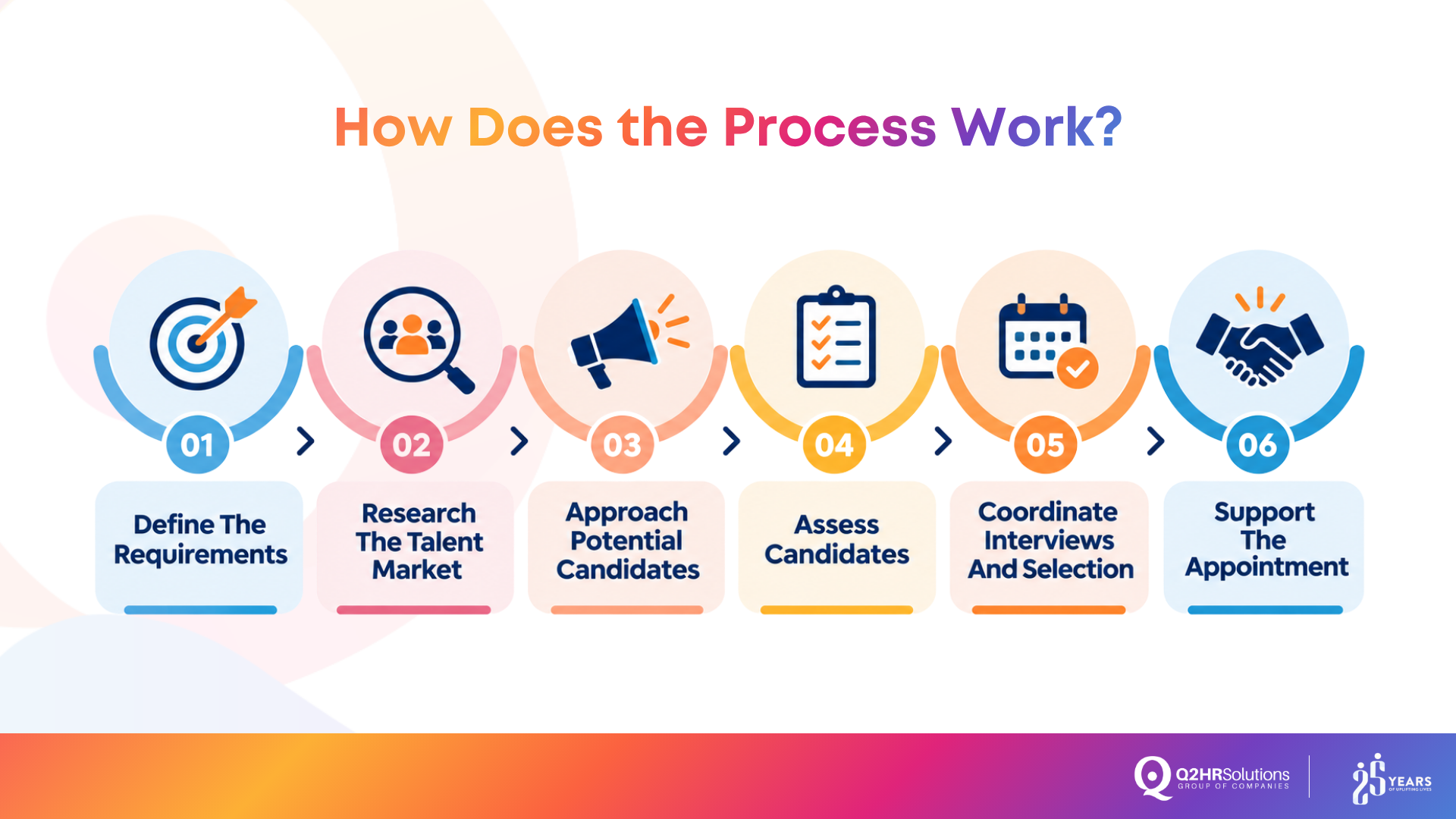
The process typically involves defining the role, researching the talent market, approaching candidates, and evaluating their suitability. The process generally follows these steps:
A structured approach helps employers make informed decisions rather than relying on a candidate’s résumé or interview performance alone.
These services connect businesses with qualified professionals and support better decisions when hiring for leadership roles. Key benefits include:
However, it does not guarantee a successful appointment. Clear role expectations, consistent assessment criteria, and employer involvement remain essential.
An executive recruitment company is worth considering when a leadership vacancy is business-critical, difficult to fill, or requires a confidential search.
Consider this if your business is:
Executive search involves a structured process of identifying and evaluating potential leaders, while headhunting takes a more proactive approach by directly reaching out to professionals who may be a good fit for a specific role.
How long does an executive search take?
The timeline depends on role complexity, candidate availability, notice periods, and interview schedules. Employers can help keep the process moving by agreeing on requirements early and providing timely feedback.
Costs vary according to the provider, seniority of the role, search complexity, and engagement model. Ask for a clear breakdown of fees, deliverables, payment terms, and any replacement provisions before signing an agreement.
Use consistent, job-related criteria, structured interviews, and appropriate reference checks. Under Australian workplace law, employers cannot disadvantage job applicants or prospective employees on unlawful discriminatory grounds.
A capable leader can shape how well a business operates, how effectively its teams perform, and how successfully it grows over time. Executive search gives employers a more targeted way to identify and evaluate senior talent, particularly when conventional recruitment methods are not enough.
Q2 HR Solutions helps organisations source potential candidates for C-suite roles and other high-level positions through targeted executive recruitment and headhunting.
Looking for the right leader for your organisation? Contact Q2 HR Solutions to discuss your executive hiring needs and explore a recruitment approach suited to your business goals.
______________________________________________________________________________________________________________________________________________________________________________________
Expert Insights By:
Ynel Nazario is a contributor for Q2 HR Solutions and a Public Relations and Strategic Communications professional with 10 years of experience. She writes about human resources, global mobility, business, technology, and socio-economic trends, with a particular interest in translating complex topics into clear, accessible insights for readers.