

SHRM’s 2025 Talent Trends research found that nearly 7 out of 10 organizations still report difficulty recruiting for full-time positions. Even as hiring conditions improve in some sectors, many employers continue to struggle to find the skills they need, especially when they need them. For US companies looking to grow and expand their teams in global markets like the Philippines, hiring challenges can quickly become a bottleneck. It’s often at this stage that business leaders start asking what is staff augmentation and whether it offers a faster, more flexible way to access talent.
The challenge is that the work often increases much faster than a hiring process can keep up. Recruiting, interviewing, and onboarding full-time employees takes time, even when the need is immediate. Because of this, businesses increasingly look for ways to add talent without permanently expanding their workforce or committing to long-term headcount increases.
The idea has become particularly relevant for US companies expanding into the Philippines. Instead of waiting months to fill positions locally, businesses can bring experienced professionals into existing teams and continue moving forward. In this article, we’ll take a closer look at staff augmentation, how it works, and why it has become a popular workforce strategy for companies looking to scale efficiently in the Philippines.
A lot of people assume staff augmentation is simply another name for outsourcing. That’s understandable because both involve bringing in external talent. But the day-to-day reality is actually quite different.
Staff augmentation is a workforce strategy where companies add external professionals to their existing teams to fill skill gaps, increase capacity, or support specific projects. Instead of handing an entire function to a third-party provider, businesses retain direct control over the work while gaining access to additional talent.
One way to define staff augmentation is to think of it as extending your current team rather than replacing it. The professionals work alongside internal employees, follow company processes, and contribute to business goals just like any other team member.
What’s interesting is that many companies don’t actively set out looking for staff augmentation. They usually discover it while searching for solutions to hiring delays, talent shortages, or expansion challenges.
Talent shortages are not exactly a new problem, but they have become more visible in recent years. Many organizations are operating in highly competitive labor markets where finding qualified professionals can take months. By the time a position is filled, business priorities may have already shifted.
It’s easy to see why more organizations are asking what is staff augmentation as they look for ways to access talent faster and scale more efficiently. Companies need workforce solutions that can adapt to changing business demands without requiring long recruitment cycles every time new talent is needed.
There is also a flexibility factor. Not every staffing need is permanent. Some projects require additional resources for six months. Others may need specialized expertise for a year. Hiring full-time employees for temporary requirements does not always make sense.
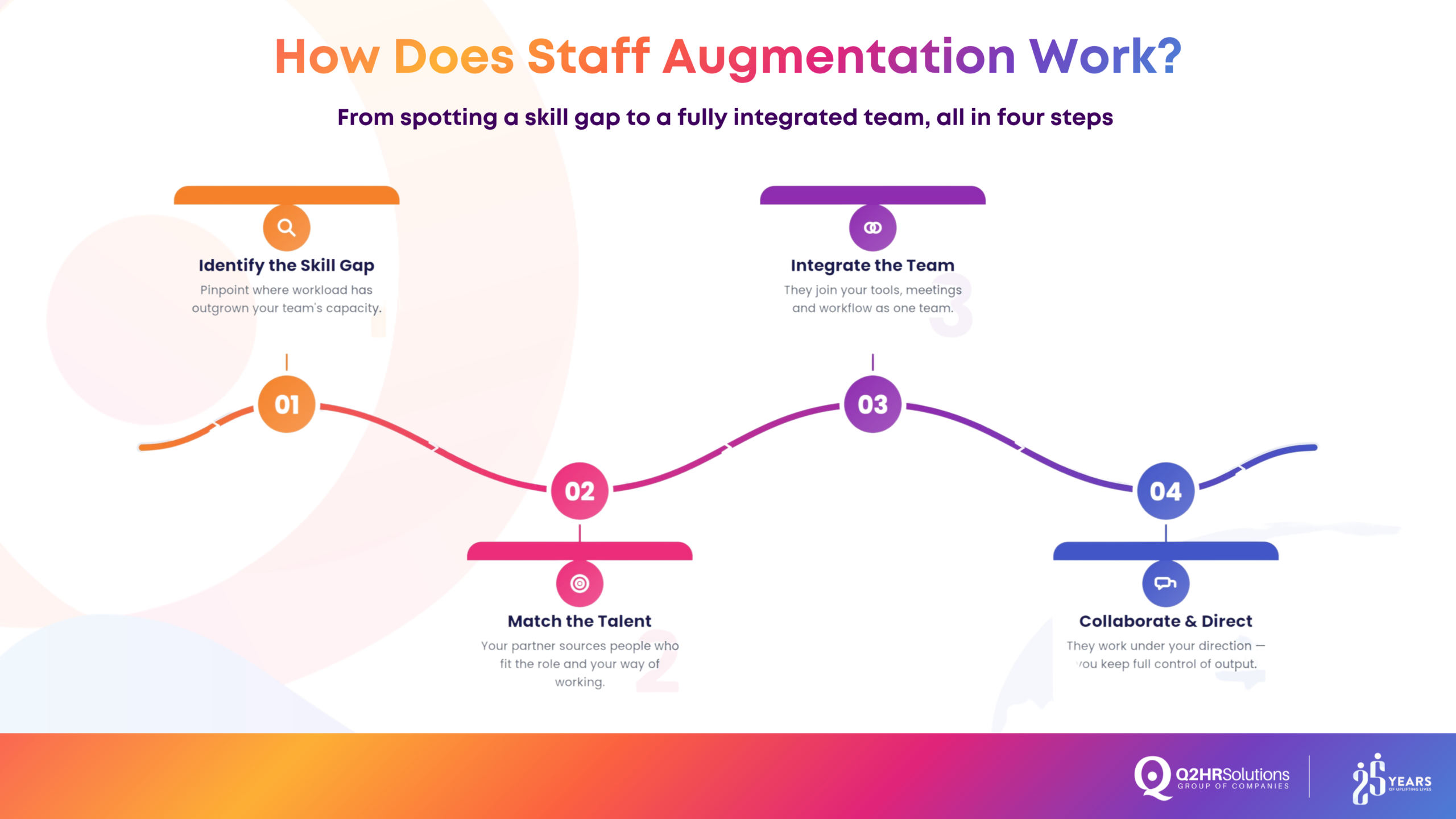
The process is often simpler than people expect. In fact, when businesses first ask what is staff augmentation, they are often surprised by how straightforward the model actually is.
A business identifies a skill gap, resource shortage, or project requirement. It then works with a staffing partner to find professionals who match those needs. Once selected, those professionals become part of the company’s workflow and collaborate with existing teams.
Most staff augmentation arrangements start with a specific challenge.
A software company may need developers to accelerate a product launch. A healthcare organization may need additional support staff during a growth period. A marketing team may require content specialists to support increasing demand. The objective is usually not replacing employees. Instead, it is adding support where workloads have outgrown current capacity.
Once professionals join the organization, they typically work under the company’s direction.
They attend meetings, collaborate with managers, and contribute to projects alongside internal employees. Because of this, companies maintain visibility and control over day-to-day operations. This direct integration is often what separates staff augmentation from traditional outsourcing models.
Not every business uses staff augmentation in the same way. Some companies bring in external talent for short-term needs like project surges or seasonal demand, while others use it to fill specific skill gaps that are harder to hire forlocally. There are also businesses that rely on staff augmentation as a long-term setup, where external professionals effectively function as part of the core team over time.
Some organizations only need temporary support. Seasonal demand, product launches, and special projects often create staffing requirements that last only a few months. Staff augmentation allows companies to meet those demands without making long-term hiring commitments.
Sometimes the issue is expertise rather than workforce size.
Businesses may need software engineers, cybersecurity specialists, financial analysts, designers, or marketing professionals with highly specific skills. In these situations, staff augmentation provides access to talent that may be difficult to find locally.
Some companies take a longer-term approach. Instead of hiring large local teams, they build dedicated remote teams that operate as permanent extensions of their business. This model has become increasingly popular among organizations expanding internationally.
The Philippines has become one of the most established destinations for global workforce expansion. Part of the reason is talent availability. The country has developed strong talent pools across customer support, technology, finance, marketing, administration, and creative services. English proficiency and cultural compatibility also make collaboration easier for many US businesses.
According to industry data from IBPAP, the Philippine outsourcing sector employs well over a million professionals and continues to grow. This has created a mature ecosystem of skilled workers who are experienced in supporting international companies.
When companies understand what is staff augmentation, the Philippines frequently becomes part of the discussion because it offers a balance of talent, scalability, and operational flexibility.
Businesses often compare staff augmentation with conventional recruitment because both approaches solve workforce challenges differently. For organizations researching what is staff augmentation, this comparison is usually where the practical differences become much clearer.
Traditional hiring can take weeks or even months. Staff augmentation often allows businesses to access qualified professionals much faster, helping teams respond more quickly to changing business demands.
Business needs rarely stay the same for long.
Staff augmentation allows organizations to scale teams up or down as projects and priorities change, which can reduce unnecessary workforce costs.
One reason companies continue to define staff augmentation as a middle ground between outsourcing and hiring is because they maintain direct oversight of the work being performed. Projects remain under company management while additional talent supports execution.
One misconception is that staff augmentation only works for technology companies. In reality, organizations across healthcare, finance, marketing, customer service, e-commerce, and professional services use augmentation models to support growth.
Another misconception is that augmented professionals operate separately from internal teams.
Most successful arrangements work because augmented staff are integrated into existing workflows rather than isolated from them.
There is also the belief that staff augmentation is only a short-term solution. While many businesses use it for temporary projects, others build long-term remote teams through the same model.
Staff augmentation is a workforce strategy that allows companies to add external professionals to existing teams to address skill gaps, increase capacity, or support specific projects.
To define staff augmentation, think of it as extending your workforce with external talent while maintaining direct control over the work being performed.
No. Outsourcing generally transfers responsibility for a function or project to an external provider, while staff augmentation adds professionals to an internal team.
The Philippines offers access to skilled professionals, strong English communication abilities, and extensive experience supporting international businesses.
Yes. While some companies use it for short-term projects, others build long-term remote teams that become integrated parts of their operations.
Most companies do not start by looking for staff augmentation. They start by trying to solve a business problem. Growth is accelerating, but hiring is taking longer than expected, and existing teams need support. Somewhere along the way, the question becomes what is staff augmentation and whether it offers a practical way forward.
For many US businesses expanding into the Philippines, the answer is yes. Staff augmentation provides access to skilled professionals, greater workforce flexibility, and the ability to scale without the delays often associated with traditional hiring.
As competition for talent continues to grow, workforce strategies will likely become more flexible rather than less. If your organization is exploring expansion opportunities in the Philippines, talking to a partner like Q2 HR Solutions can help you understand how staff augmentation can be applied to your setup in a real-world context, not just on paper.