

Temporary staffing gives Australian businesses a way to bring in workers for a limited period when they need additional capacity without making an immediate permanent hire. It can help manage seasonal demand, employee absences, short-term projects, skills gaps and unexpected changes in workload.
For businesses considering this approach, it is important to understand that this arrangement is not the same as casual employment, fixed-term employment or labour hire. Understanding these differences can help businesses choose the right workforce arrangement for their needs.
This approach involves filling a short-term workforce need with a worker who is not being hired for an ongoing permanent position. A business can recruit temporary staff directly or work with a temp staffing agency or labour-hire provider.
Temporary workers can support businesses across many industries and roles. For example, a company may need additional administrative staff during a busy period, skilled workers for a specific project or someone to cover an employee’s extended absence.
The process starts by identifying a short-term workforce requirement and determining the best way to fill it.
A typical process includes:
Australian businesses also need to choose the appropriate employment type and understand the obligations that come with it. Business.gov.au notes that the type of worker an employer hires affects its obligations to the employee and government.
Temporary employment is a workforce solution, while casual and fixed-term employment are specific employment arrangements.
| Arrangement | General Description |
| Short-term staffing | Describes the business’s short-term solution for a limited or changing workforce need |
| Casual employment | Employment without a firm advance commitment to ongoing work |
| Fixed-term employment | Employment under a contract that ends at a specified time or after a defined period |
| Permanent employment | Ongoing full-time or part-time employment |
| Labour hire | A third-party arrangement where a labour-hire provider supplies workers to another business |
Under Fair Work rules, casual employment and fixed term contracts have different criteria and requirements. Businesses should therefore avoid using “temporary,” “casual,” and “fixed-term” interchangeably.
Labour hire is an arrangement where a worker is employed by a labour-hire provider or temp staffing agency and supplied to another business.
Labour hire can give businesses access to temporary workers while the provider manages aspects of the employment relationship.
The main benefit of this approach is workforce flexibility. Businesses can adjust their workforce as their needs change without immediately committing to an ongoing position.
Common reasons include:
This approach may be suitable when your workforce requirement is limited, variable or connected to a specific project or period.
You might consider it if:
The key question is: Do you have a short-term workforce requirement, or are you actually creating an ongoing position?
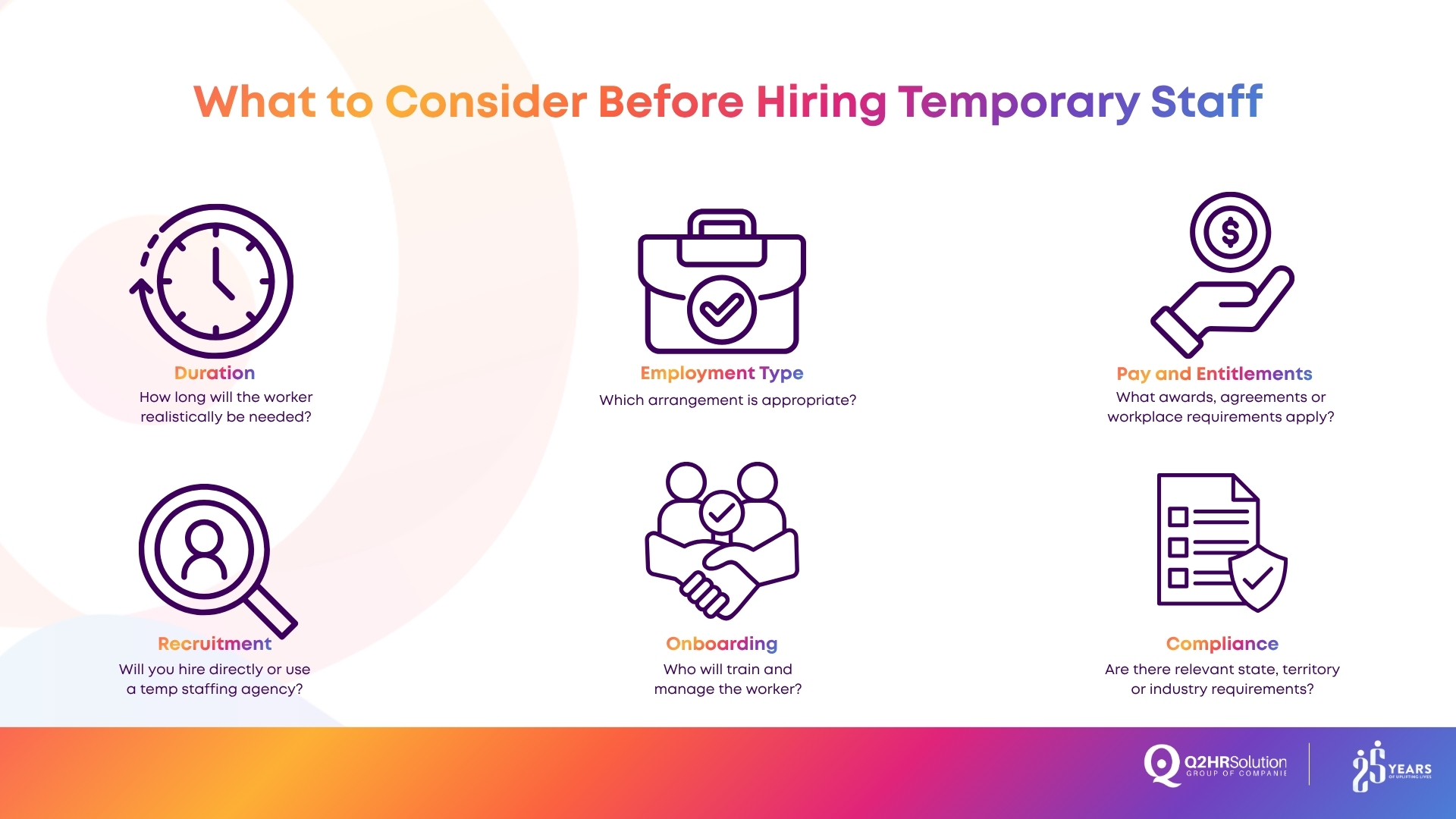
Before engaging, consider:
Assignments can last from a short period to several months or longer, depending on the business requirement and employment arrangement. The expected duration should be established before the worker starts.
No. The term describes a short-term workforce need, while casual employment is a specific employment arrangement with its own legal definition and entitlements.
Short-term staffing describes the workforce solution, while labour hire describes a particular employment arrangement. With labour hire, the worker is employed by the temp agency and supplied to a host business.
Yes, depending on the circumstances and employment arrangement. If a business’s workforce needs become ongoing, the worker and employer may move to an appropriate permanent arrangement.
It helps businesses source and place workers for short-term roles. Depending on the arrangement, the provider may also manage aspects of recruitment, employment administration and payroll.
The right temp staffing approach can help businesses manage changing workloads while meeting their workforce and employment obligations.
Whether a business needs additional staff for a busy period, support for a short-term project, or filling an unexpected staffing gap, Q2HR Solutions provides tailored temporary staffing support across Australia, backed by 26 years of experience.
Need the right staffing support in Australia? | Speak to the Q2 HR Solutions team at https://www.q2hrsolutions.com/contact-us/.
______________________________________________________________________________________________________________________________________________________________________________________
Expert Insights By:
Ynel Nazario is a contributor for Q2 HR Solutions and a Public Relations and Strategic Communications professional with 10 years of experience. She writes about human resources, global mobility, business, technology, and socio-economic trends, with a particular interest in translating complex topics into clear, accessible insights for readers.