

There is a point in many growing companies where hiring quietly becomes part of the operational problem. A few years ago, companies could post a job ad online and expect a decent shortlist within a week or two. That does not happen as often anymore. Hiring teams today are dealing with a very different situation. Somewhere in that shift, this is usually when companies begin hearing more conversations around the rpo meaning in recruitment and why outsourcing hiring functions has become more common across different industries.
Skilled candidates are getting harder to attract, hiring timelines are getting longer, and recruiters are expected to fill more roles with the same resources. In some industries, one delayed hire can slow down an entire department. In others, constant hiring demand quietly burns out internal HR teams.
According to LinkedIn’s Global Talent Trends reports, employers across industries continue to struggle with talent shortages, especially in technical, healthcare, customer service, engineering, and leadership roles. Because of this, recruitment is no longer viewed as a purely administrative task. It has become a business continuity issue.
In this article, we’ll take a deep dive on what Recruitment Process Outsourcing is, how it works, the different RPO models companies use today, its advantages and limitations, and why more businesses are treating recruitment outsourcing as a long-term growth strategy rather than a temporary hiring fix.
The RPO meaning in recruitment stands for Recruitment Process Outsourcing (RPO), a hiring model where a company outsources parts or all of its talent acquisition and recruitment operations to an external recruitment partner.
Instead of only helping fill individual vacancies, an RPO becomes involved in the company’s broader recruitment process. They may handle sourcing, screening, interviews, employer branding, recruitment marketing, onboarding coordination, and workforce planning depending on the engagement structure.
In the intricate landscape of modern hiring, RPO shines as subject-matter experts. With talent acquisition as the core of their competency, they adeptly navigate the complexities of the recruiting environment. From staying abreast of cutting-edge recruiting technologies to effectively managing and nurturing candidates and hiring managers, they bring a wealth of expertise to the table.
Rather than focusing only on quick placements, RPO providers are usually measured through hiring performance indicators such as:
Because of this, RPO is often viewed as a strategic hiring partnership instead of a transactional staffing arrangement. Companies also adopt RPO for different reasons. Some organizations need support during rapid expansion. Others simply need access to better recruitment systems, technology, or specialized sourcing expertise that they do not currently have internally.
Understanding the RPO meaning in recruitment becomes clearer when you look at how Recruitment Process Outsourcing operates in real business settings. At its core, RPO is a model where external recruitment specialists are embedded into a company’s hiring process to support or fully manage talent acquisition functions.
This setup is not just about outsourcing tasks. It is about integrating recruitment expertise into the company’s existing structure so hiring becomes more consistent, scalable, and aligned with business needs.
The process usually begins with workforce planning discussions between the RPO provider and the company. During this stage, the team studies hiring requirements, expected headcount demand, business goals, and current recruitment challenges.
They also assess deeper factors like hiring bottlenecks, employer branding position, and internal recruitment capacity. This helps the RPO team understand not just what roles that needs to be filled, but also why hiring is happening in the first place.
Once the planning part is clear, the RPO provider starts designing the actual recruitment workflow. This includes aligning processes with the company’s Applicant Tracking System (ATS), defining hiring stages, and setting up sourcing strategies based on role requirements.
At the same time, structured systems are also introduced such as interview frameworks, hiring scorecards, and KPIs for recruitment. These elements help standardize decision-making and improve hiring consistency across teams.
After the systems are in place, RPO recruiters begin executing the hiring process. In many cases, they are embedded directly into the client’s organization and work closely with HR teams and hiring managers on a daily basis.
Because of this setup, communication becomes more direct and hiring decisions become faster. Over time, the recruitment process becomes more measurable, predictable, and easier to scale, especially during periods of high hiring demand.
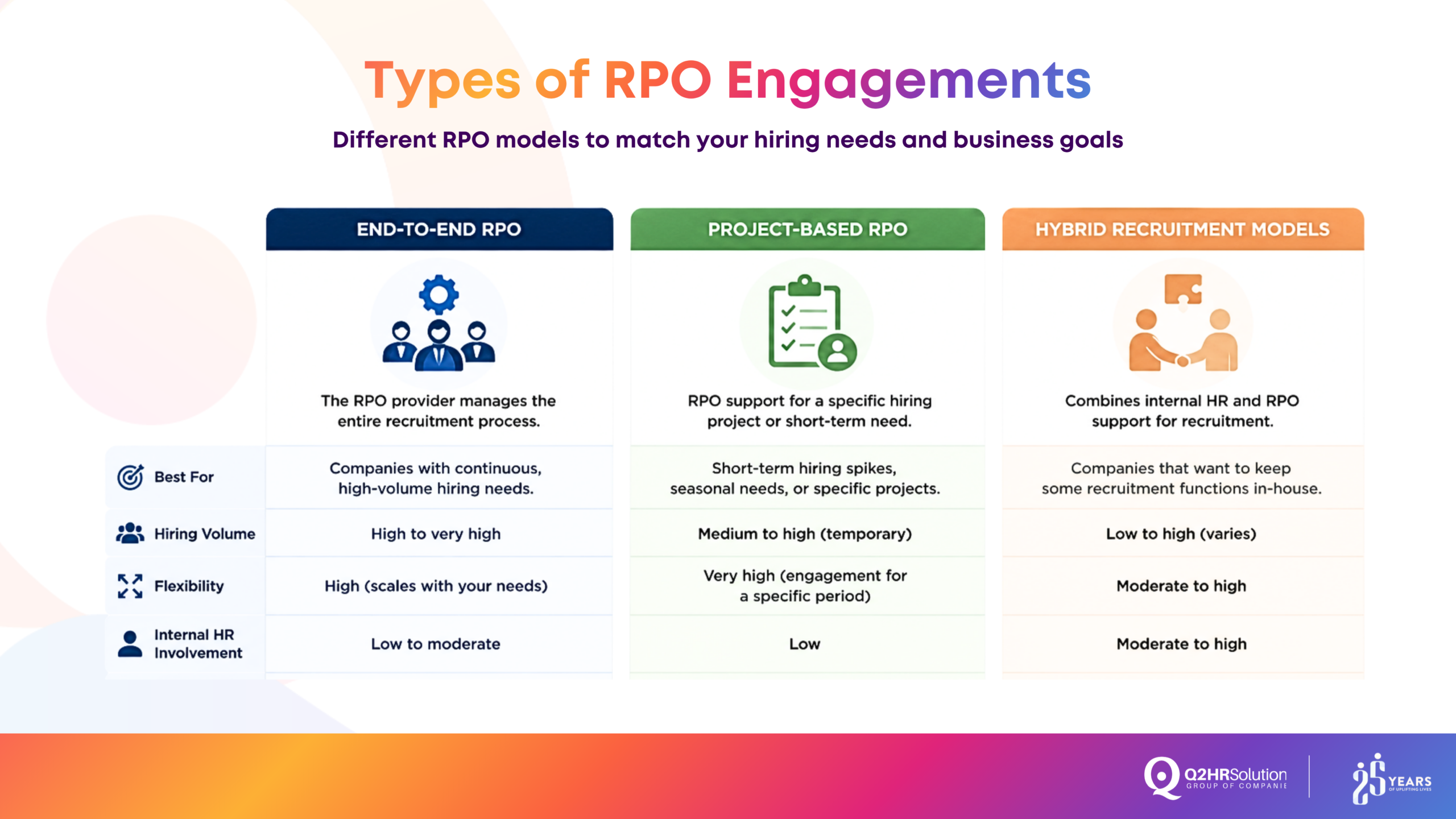
To really understand the rpo meaning in recruitment, it helps to move away from definitions and look at how companies actually structure it in practice. The setup can vary significantly depending on how much of the hiring process a business wants to outsource.
If you’re considering outsourcing recruitment services in the Philippines, it helps to familiarize yourself with the most common RPO engagement types below.
End-to-end RPO involves outsourcing the full recruitment function. The RPO provider may manage job postings, sourcing, screening, interview coordination, reporting, onboarding support, recruitment marketing, and workforce planning.
This model is usually more common among companies with continuous high-volume hiring. BPO companies, shared services operations, logistics businesses, and rapidly expanding organizations often explore this structure because recruitment demand remains ongoing. The provider essentially becomes an extension of the internal talent acquisition team.
Project-based RPO is typically used for temporary hiring spikes. A company may suddenly need to hire fifty employees within three months because of expansion, seasonal demand, or new client requirements.
Instead of permanently expanding the internal recruitment team, the company temporarily partners with an RPO provider. This model appeals to businesses that experience fluctuating workforce demand.
Some businesses combine internal recruitment with outsourced recruitment support.
Internal HR teams may continue handling culture alignment, final interviews, and onboarding while external recruiters focus on sourcing and screening. This arrangement has become increasingly common because many companies still want direct visibility into hiring decisions while gaining additional recruitment capacity.
The hybrid setup often works well for growing Philippine companies that are scaling gradually rather than aggressively.
Many Philippine companies are exploring RPO because hiring has become harder to manage internally while maintaining speed and quality at the same time. The hiring environment in the Philippines has changed significantly over the last few years.
The Business Process Outsourcing industry continues expanding aggressively. According to the IT and Business Process Association of the Philippines (IBPAP), the Philippine IT-BPM sector remains one of the country’s largest employment generators, employing millions of Filipinos across customer service, finance, healthcare support, and technology functions. That scale naturally increases competition for experienced talent.
At the same time, industries outside BPO are also hiring more aggressively. Technology startups, logistics firms, e-commerce companies, construction businesses, healthcare providers, and multinational shared services operations are all pulling from overlapping talent pools. This creates a difficult situation for growing businesses.
Smaller and mid-sized companies usually cannot match the employer branding power, compensation flexibility, or recruitment budgets of larger organizations. Because of this, internal HR teams often struggle to compete for qualified candidates, especially in specialized or leadership positions. The pressure becomes even heavier when hiring demand suddenly spikes.
A company may need to hire twenty people within two months because of a new client acquisition. Another business may open operations in Cebu or Clark and suddenly require local hiring support. Some companies encounter high attrition and need replacement hiring while still handling expansion. Internal recruitment teams are not always built for that level of fluctuation. This is why the rpo meaning in recruitment has become tied closely to scalability.
RPO allows companies to expand recruitment capacity without immediately building a large in-house talent acquisition department. Instead of hiring additional recruiters internally, businesses partner with providers that already have recruitment infrastructure, sourcing systems, talent networks, and recruitment technology in place. For many companies, the appeal is not simply outsourcing. It is operational flexibility.
Hiring problems usually start small before becoming operational bottlenecks. A lot of businesses do not initially decide to outsource recruitment because they want to. Often, they arrive there after months of recurring hiring frustrations.
One of the biggest pain points companies experience is slow hiring turnaround.
A position remains open for months. Hiring managers delay interviews because they are busy with operations. Recruiters struggle to source qualified candidates. Applicants accept offers from competitors before the process even finishes.
According to LinkedIn Global Talent Trends reports, candidate expectations around hiring speed have changed dramatically. Delayed recruitment processes now directly affect candidate drop-off rates. Skilled professionals often entertain multiple offers simultaneously, which means companies with slow recruitment cycles lose talent faster. This creates operational strain.
Existing employees absorb additional workload while vacancies remain unfilled. Burnout increases. Productivity becomes inconsistent. Client deliverables may even become affected. And for growing companies, slow recruitment eventually becomes a revenue issue.
In many Philippine companies, HR departments already handle multiple responsibilities beyond hiring. Payroll administration, employee engagement, labor compliance, benefits coordination, training, documentation, and employee relations all compete for time. Recruitment then becomes reactive instead of strategic.
The problem is that hiring volume rarely stays stable during growth phases. A team that comfortably handled five hires per month may suddenly need to manage thirty. Without additional recruitment support, quality usually suffers.
Candidate screening becomes rushed. Follow-ups become inconsistent. Employer branding weakens because communication slows down. Good applicants disengage.
This is one reason the rpo meaning in recruitment has shifted beyond just outsourcing costs. Businesses increasingly associate RPO with recruitment capacity management.
Some positions are significantly harder to fill than others. Technology roles, healthcare positions, engineering functions, finance specialists, bilingual support staff, and senior leadership positions often require highly targeted sourcing. Traditional job postings alone rarely solve these hiring needs.
According to JobStreet by SEEK employer insights, many Philippine employers continue reporting challenges in sourcing qualified specialized talent despite active hiring demand. This leads companies toward external recruitment expertise. RPO providers often maintain dedicated sourcing teams, recruitment databases, market mapping capabilities, and passive candidate networks. Because of this, they may access talent pools that internal HR teams struggle to reach consistently.
A lot of companies initially assume outsourcing recruitment automatically means higher costs. Sometimes the opposite happens. Internal hiring inefficiencies can quietly become expensive over time.
Job ad spending increases. Recruiters spend excessive hours sourcing low-fit candidates. Hiring managers lose operational time conducting repeated interviews for unsuccessful applicants. Employee turnover rises because hiring quality becomes inconsistent.
According to the Society for Human Resource Management (SHRM), poor hiring decisions create measurable business costs through lost productivity, turnover replacement expenses, onboarding waste, and operational disruptions. This is where the cost-versus-quality discussion becomes important.
The cost versus quality debate is usually the biggest concern companies have when discussing RPO.
Many business leaders immediately focus on outsourcing fees first. That reaction is understandable because recruitment outsourcing appears like an additional operational expense. But the deeper question is often whether the current hiring process is already costing more than expected.
A company may save money initially by maintaining a very lean recruitment setup.
Maybe one HR generalist handles all recruitment functions. Maybe hiring tools are limited. Maybe sourcing strategies rely heavily on free job postings. On paper, the recruitment cost looks low. Operationally, however, the hidden costs start accumulating.
Vacancies stay open longer. Teams become understaffed. Overtime expenses increase. Managers spend additional hours interviewing weak-fit applicants. Employee turnover rises because rushed hiring decisions lead to poor retention. Over time, businesses end up paying for inefficiency indirectly.
This is why discussions around the rpo meaning in recruitment increasingly focus on recruitment outcomes rather than recruitment activity alone.
High-quality recruitment rarely happens accidentally. Strong hiring processes require sourcing tools, recruiters, employer branding support, analytics, candidate engagement systems, and recruitment coordination. Large organizations typically invest heavily in these areas internally.
Growing companies often cannot justify building the same infrastructure immediately. This creates a gap between hiring expectations and recruitment capabilities. RPO providers essentially spread recruitment infrastructure costs across multiple clients. Because of this, companies gain access to recruitment systems and expertise without fully building those capabilities in-house.
Some companies prioritize cost reduction so aggressively that recruitment quality becomes secondary. This usually creates problems later.
Poor-fit hires leave faster. Candidate experiences deteriorate. Hiring managers lose confidence in recruitment teams. Internal turnover creates additional replacement hiring. Eventually, the business ends up spending more time fixing hiring problems than preventing them.
An effective RPO partnership tends to focus on balancing speed, cost, and candidate quality simultaneously. That balance matters because over-optimizing one area often damages another.
RPO and staffing agencies both support recruitment, but they operate differently.
A traditional staffing agency usually focuses on candidate placement. The engagement is often transactional. A company opens a role, the agency submits candidates, and placement fees are paid when someone gets hired.
RPO arrangements tend to be more integrated.
Instead of simply providing applicants, the RPO provider may become involved in recruitment operations, hiring process design, analytics, candidate experience management, employer branding support, and workforce planning.
Another major difference is scalability. Staffing agencies often operate role by role. RPO providers usually look at recruitment performance more holistically. This broader operational involvement explains why discussions around the rpo meaning in recruitment increasingly focus on process optimization rather than only talent sourcing.
No, RPO is no longer limited to large corporations.
Years ago, Recruitment Process Outsourcing was mostly associated with multinational enterprises handling massive recruitment volumes. That perception has changed. Mid-sized businesses now encounter many of the same hiring challenges large corporations face, just at a different scale.
A fifty-person company growing to one hundred employees within a year can experience recruitment strain very quickly. Internal HR structures may not expand fast enough to support that growth.
At the same time, smaller companies usually need to stay lean operationally.
Hiring multiple internal recruiters immediately may not make financial sense, especially if recruitment demand fluctuates. This is partly why the rpo meaning in recruitment has become more relevant among startups, scaling businesses, and regional companies in the Philippines. RPO creates recruitment flexibility without requiring permanent expansion of the HR department.
Several industries in the Philippines actively use Recruitment Process Outsourcing because hiring demand tends to fluctuate or scale aggressively.
The BPO sector remains one of the largest users of RPO solutions. High-volume hiring, shifting workforce requirements, and ongoing attrition create constant recruitment pressure. Large customer support operations may need hundreds of hires within short periods depending on client expansion.
This creates strong demand for scalable recruitment operations.
Technology hiring has become increasingly competitive in the Philippines.
Software developers, cybersecurity specialists, cloud engineers, data analysts, and digital product professionals remain highly sought after. Many technology companies partner with RPO providers because specialized sourcing requires dedicated recruitment expertise.
Healthcare organizations continue facing staffing challenges locally and globally. Nurses, medical coders, healthcare support staff, and allied health professionals remain in demand. Recruitment timelines and compliance requirements in healthcare can become particularly complex, which increases interest in outsourced recruitment support.
The rapid growth of logistics and e-commerce operations created hiring surges across warehousing, operations management, customer support, and delivery coordination.
Recruitment needs in these industries often fluctuate seasonally. Because of this, project-based RPO arrangements have become increasingly relevant.
Companies usually measure RPO success through hiring outcomes rather than recruitment activity alone. Metrics vary depending on business priorities.
One of the most common measurements is time-to-hire.
If recruitment timelines improve without sacrificing candidate quality, the partnership generally creates operational value. Faster hiring helps reduce productivity gaps caused by vacancies.
Quality of hire is harder to measure but often more important long term. Businesses usually assess retention rates, employee performance, onboarding success, and hiring manager satisfaction.
A recruitment process that fills roles quickly but produces high turnover eventually becomes unsustainable.
Cost evaluation should consider more than outsourcing fees alone. Businesses also examine vacancy costs, recruiter productivity, turnover reduction, operational efficiency, and hiring scalability.
This broader perspective matters because recruitment inefficiencies often create indirect business costs.
Some organizations also monitor candidate feedback, offer acceptance rates, and employer branding perception. Recruitment quality increasingly affects long-term talent attraction.
Because of this, the rpo meaning in recruitment now extends beyond transactional hiring support. It increasingly connects with overall workforce strategy.
Companies usually start considering RPO after certain hiring patterns become difficult to ignore. Recruitment teams constantly missing hiring targets is one sign. Repeated delays in filling operationally critical roles is another.
Some businesses notice managers spending excessive time on recruitment instead of operational leadership. Others experience growing turnover because rushed hiring decisions create weak employee fit.
Expansion plans also commonly trigger RPO discussions. A company opening new regional offices or scaling client operations may suddenly require hiring infrastructure beyond its current capacity.
There are also cases where recruitment data becomes inconsistent. Leadership teams cannot accurately track hiring pipelines, candidate conversion rates, sourcing performance, or recruitment forecasting. At that point, outsourcing recruitment support becomes less about convenience and more about organizational sustainability.
RPO costs in the Philippines vary widely depending on recruitment scope, hiring volume, specialization requirements, and engagement structure. Some providers charge monthly management fees. Others operate on per-hire pricing, project-based contracts, or hybrid structures.
Volume hiring projects naturally cost differently from executive recruitment engagements. Specialized hiring also tends to require higher sourcing investment. Technology recruitment, healthcare staffing, and niche technical hiring usually involve more extensive sourcing efforts because candidate availability remains competitive.
This is why comparing RPO pricing alone can become misleading. Two providers may offer different pricing structures because they are delivering different recruitment capabilities. The more useful conversation often revolves around operational impact. If an RPO setup improves hiring speed, retention quality, workforce stability, and recruiter efficiency, the overall business value may outweigh the recruitment expense itself.
That said, unrealistic expectations can still create disappointment. Some companies expect premium recruitment outcomes while heavily minimizing recruitment budgets. In practice, recruitment quality usually reflects the level of operational investment behind it.
Understanding the rpo meaning in recruitment is not only about outsourcing hiring tasks, but also about choosing a provider that can align with your industry and long-term hiring goals. Specialized providers usually understand talent availability, salary expectations, and hiring behavior more accurately, which often improves sourcing quality and hiring efficiency.
At the same time, recruitment demand can change quickly depending on business conditions. A strong RPO provider should be able to scale hiring support up or down during expansion phases, seasonal hiring spikes, new market entry, or workforce restructuring. Flexibility is important because recruitment needs rarely stay constant for long.
Technology directly affects recruitment efficiency and visibility. Modern RPO providers often use ATS platforms, recruitment automation tools, CRM systems, analytics dashboards, and AI-assisted sourcing technology to improve hiring workflows and candidate management. Better systems usually lead to faster hiring cycles and smoother candidate experiences.
Beyond technology, companies should also evaluate reporting capabilities. Recruitment performance should be measurable through metrics such as time-to-fill, candidate pipeline health, conversion rates, source effectiveness, and hiring forecasts. Without clear reporting, optimizing recruitment performance becomes difficult.
Recruitment also involves evaluating whether the provider’s pricing structure aligns with your hiring strategy. Some providers use monthly retainers, while others operate on project-based pricing, recruiter-on-demand billing, or hybrid models. Knowing how pricing works helps businesses assess long-term value more accurately instead of focusing only on upfront cost.
RPO recruiters often serve as direct representatives of the company throughout the hiring process, which makes cultural alignment highly important. The provider should understand your employer brand, company values, communication style, and hiring philosophy to ensure consistency in how candidates experience the recruitment process.
It is also important to evaluate how the provider manages candidate communication, interview scheduling, offer coordination, and rejection handling. Candidate experience can significantly affect employer reputation, especially in competitive hiring markets. Reliable RPO partners should be able to demonstrate measurable recruitment results across similar industries or hiring environments.
No, RPO specifically focuses on recruitment functions.
Human Resources covers a much broader scope including payroll, employee relations, labor compliance, training, compensation, and organizational development. Recruitment Process Outsourcing concentrates mainly on talent acquisition and hiring operations.
Yes, many small and mid-sized businesses now use project-based or hybrid RPO setups.
Smaller companies often benefit from recruitment scalability because hiring demand may fluctuate heavily during growth stages.
Not necessarily.
In many cases, companies explore RPO specifically because hiring quality has already become inconsistent internally. The effectiveness of RPO depends heavily on provider capability, process alignment, and communication quality.
It depends on the recruitment structure.
Some project-based RPO engagements last only a few months. Full end-to-end RPO partnerships may continue for years depending on hiring demand and operational goals.
RPO providers can support various positions including volume hiring, technical recruitment, executive hiring, healthcare staffing, finance roles, customer support operations, and specialized professional functions.
Capabilities usually vary depending on provider expertise.
It depends on hiring scale and business structure.
For companies with sustained high-volume recruitment needs, RPO may create operational efficiency because recruitment infrastructure becomes shared. For organizations with very limited hiring demand, maintaining internal recruitment alone may still be sufficient.
Recruitment has changed significantly over the past several years. Hiring today involves more competition, more technology, more candidate expectations, and more operational pressure than before. Because of this, companies are realizing that recruitment can no longer rely entirely on reactive hiring methods.
That shift is why conversations around the rpo meaning in recruitment have become more common among growing Philippine companies. Businesses are no longer evaluating recruitment only by how many resumes come in. They are looking at hiring speed, workforce stability, candidate quality, employer reputation, and operational scalability all at the same time.
RPO is not automatically the right solution for every company. Some businesses still manage hiring effectively internally. Others may only need temporary recruitment support during expansion periods. But for organizations experiencing persistent hiring strain, overloaded HR teams, delayed recruitment timelines, or inconsistent hiring quality, Recruitment Process Outsourcing has become a practical operational strategy rather than just an outsourcing trend.
At Q2 HR Solutions, we help companies build scalable and efficient recruitment systems through our Recruitment Process Outsourcing solutions. Whether you need end-to-end hiring support, volume recruitment assistance, or specialized sourcing expertise, our team can help you strengthen your workforce strategy and improve hiring outcomes. If your organization is currently evaluating recruitment challenges, workforce expansion plans, or hiring scalability concerns, reach out to us today and learn how our RPO services can support your business growth and long-term talent acquisition goals.