

The Philippines is a leading destination for businesses seeking staffing solutions, recruitment staffing solutions, and reliable workforce support. Whether you’re partnering with a Philippines staffing agency for local hiring or overseas recruitment, verifying that an agency is legitimate is essential before entering any agreement.
A legitimate staffing agency in the Philippines businesses and applicants can trust should be licensed by the appropriate government authority. Agencies recruiting workers for overseas employment must be licensed by the Department of Migrant Workers (DMW), while agencies hiring for local positions must be authorized by the Department of Labor and Employment (DOLE). Beyond licensing, businesses should also watch for warning signs such as requests for upfront payments, unprofessional communication, or vague job offers.
This guide explains how to verify a staffing agency, identify red flags, and protect your business from fraudulent recruiters.
Choosing the right staffing firm is more than a business decision—it is a legal and financial safeguard. Philippine labor laws define recruitment and placement broadly, covering activities such as advertising jobs, referring applicants, hiring, transporting workers, and offering employment opportunities.
Many businesses assume that a company registered with the SEC, DTI, or BIR is automatically authorized to recruit workers. However, business registration is different from holding a recruitment license. Only agencies licensed by the DMW or DOLE can legally provide staffing and recruitment services.
Working with unlicensed staffing firms can expose businesses to legal penalties, financial losses, reputational damage, and disruptions in hiring operations.
Two government agencies oversee recruitment activities in the Philippines.
For overseas employment, the Department of Migrant Workers (DMW) regulates recruitment agencies deploying Filipino workers abroad and maintains an official database of licensed agencies and approved job orders.
For local employment, the Department of Labor and Employment (DOLE) regulates Private Employment Agencies (PEAs) through the Bureau of Local Employment. These agencies provide recruitment and staffing solutions for positions within the Philippines.
Knowing which agency regulates your recruitment partner is the first step toward finding a legitimate staffing solutions agency.
If you’re planning to hire through an overseas recruitment agency, begin by confirming its license with the DMW.
Start by requesting the agency’s:
Next, visit the DMW website and search the official list of licensed recruitment agencies. The online database allows you to verify:
Always confirm that the advertised position matches the approved job order. For example, an agency approved to recruit nurses cannot legally recruit caregivers under the same job order.
Businesses may also seek assistance from their local Public Employment Service Office (PESO) when verifying agencies.
Businesses looking for local staffing agencies should verify that the agency holds a valid Private Employment Agency license issued by DOLE.
Verification is straightforward:
Legitimate staffing agency solutions providers will willingly provide licensing information and answer questions about their legal authority.
Before signing any agreement with a staffing solutions company, ask for documents proving the agency’s legitimacy.
These include:
A professional staffing solutions employment agency should readily provide these documents. Refusal to do so should be treated as a warning sign.
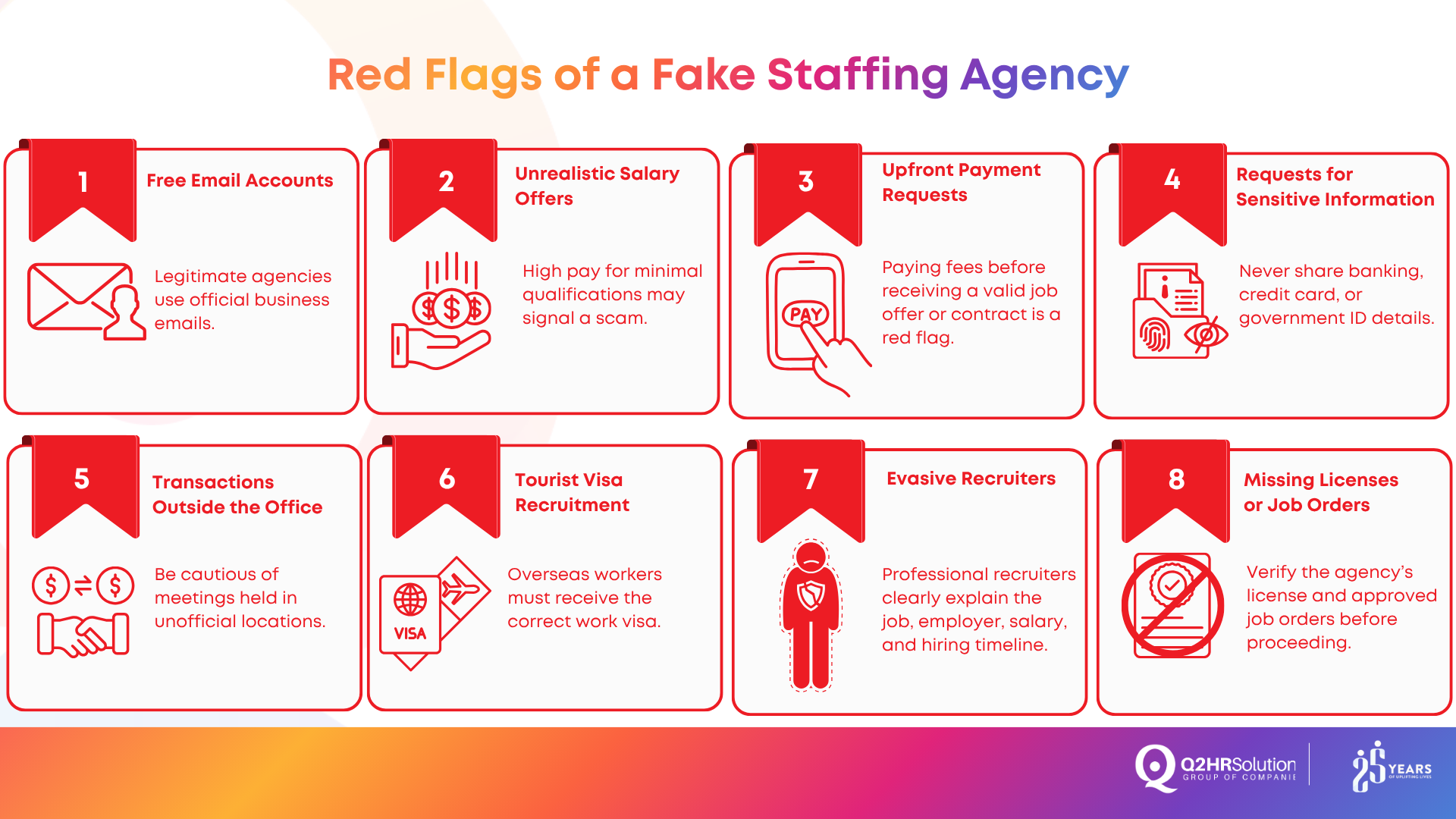
Scammers often display similar warning signs regardless of where they operate.
Legitimate agencies usually communicate through official business email addresses rather than free Gmail or Hotmail accounts. Poor grammar, spelling mistakes, or inconsistent branding may indicate fraud.
Offers that promise unusually high salaries with minimal qualifications are common recruitment scams. Compare compensation with current industry standards before proceeding.
One of the biggest warning signs is being asked to pay processing fees before receiving a valid job offer or signed contract.
A legitimate staffing agency business follows established recruitment procedures and provides official receipts for every payment.
Avoid sharing banking details, credit card information, or government identification unless you’ve confirmed the agency’s legitimacy and secured employment.
Meetings held in restaurants, shopping malls, coffee shops, or private residences instead of the agency’s registered office should raise immediate concerns.
Workers recruited for overseas employment should always receive the appropriate work visa. Agencies encouraging travel on tourist visas may be engaging in illegal recruitment.
Professional recruiters clearly explain job responsibilities, employers, compensation, and hiring timelines. If answers are vague or inconsistent, continue your search and find staffing agency partners with a proven track record.
Every legitimate recruitment agency should have a valid government license and approved job orders. If either is missing, do not proceed.
Illegal recruitment occurs when recruitment activities are performed without the proper government license or beyond the authority granted by that license.
Examples include:
Philippine law imposes severe penalties on illegal recruiters, including imprisonment for serious violations.
Some agencies may legally collect placement fees, but only after a legitimate job offer has been made and required documentation has been completed.
Businesses and applicants should be cautious when:
A trustworthy provider of workforce staffing solutions prioritizes transparency throughout the recruitment process.
If you suspect fraudulent recruitment activity:
Prompt reporting helps protect both businesses and job seekers from recruitment scams.
The DMW regulates agencies recruiting Filipino workers for overseas employment, while DOLE licenses agencies providing local recruitment services within the Philippines.
Yes. The DMW maintains an online database of licensed overseas recruitment agencies, while DOLE publishes information on licensed Private Employment Agencies.
No. Legitimate agencies generally do not request advance payments before a valid job offer and signed employment contract. If a recruiter asks for money upfront, treat it as a warning sign.
Common warning signs include unrealistic salary offers, requests for upfront payments, missing licenses, unofficial meeting locations, poor communication, and refusal to provide documentation.
Verifying a staffing agency Philippines companies can rely on is an essential step before outsourcing recruitment. Always confirm whether the agency is licensed by the DMW or DOLE, request official documentation, verify approved job orders, and remain alert for common recruitment scams.
Businesses looking for dependable staffing solutions services, recruitment agencies, or comprehensive end-to-end recruitment outsourcing should partner only with agencies that demonstrate full compliance with Philippine labor regulations.
Q2 HR Solutions provides trusted recruitment services, Recruitment Process Outsourcing (RPO), and workforce management services designed to help organizations recruit qualified talent while remaining fully compliant with Philippine labor laws. Whether you need staffing support, specialized hiring, or long-term workforce planning, Get in touch with the Q2 HR Solutions team and build a stronger, more productive teams.
___________________________________________________________________________________________________________________________________________________________________________
Expert Insights By:
Ferdinand A. A. Limbo (Ferdie) is a Consultant at Q2 HR Solutions. He has over 20 years of successful experience in Human Resources, Facilities Services and Management, Retail, Wholesale, and other industries as an executive achieving winning results. Ferdie attended an MBA Program at the University of Santo Tomas.