

Picture this. A company hires someone who interviewed well and had a solid resume. The candidate also came across confident during final interviews. Three months later, the employee constantly needs follow-ups, struggles with pressure, and starts creating friction with teammates. This kind of scenario happens more often than companies admit. In hindsight, this is exactly the kind of situation a psychometric assessment is meant to surface early.
On paper, everything could look fine during the hiring process. The experience matches, the interviews go well, and the decision feels safe. But once real work starts, the gaps slowly show up, not in technical ability, but in behavior under pressure, communication style, and how someone actually works with a team day to day.
This is usually where companies start realizing something important. Interviews can only reveal so much. People can prepare answers, present themselves well, and still behave very differently once the job becomes real and messy. This is where assessment tests becomes useful. It helps hiring teams look beyond surface-level impressions and measure traits connected to how someone thinks, reacts, solves problems, and adapts inside actual work environments.
In this article, we’ll discuss what skills a psychometric assessment typically measures, why businesses rely on them during hiring, where companies often struggle with assessment quality, and why these hiring decisions affect long-term operational performance more than expected.
A psychometric assessment is a structured way of measuring a person’s cognitive abilities, behavioral tendencies, and personality traits to better understand how they are likely to perform in a work environment. In simple terms, it tries to go beyond what a resume or interview can show, and instead looks at how a candidate thinks, reacts, and behaves under different situations.
Based on research from the American Psychological Association (APA), psychometric tests are commonly used in industrial and organizational psychology because they help improve the accuracy of hiring decisions when combined with interviews and other selection methods. Structured assessments like these tend to be more consistent in predicting job performance compared to unstructured interviews alone.
In practice, assessment may include different types of evaluations. Some focus on cognitive ability such as logical reasoning, numerical analysis, and verbal comprehension. Others measure behavioral traits like teamwork style, decision-making approach, emotional stability, and how a person handles stress or conflict in the workplace. These dimensions help companies build a more complete picture of a candidate beyond technical skills.
According to SHL, one of the widely referenced assessment providers in talent measurement, psychometric tools are not meant to label people as “good” or “bad” candidates. Instead, they are designed to match individuals to roles where their natural strengths are more likely to succeed. This is also why many HR practitioners treat assessment results as one layer of hiring data, not the sole basis for decision-making.
Yes, psychometric assessment can be reliable when properly designed and scientifically validated.
The key issue is quality. Legitimate assessment test providers typically conduct reliability testing, validation studies, and statistical analysis to ensure assessments measure what they claim to measure. This is important because unreliable assessments create inconsistent results. For example, if a candidate receives dramatically different outcomes from the same test within a short period, the assessment itself may lack reliability.
Reputable providers also update assessment models periodically because workplace expectations evolve over time.
Hiring has become more expensive than many companies expected. This is not only because salaries increased. Recruitment itself became heavier. Teams spend weeks screening applicants, managers sit through multiple interviews, onboarding takes time, and replacement hiring becomes costly when employees leave early. According to the Society for Human Resource Management (SHRM), replacing an employee can cost between six to nine months of that employee’s salary depending on the role and industry.
Because of this, companies started looking for ways to predict performance earlier in the hiring process. This is where psychometric assessment tools entered the conversation more seriously. But what makes this important is consistency.Interviews are still valuable, but interviews can also become subjective. Different interviewers notice different things. Some candidates perform extremely well socially even when their work habits are weak. Others become nervous during interviews despite being highly capable employees. A structured psychometric assessment helps reduce some of that inconsistency.
A psychometric assessment measures behavioral and cognitive patterns connected to workplace performance.
That sounds technical at first, but the idea itself is fairly practical. Companies are essentially trying to understand how someone thinks, reacts, communicates, solves problems, and operates under pressure before fully investing in the hiring process.
Some assessments focus heavily on aptitude. Others lean more toward personality and workplace behavior. Most modern hiring systems combine multiple areas because job performance rarely depends on one trait alone.
One of the things that a structured psychometric test measures is cognitive ability, which often correlates strongly with learning speed and problem-solving. Research from Schmidt and Hunter, frequently cited in industrial-organizational psychology studies, found that general cognitive ability remains one of the strongest predictors of job performance across industries. Companies pay attention to this because employees constantly encounter unfamiliar situations, especially in fast-growing environments.
A cognitive-focused psychometric assessment may evaluate numerical reasoning, verbal reasoning, logical analysis, pattern recognition, and critical thinking. These tests are not necessarily measuring intelligence in a broad academic sense. Instead, they measure how efficiently someone processes information and arrives at conclusions.
One of the biggest hiring frustrations inside companies is not always outright failure. Sometimes the issue is slower execution.
Managers notice employees repeatedly escalating basic problems, struggling with ambiguity, or needing excessive guidance for routine decisions. Individually these situations seem manageable, but collectively they create operational drag.
This is partly why strong psychometric assessment systems matter during hiring. Businesses are trying to identify candidates who can adapt independently rather than constantly relying on supervision. For Philippine companies handling international clients, especially in outsourcing, technology, and customer support industries, this becomes even more important. Global clients often expect employees to operate with autonomy and speed. Hiring mistakes quickly become visible.
Communication skills are not always obvious during interviews. Some candidates interview extremely well. But sometimes, that does not always translate to effective workplace communication.
A person may sound polished in a one-hour interview but struggle with collaboration, feedback, or conflict management after joining the company. Another employee may appear quiet initially yet communicate very effectively within teams.
Because of this, many psychometric assessment platforms include behavioral communication indicators. These assessments attempt to evaluate traits like assertiveness, empathy, listening behavior, collaboration style, and social adaptability.
The goal is not to label personalities as good or bad. The goal is compatibility. According to a report from Gallup, poor communication contributes heavily to employee disengagement and reduced productivity. Businesses often underestimate how expensive interpersonal dysfunction becomes over time.
The pandemic changed how companies think about workplace pressure. Stress signs were often visible inside office environments. Today, distributed teams make those signals harder to detect. Because of this, many companies started incorporating emotional resilience metrics into psychometric assessment systems.
Stress tolerance assessments attempt to measure how individuals respond to pressure, uncertainty, deadlines, setbacks, and criticism. This does not mean companies are looking for emotionless employees. That idea is unrealistic.Instead, businesses want employees who can maintain reasonable decision-making under pressure without becoming disruptive to the team.
Personality assessments are about fit, not perfection. There’s a misconception that personality testing is designed to find “ideal” people. Most legitimate assessment test systems do not work that way. Instead, they measure patterns.
Some people naturally prefer structure and routine. Others perform better in flexible, fast-changing environments. Some individuals thrive in collaborative cultures while others prefer independent work.
None of these traits are automatically positive or negative. Problems usually happen when the environment and personality style consistently clash. This is why psychometric tests became increasingly common in leadership hiring, graduate recruitment, and volume hiring environments. Organizations are trying to reduce mismatch before onboarding even begins.
Leadership assessments go beyond confidence. Some individuals speak confidently but struggle with accountability, conflict management, or strategic thinking. Others lead quietly yet build extremely stable and productive teams.
A leadership-focused psychometric assessment may evaluate decision-making patterns, emotional control, influence style, adaptability, accountability, and motivational tendencies. Leadership hiring mistakes tend to be expensive because poor managers affect entire departments. Productivity drops, attrition rises, employee morale weakens, and organizational trust declines.
Gallup has repeatedly reported that managers significantly influence employee engagement levels. A psychometric test helps reveal whether someone naturally demonstrates behaviors associated with coaching, collaboration, resilience, and strategic thinking. Without this visibility, promotions sometimes become based purely on tenure or technical expertise.
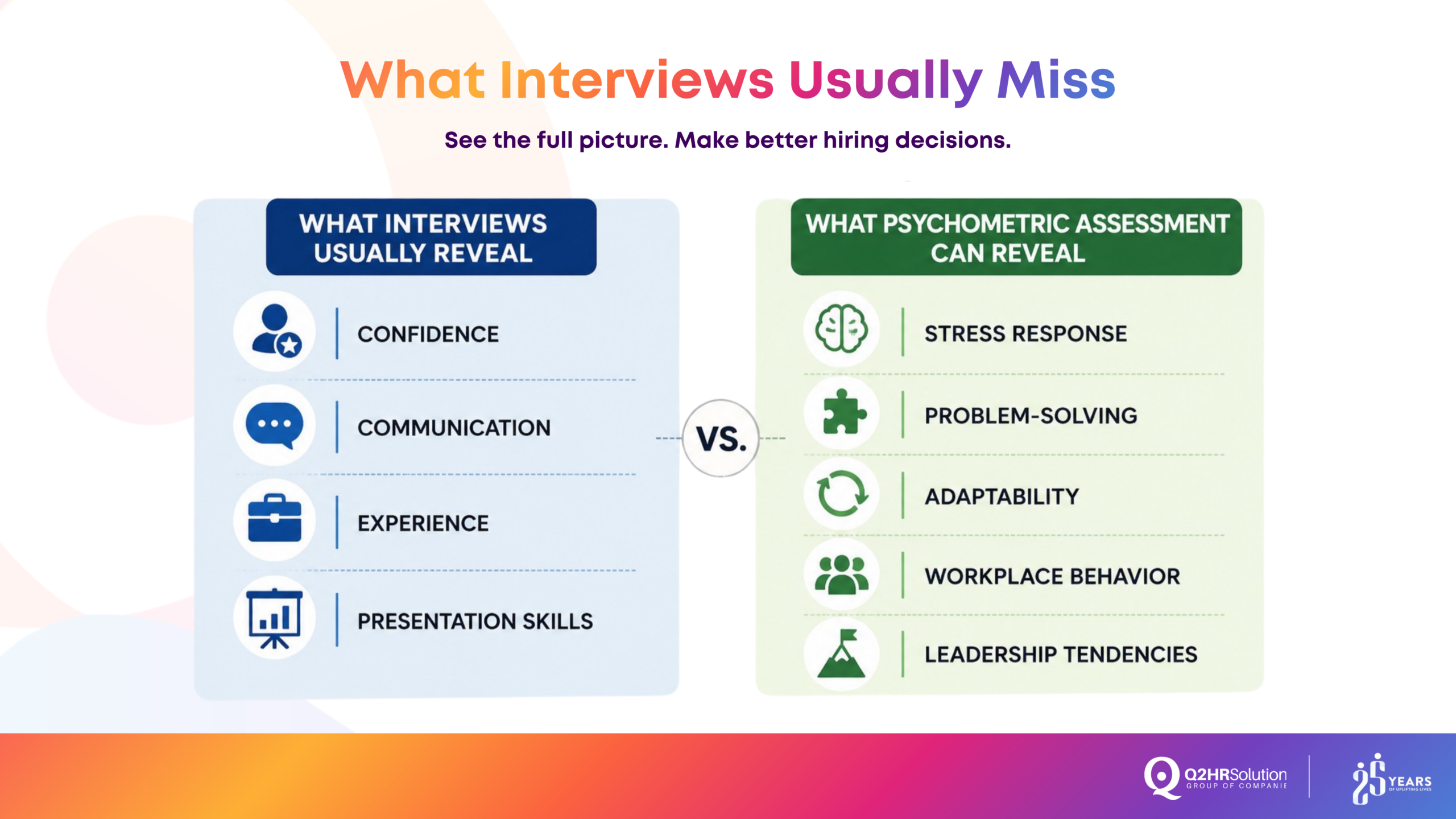
Skills can be trained faster than behavior, and many companies eventually realize this after enough hiring cycles. Not that technical skills don’t matter anymore, but behavioral issues often create larger operational problems.
An employee can learn software systems relatively quickly. Teaching accountability, adaptability, emotional regulation, or communication habits is much harder. This is partly why psychometric assessment adoption increased across industries like BPO, technology, finance, healthcare, and shared services.
Businesses noticed that technical competency alone did not guarantee stability or team success. High performers are usually behaviorally adaptable When managers describe their strongest employees, they often mention more than technical ability. They mention initiative, reliability, problem-solving skills and collaboration.
These behavioral characteristics strongly affect long-term performance. Employees who adapt well typically require less supervision, integrate into teams faster, and handle workplace uncertainty more effectively. This does not mean thatassessment should replace interviews or technical evaluations. It works best as an additional layer of insight.
A common concern among businesses, especially small and mid-sized companies in the Philippines, is pricing. High-quality psychometric assessment platforms can appear expensive initially. Licensing fees, customized reports, interpretation support, validation studies, and integration costs add up quickly. For organizations already managing recruitment budgets carefully, assessment spending can feel difficult to justify.
Because of this, some companies choose the cheapest available testing tools. This is usually where the quality problem starts. Cheap assessments often create misleading confidence as some platforms only generate generic personality descriptions that sound impressive but provide little predictive value for actual job performance.
A low-quality assessment can also create false confidence during hiring decisions. Recruiters may believe they are making data-driven choices even when the underlying test has weak reliability. This can become more expensive than having no assessment at all. Poor hiring decisions lead to turnover, retraining costs, onboarding repetition, productivity gaps, and management fatigue.
The reports become too generic to use. One of the most common complaints from hiring teams is that some assessment reports feel vague. The results sound polished, but they do not actually help managers make decisions. A report might describe a candidate as “motivated yet cautious” or “collaborative but independent.” Statements like these are broad enough to apply to almost anyone.
This creates frustration because hiring teams still end up relying purely on instinct. A good assessment should produce actionable insights connected to actual workplace behaviors.
Applicants can also tell when a hiring process feels poorly designed. Some outdated assessments are unnecessarily long, repetitive, or confusing. Others feel disconnected from the role itself. This matters because candidate experience increasingly affects employer branding.
According to LinkedIn Talent Solutions research, candidates often associate recruitment quality with overall company quality. A poorly structured assessment process can damage perception, especially among highly skilled applicants.For competitive industries in the Philippines where skilled talent is limited, employer perception matters more than companies sometimes realize.
Managers can no longer rely on office visibility. Traditional office environments allowed managers to observe behavior constantly. But changes in usual work arrangements like Remote and hybrid work, changed that.
Now, companies often evaluate employees based more heavily on output, communication quality, responsiveness, and independent problem-solving. These changes increased interest in assessment tests because behavioral traits became more visible operationally.
Employees who struggle with accountability, focus, or communication may experience greater difficulty in remote settings. Meanwhile, adaptable and self-directed employees often perform extremely well.
Another thing is that hiring remotely introduces additional uncertainty. Recruiters may never physically meet candidates before onboarding. Interviews happen online. Team interactions are limited and creates additional hiring uncertainty.Because of this, many companies use psychometric assessment to supplement remote recruitment processes.
The goal is not to remove human judgment. The goal is to reduce blind spots.
How Assessments should support decisions, not replace them
One misconception is that psychometric assessment results should automatically determine hiring outcomes. That approach usually creates problems. Assessments work best when combined with interviews, technical evaluations, reference checks, and managerial judgment.
Human behavior is too complex for any single tool to predict perfectly. Still, structured assessments often improve hiring consistency significantly compared to relying purely on intuition. According to research from the American Psychological Association, structured evaluation methods generally outperform unstructured hiring approaches in predicting job performance.
Recruitment mistakes also creates operational instability. Most companies do not immediately calculate the full cost of poor hiring. The financial impact spreads quietly across departments. Managers spend additional hours coaching underperforming employees. Teams absorb productivity gaps. Projects slow down. Clients become frustrated. HR departments restart recruitment cycles.
Eventually the organization realizes the issue was never just recruitment cost. It was business disruption. This is why assessment test increasingly functions as a risk-reduction tool rather than simply a screening exercise. Better hiring consistency improves long-term scalability before scaling companies eventually encounter a consistency problem.
Different hiring managers apply different standards. Recruitment quality varies between departments. Team cultures become uneven.
Some assessment providers look impressive because of sleek dashboards, colorful graphs, and polished reports. But good design does not always mean the assessment itself is reliable. Companies sometimes get attracted to platforms that look modern, only to realize later that the results are too generic or inconsistent to actually help with hiring decisions. This is why experienced HR teams usually pay closer attention to the science behind the assessment instead of just the presentation.
A strong assessment provider should go through proper validation and reliability testing. Reliability means the test produces consistent results over time, while validation checks whether the assessment is actually measuring the skills or behaviors it claims to measure. According to the American Psychological Association (APA), scientifically validated assessments are generally more effective in predicting workplace performance compared to unstructured hiring methods alone. Reputable providers often publish research studies, technical documentation, or validation reports to support their tools.
This matters because hiring mistakes are expensive. A visually impressive dashboard means very little if the assessment itself cannot help predict how someone communicates, solves problems, or performs under pressure. Companies sometimes spend less on low-quality testing platforms, but end up spending more later through turnover, retraining, and poor hiring decisions. In the long run, the quality of the assessment matters far more than how attractive the platform looks.
Behavior at work is affected by culture, environment, and local workplace expectations. Because of this, an assessment built heavily around Western workplace norms may not always align perfectly with Philippine work culture. Communication styles, leadership expectations, teamwork behavior, and even how people respond to authority can vary across countries and industries.
For example, some workplaces abroad value very direct communication, while many Filipino teams tend to prioritize harmony, respect, and relationship-building during collaboration. Without proper interpretation, certain personality or behavioral traits may be misunderstood. This is one reason some companies prefer assessment providers with experience in Southeast Asian hiring environments. The goal is not to change the science, but to interpret results within the right cultural context.
According to research from SHL and other talent assessment organizations, workplace context strongly affects how behavioral assessments should be interpreted. This becomes even more important for companies in the Philippines handling customer service, outsourcing, healthcare support, or international operations. Different industries require different communication styles and stress-management behaviors, which means assessment interpretation should reflect actual workplace realities instead of relying purely on global benchmarks.
A good psychometric assessment provider usually offers more than just software or automated reports. The strongest providers also help companies understand what the results actually mean. This becomes important because many hiring managers are not trained psychologists. They may know what the role requires operationally, but interpreting behavioral data and personality patterns is a different skill altogether.
Without proper support, assessment reports can easily become underutilized. Hiring teams may read through pages of results without fully understanding how those insights connect to actual workplace performance. According to the Society for Industrial and Organizational Psychology (SIOP), assessments are generally more effective when paired with proper interpretation and structured hiring processes. This helps companies make better decisions instead of relying purely on instinct or assumptions.
Strong providers usually help businesses through implementation support, benchmarking guidance, and role-specific interpretation. For example, a highly assertive personality may work well for sales roles but create friction in highly collaborative operational teams. Context changes how results should be viewed. Without guidance, companies often end up collecting large amounts of assessment data without actually improving hiring quality or workforce performance.
A psychometric assessment commonly measures cognitive ability, problem-solving, communication behavior, personality traits, emotional resilience, leadership tendencies, and adaptability. The exact skills depend on the assessment type and job role.
They can be highly useful when scientifically validated and combined with interviews and technical evaluations. Reliable assessment systems improve hiring consistency, but they should not function as the only basis for employment decisions.
Many Philippine companies use psychometric assessment tools to reduce hiring risk, improve recruitment consistency, and identify candidates who align better with role demands and company culture.
This became more important as remote work, outsourcing growth, and international hiring expectations increased.
No assessment predicts performance perfectly.
However, studies from industrial-organizational psychology consistently show that cognitive and behavioral assessments can improve the accuracy of hiring decisions compared to relying purely on unstructured interviews.
In many cases, yes.
Higher-quality assessment test systems often provide stronger reliability, better validation, clearer reporting, and more relevant hiring insights. Businesses sometimes spend more money later correcting hiring mistakes caused by low-quality assessments.
Sometimes the most expensive employee is not the one with the highest salary. It’s the one who looked perfect during hiring but slowly creates delays, tension, turnover, or performance problems once actual work begins. And by the time companies realize it, the business has already spent months dealing with the consequences.
That’s partly why assessment tools continue gaining attention across the Philippines. Companies are starting to realize that resumes and interviews only show one side of a candidate. The harder part is understanding how someone thinks, communicates, adapts, and behaves once pressure, deadlines, and real workplace dynamics enter the picture.
Of course, no psychometric assessment can guarantee perfect hiring decisions. People are still complicated. Workplaces are still unpredictable. But a well-designed assessment gives companies clearer visibility into patterns that are normally difficult to spot early in the hiring process. And for growing organizations, that visibility can prevent a lot of expensive problems later on.
At the same time, businesses still face the balancing act between cost and quality. Some assessment platforms are cheap but provide very little hiring value. Others require stronger investment but offer deeper insights that actually support workforce decisions long term. This is usually where companies begin realizing that hiring quality is not just an HR issue anymore. It affects productivity, retention, leadership stability, and overall business performance.
If your organization is currently reviewing hiring strategies, talent screening processes, or workforce quality concerns, you can reach out to us and discuss how assessment-driven hiring approaches can support long-term growth more sustainably.