

People often assume hiring decisions are made in the answers candidates give. But in reality, a lot of hiring outcomes are shaped in the space between answers. It is how someone processes a question, how they react under pressure, and how consistent their thinking stays when the conversation suddenly shifts direction. That “space” is hard to see in a normal interview. A psychometric assessment is built almost entirely around it.
Instead of stopping at surface impressions, this kind of testing looks at how people actually think, solve problems, and behave when work gets messy. For Australian companies expanding into the Philippines, that turns out to be a very practical thing. When teams are distributed and you do not have much time to observe someone in person, you need a more reliable way to reduce mismatch. This is especially true for remote and offshore teams, where day-to-day observation is limited.
In this article, we will walk through what psychometric assessment usually measure, why those things matter in real workplace settings, and how companies are using the results to hire better across borders like Australia and the Philippines.
A psychometric assessment measures the underlying traits that do not always show up in interviews. It measures how a person thinks, reacts, solves problems, and behaves under pressure. In simple terms, the tool is trying to answer one difficult question: “How will this person actually perform when the job stops being predictable?”
Most companies using psychometric assessment are not chasing perfect scores. They are looking for patterns. They want to see how fast someone processes information, how consistent their decision-making is, and how they respond when things get unclear. Those patterns tend to predict job performance more reliably than a polished interview answer ever could.
Research published by the Society for Industrial and Organizational Psychology (SIOP) has long shown that cognitive ability tests, which are often part of these assessments, remain one of the strongest predictors of job performance across industries. That is especially relevant for fast-scaling teams, like the ones you see when Australian companies expand into Southeast Asia.
So instead of guessing based on confidence or communication style, this kind of testing quietly maps what is happening underneath the surface.
Companies lean on psychometric tests because interviews on their own are often inconsistent. They get heavily influenced by bias, tone, and first impressions. Most hiring managers do not realise how much an interview is shaped by attitude and confidence. A candidate who is calm and articulate can come across as more capable than someone who is equally skilled but less expressive. This is where structured testing becomes useful. It strips away some of that surface-level interpretation.
LinkedIn’s Global Talent Trends report has repeatedly shown that companies struggle with hiring consistency, especially in remote or offshore teams. Australian firms expanding into the Philippines feel this even more, because communication styles across cultures are different. A standardised test creates a shared baseline that does not depend on accent, confidence, or interview style.
There is also the question of scale. When you are hiring five people, intuition might still hold up. When you are hiring fifty across multiple regions, intuition starts to get risky. These tools help standardise decisions, so teams are not comparing “gut feelings” but measurable traits instead.
Because of that, a lot of HR teams now treat the test as a filter rather than a final verdict. Not the thing that makes the decision, but the thing that quietly removes costly mismatches early.
A psychometric assessment usually measures cognitive abilities like logical reasoning, numerical ability, verbal comprehension, and problem-solving speed. These are not academic tests in disguise. They are more about understanding how someone processes real-world information under time pressure.
Think about roles in operations, finance, or customer support leadership. People in those jobs are constantly interpreting data, making calls, and prioritising tasks. A structured psychometric assessment simulates that mental load in a controlled way, so you get a sense of how someone copes before you actually hire them.
Research from SHL shows that cognitive ability scores can predict job performance with significant accuracy, especially in complex roles. That is one reason multinational companies rely on this data when hiring across different markets.
But the interesting part is not really the score. It is the pattern. A candidate who scores high in verbal reasoning but only moderate in numerical reasoning might thrive in client-facing roles and struggle in data-heavy ones. The test makes those tendencies visible before any decision gets locked in.
For fast-growing Australian companies expanding into the Philippines, this matters because roles often change quickly. What you hire someone for in month one might look different by month six. These tests help you predict adaptability, not just current capability.
A good test is not just measuring abstract abilities. It is quietly mirroring how someone behaves in real work situations. Cognitive speed, for example, often translates into how quickly someone can respond to shifting priorities. A candidate who processes information fast is usually more comfortable in roles where decisions need to be made before all the data is in. Someone slower but more accurate might do better in roles that reward precision over speed.
This is where companies sometimes misread the results. The test is not saying one person is “better” than the other. It is showing how they operate under pressure, which is a completely different thing.
In Australian companies expanding into the Philippines, this gets especially relevant in operational roles where teams deal with fast-changing client requirements. The test helps you spot whether someone is naturally reactive or reflective. And honestly, both can be valuable. It depends on the structure of the team and what the role actually needs.
Picture two candidates for the same operations role. One is quick and confident and loves making fast calls, the other is slower but rarely misses a detail. On paper they might score similarly. In practice, the fast one could be brilliant during a chaotic launch period and frustrating in a compliance-heavy month, while the careful one is the opposite. The test does not tell you who to hire. It tells you where each person is likely to shine, so you can place them on purpose instead of by accident.
What often happens is that performance issues get blamed on skill gaps when the real problem is a mismatch in working style. A proper evaluation helps surface that early, before it turns into a bigger problem down the line.
A psychometric assessment evaluates personality by measuring traits like openness, conscientiousness, emotional stability, and how someone works within a team. Unlike the cognitive part, this section is not about right or wrong answers. It is about behavioural tendencies and how a person is likely to act over time.
Someone who scores high in conscientiousness, for instance, tends to be more structured, detail-oriented, and consistent with deadlines. Someone high in openness might be more adaptable but less comfortable with rigid routine. Neither is good or bad on its own. It is about matching the trait to the role.
One framework that often sits underneath this part is the Big Five personality model, which is widely validated in industrial psychology research. Studies published in the Journal of Applied Psychology show that these measured traits can correlate meaningfully with job performance, with conscientiousness standing out in particular.
In real workplaces, this matters more than people expect. A technically skilled employee who struggles with collaboration or stress management can slow down an entire team. Picking that up early through a structured test can save a lot of friction later.
For companies moving from Australia into the Philippines, this becomes even more important because team structures are often hybrid: some people offshore, some onshore. The testing helps make sure personality fits across distributed teams, not just skill on paper.
In a traditional office, personality misalignment is easier to catch. People interact daily, managers see behaviour directly, and the small informal conversations fill in the gaps. But in distributed teams, especially between Australia and the Philippines, those signals get weaker. Most interactions are built around meetings, reports, and updates, not casual desk-side chats.
A good test helps highlight whether someone is naturally collaborative or more independent, how they respond to feedback, and how they handle ambiguity in communication. These traits might not feel critical during hiring, but they become very visible after onboarding, once workflows start depending on consistency.
This is why companies increasingly use these tools not just to hire talent, but to design teams more deliberately. It helps answer practical questions like “Who should be client-facing?” or “Who should handle the execution-heavy work?” When you are building a team across two countries, those answers save a lot of guesswork and a lot of awkward reshuffling later on.
Yes. A psychometric assessment can measure emotional intelligence indirectly, by looking at how people respond to interpersonal scenarios and stress-based decisions.
Emotional intelligence is harder to put a number on, but these tests often include situational judgement questions that simulate workplace conflict, feedback conversations, or pressure situations. A candidate might be asked how they would respond to a missed deadline caused by a teammate. Their answer reveals something about emotional regulation, empathy, and problem-solving style.
TalentSmart research, which gets cited a lot in leadership development studies, suggests that emotional intelligence accounts for a large share of the differences in workplace performance, especially in leadership roles. Not all of it can be fully captured in a test, but the assessment can approximate behavioural tendencies in controlled scenarios.
That is why these tools are common for customer-facing roles, team leads, and managers. It is not about finding “emotionally perfect” people. It is about understanding how someone behaves when tension shows up.
In cross-border teams, especially Australian firms managing Philippine-based staff, this layer becomes critical. Miscommunication usually is not about language. It is about emotional interpretation. A bit of structured insight here helps reduce that uncertainty.
Most companies do not notice emotional intelligence gaps right away. They tend to show up slowly, often in patterns that are easy to mislabel as “communication issues” or “performance inconsistency.” A good test surfaces these tendencies early, but what it really reveals is how someone reacts when things get emotionally loaded: receiving hard feedback, dealing with a missed deadline, or managing conflict inside a team.
In cross-border setups, especially between Australian managers and Philippine-based teams, these moments come up a lot because communication styles differ. The test helps identify who is more emotionally flexible versus who might take feedback more rigidly.
It also helps predict whether someone is likely to escalate a conflict or calm it down. In leadership pipelines, that is a big deal, because technical competence on its own does not prevent team breakdowns. How someone handles emotion does.
Psychometric testing plays a major role in leadership hiring because it helps evaluate decision-making style, resilience, and strategic thinking. Leadership is rarely about technical ability alone. The test focuses on how a candidate handles ambiguity, pressure, and competing priorities.
Someone might show strong analytical thinking but a low tolerance for uncertainty. That profile could work well in a structured environment but struggle in a startup or an expansion-stage company. Knowing that in advance changes how you place people, and it saves you from setting a good candidate up to fail.
Harvard Business Review has pointed out that many leadership failures come not from a lack of skill, but from poor behavioural fit in fast-changing environments. That is exactly where this kind of evaluation earns its keep.
In Australian companies expanding into the Philippines, leadership hiring is often complicated. Managers need to operate across cultures, time zones, and expectations. A structured test gives you a steadier lens for judging whether someone can actually handle that complexity.
Psychometric Assessment does not replace leadership interviews. It grounds them. Instead of leaning on confidence or a good story, you get data that reflects how a leader is likely to behave under real pressure.
One pattern that shows up again and again in leadership hiring is the overvaluation of confidence.
Some candidates look like strong leaders, especially on paper and in the room. But the test sometimes reveals a different layer underneath: low tolerance for ambiguity, limited patience for slower teams, or an overly rigid decision-making style. None of that is obvious in a confident interview.
This kind of testing helps reduce that blind spot by showing how a leader is likely to behave when things do not go to plan. And in real leadership roles, things rarely go to plan.
For Australian companies expanding into the Philippines, this matters even more, because leadership here often means bridging different working cultures, expectations, and levels of autonomy. The results help you see whether a leader is naturally inclusive in how they decide, or whether they tend to centralise control. That single distinction can shape how a whole offshore team feels and performs.
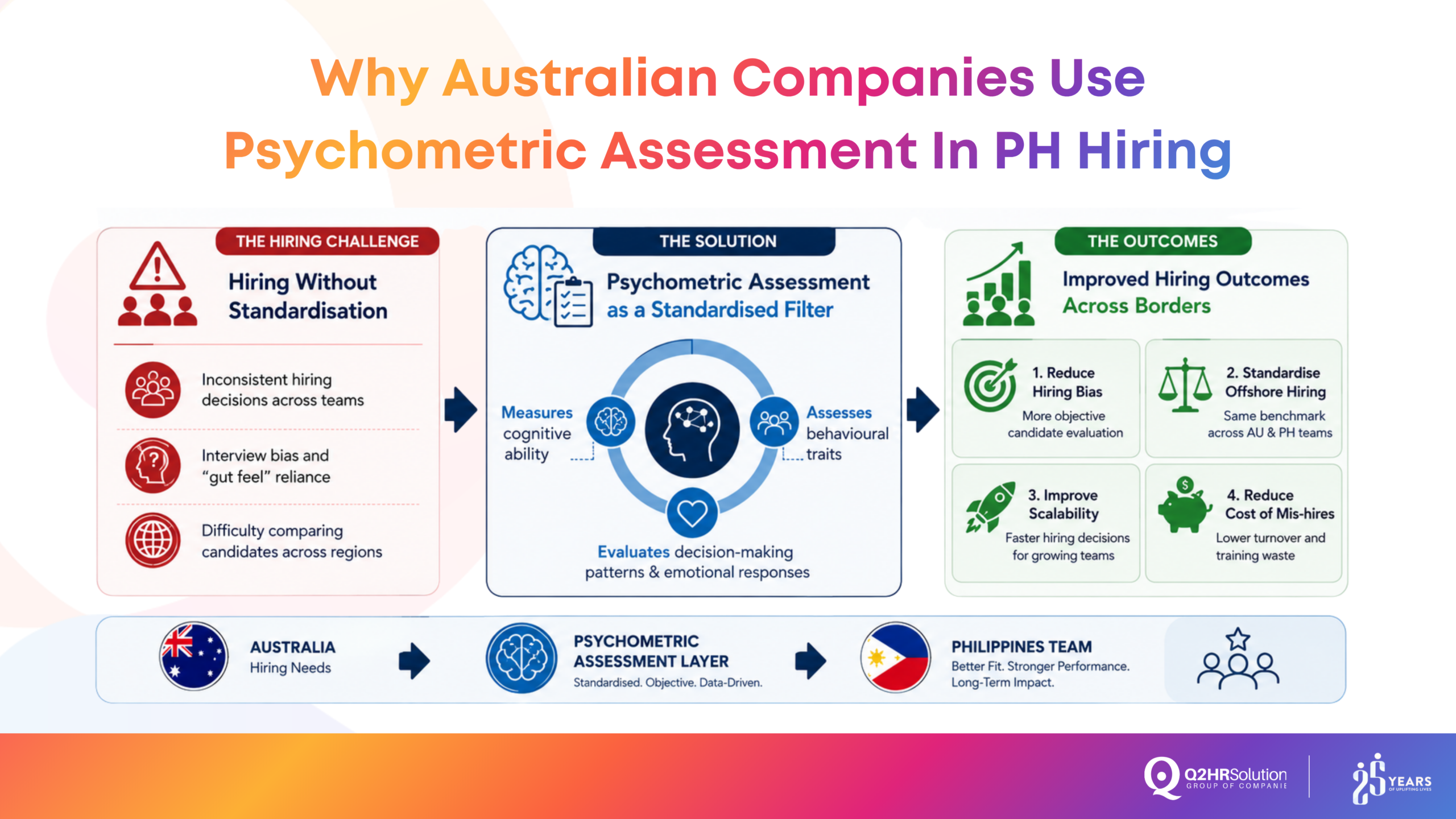
Australian companies expanding into the Philippines increasingly use a psychometric assessment to standardise hiring across remote and offshore teams. When teams are spread out, hiring gets harder to calibrate. What one manager calls “high potential,” another might not. The test helps cut down that inconsistency.
In shared services, customer support, and marketing operations roles, Australian firms often hire at scale in the Philippines. A consistent test means candidates meet the same baseline no matter which recruiter screens them first.
According to Deloitte’s Human Capital Trends reports, companies with standardised assessment systems tend to see better hiring efficiency and lower turnover in distributed teams. That is a big reason this approach is becoming more common in offshore hiring models.
There is a practical cost angle too. Hiring mistakes in offshore teams are expensive, and not just in recruitment fees. They cost you in training and onboarding time as well. Filtering out early mismatches takes a real bite out of that risk.
In practice, the rollout is usually simple. A candidate completes a short online test early in the process, often before or just after the first interview, and the results sit alongside the CV and interview notes rather than replacing them. For a team in Sydney hiring twenty support staff in Manila, that small step keeps everyone working from the same yardstick, even when the interviews happen across different time zones and different recruiters.
Over time, companies start building their own internal benchmarks. They begin to notice how their high performers tend to score, and that pattern quietly informs future hiring decisions. The longer you use it, the more tailored it becomes to your own teams and your own way of working.
A psychometric assessment is useful, but it is not the full picture of a candidate. It works best as a decision-support tool, not a standalone decision-maker.
The first limitation is context. The test captures behaviour in controlled conditions, not real workplace dynamics. People can behave differently in actual team environments, where the pressure is social, not just task-based. Someone might do well in a timed reasoning test but struggle in real projects where priorities shift every hour, stakeholders interrupt the workflow, and communication is far less tidy. That kind of environment is hard to fully recreate in any test.
There is a related point here: work itself is rarely as “clean” as the test is designed to be. In real roles, especially in fast-scaling teams like those of Australian companies expanding into the Philippines, people deal with ambiguity, informal coordination, and expectations that keep shifting. The test can approximate some of that, but it cannot fully recreate the messiness of real execution. So it should always be read as a snapshot, not a full simulation of performance.
The second limitation is over-reliance. Some companies treat the test as a final gatekeeper, which can quietly screen out strong candidates who simply test poorly under pressure. This happens more often than people think. Test anxiety, unfamiliarity with the format, or even timing pressure can distort the results. Someone who is excellent in actual work might underperform on the day, just because the format does not match how they naturally think.
This is also where hiring teams can accidentally build in bias. When a test is treated as “truth,” it can override qualitative signals like curiosity, communication quality, or a strong track record. Those signals still matter, because they reflect how a person behaves in unstructured situations, which is something no test can fully replicate.
In practice, the strongest hiring systems do not fully “trust” the test or ignore it entirely. They treat it as a structured input that sharpens judgement rather than replacing it. It narrows the uncertainty. It does not erase it.
Used properly, this kind of testing improves decision-making by adding structure to something that is usually pretty subjective. Used blindly, it can create false certainty, where a team feels confident about a decision that is actually based on incomplete data. And in high-growth environments, especially when teams are scaling across regions, that false certainty is often where the most expensive hiring mistakes begin.
These tests are not replacing intuition. They are changing what intuition relies on. Hiring used to lean heavily on “gut feel.” A manager liked how someone spoke, or felt comfortable with their presence, and that became part of the decision. But intuition without structure can be wildly inconsistent, especially when you are hiring across regions or scaling a team fast.
What the test does is give intuition something solid to anchor to. Instead of leaning on a vague impression, hiring teams can look at structured information about cognitive ability, behaviour, and personality.
Even then, the final call still needs human judgement. A test cannot fully capture context, motivation, or cultural nuance. It can show tendencies, but it cannot really explain intent. That is why the companies that use these tools well do not treat them as automated decision-makers. They treat them as decision-support systems, full stop.
It measures thinking ability, personality traits, decision-making style, and behavioural tendencies in everyday workplace scenarios.
It is generally considered a strong predictor when it is combined with other hiring tools, especially for cognitive ability and structured roles.
Yes. Many Australian companies use them to standardise hiring when building teams in countries like the Philippines.
Preparation helps with familiarity, but these tests are designed to measure natural patterns rather than memorised answers.
No. It complements interviews by adding measurable behavioural and cognitive data to the conversation.
At the end of the day, hiring still comes down to people making decisions about other people. What a psychometric assessment does is shrink the blind spots in those decisions.
For Australian companies expanding into the Philippines, those blind spots can get expensive. A wrong hire does not just slow down one team. It can ripple across workflows in two countries. The test does not solve everything, but it gives structure to something that is usually pretty intuitive.
And maybe that is the real value. Not perfection, just clarity.
Hiring is rarely a straight line. It is a series of trade-offs such as speed versus accuracy, confidence versus evidence, intuition versus structure. The test does not remove those trade-offs, but it does make them easier to see.
If your team is exploring more structured ways to evaluate candidates across markets, a psychometric assessment is usually a good place to start the conversation. It does not replace judgement. It just makes it harder to fall back on guesswork. Feel free to reach out if you would like to explore how this kind of testing can fit into your hiring process more practically, especially for cross-border teams.